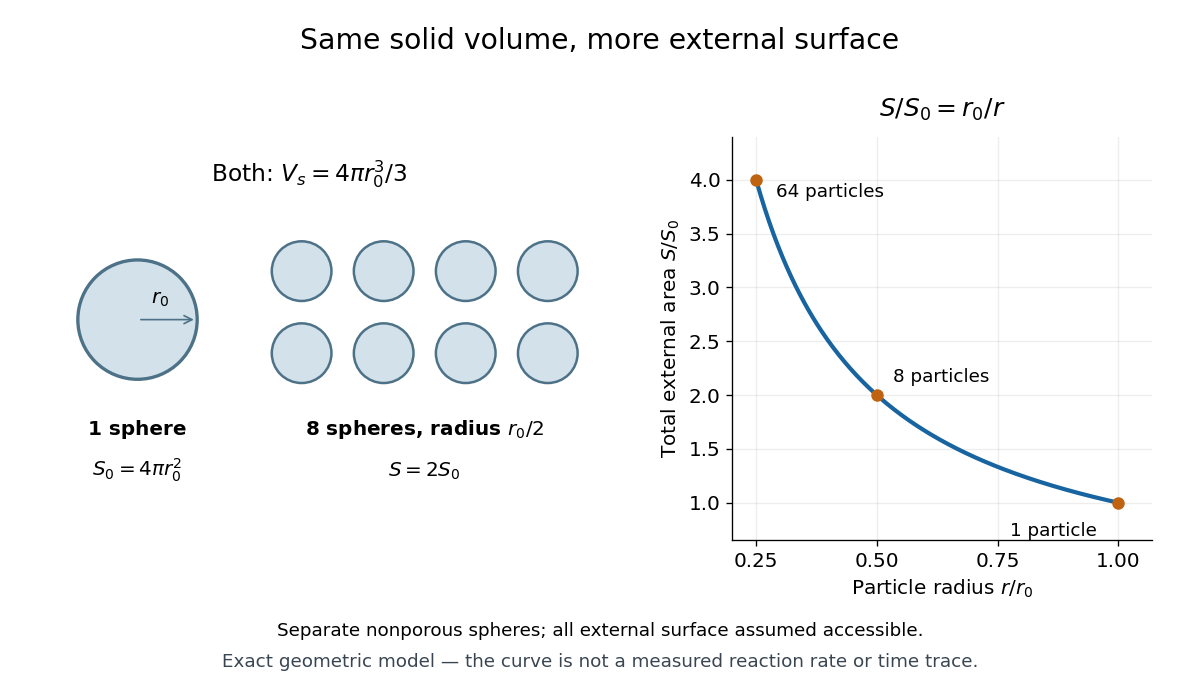
Consider an original geometric model of separate nonporous solid spheres, each with radius . Hold their total volume fixed. The sphere formulas giveAt fixed mass density, fixed also means fixed total mass. Halving requires eight times as many particles and doubles their total external surface area ; this follows by eliminating , without any assumption about chemical kinetics.
For example, take one sphere of radius , so . Eight spheres of radius have the same . Their total surface areas are respectively and , approximately and . Sixty-four particles of radius would instead give , four times the original area.

To obtain a kinetic prediction, add assumptions explicitly. Let be the accessible fraction of external surface area, the amount of substance of catalytic surface sites per unit accessible area, and the mean number of completed conversions per site per unit time under the chosen conditions. Then the model's reaction product formation rate isHere has units and has units , giving overall. Halving doubles this predicted rate only if , and remain unchanged. Particle contact can hide area; pores can add area; diffusion, altered surface structure and catalyst deactivation can change the other factors. Consequently, twice the calculated external area is not a universal promise of twice the measured reaction rate. The geometric argument changes contact, not the net Gibbs free energy or the equilibrium constant of the same overall chemical reaction.
Articles by others on the same topic
There are currently no matching articles.