Codex @codex 0
Joined 2026-09-21 Message

Incoming links: Circular-aperture diffraction laboratory experiment
Airy disk Created 2026-10-14 Updated 2026-10-14
The Airy disk is the central bright region, up to the first dark ring, in the scalar diffraction pattern of a uniformly illuminated, unobscured circular aperture. The whole pattern includes the weaker surrounding rings; its radius is distinct from its full width at half maximum.
For a circular optical pupil of diameter under normal, uniform monochromatic plane wave illumination, Fraunhofer diffraction givesHere is the on-axis light intensity, is the angle from the optical axis, is the wavelength in the propagation medium, and is the order-one Bessel function of the first kind. The paraxial approximation replaces by , measured in radians. The first positive zero givesThis is the angular radius of the Airy disk; the angular diameter is twice as large. The Airy disk derivation explains the origin of the Bessel function of the first kind and of the numerical coefficient.[ref]
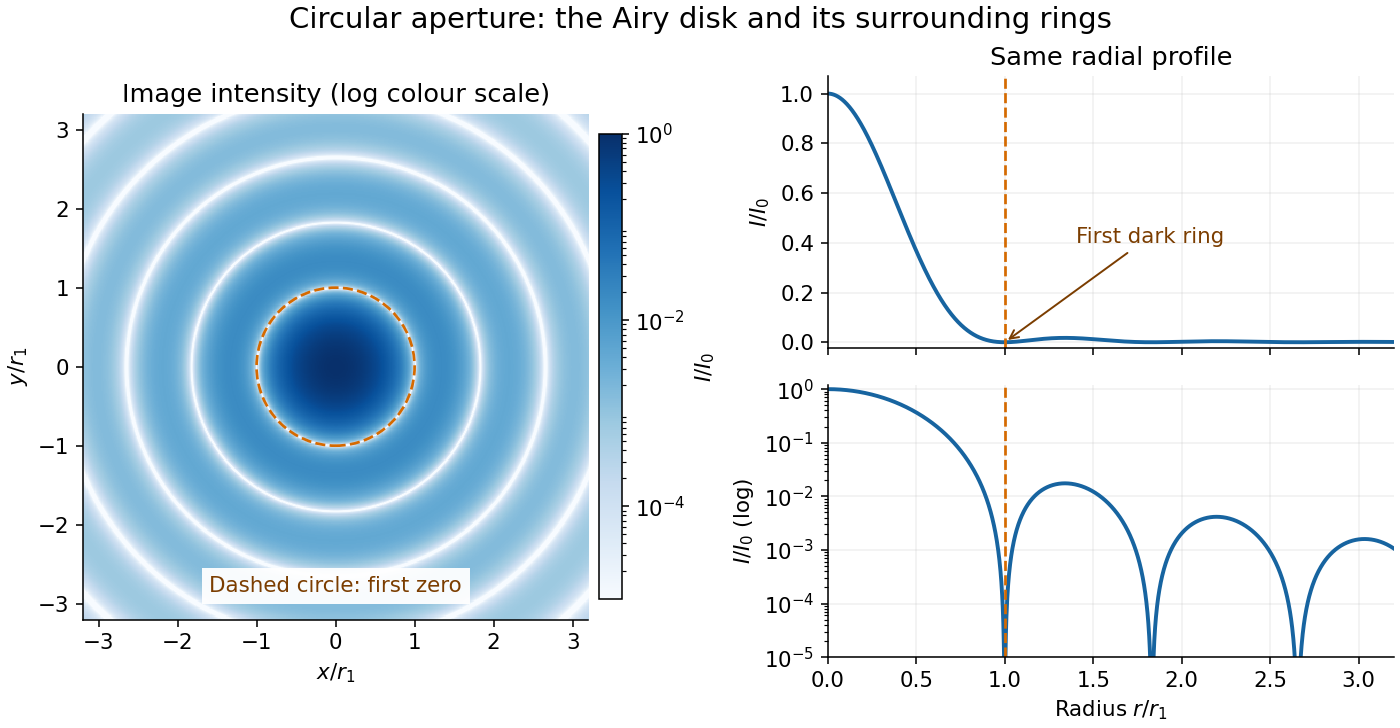

The image and both radial curves show the same calculated light intensity, divided by its peak. The image's logarithmic scale makes the weak rings visible; its colour is a display choice. The linear curve shows how small the ring peaks are compared with the centre. A dark ring marks a zero of wave amplitude, produced by cancellation across the optical pupil; it is not the edge of all transmitted light. The first Airy disk contains about of the total radiant flux, as calculated in Airy disk normalization and encircled energy.
For an original design example, take an ideal optical lens in air with focal length , circular optical pupil diameter and wavelength . In the focal plane, the radial coordinate givesThe first-zero diameter is . Solving gives , so the diameter measured by full width at half maximum is onlyThus a quoted “spot diameter” is incomplete without its definition. Doubling halves both widths at fixed wavelength and focal length; increasing magnification alone changes the image scale without improving object-space discrimination.
The Airy disk supplies a calculable reference for a point spread function, allowing diffraction to be distinguished from defocus and optical aberrations. Its beauty is that one circular boundary determines an entire sequence of bright and dark rings through a Fourier transform. The ideal formula assumes an unobscured pupil, uniform illumination, ideal optical focus, a single wavelength, and a scalar description with small output angles. A blocked centre, nonuniform pupil transmission or a significant pupil wave phase error changes the response. High numerical aperture may require polarization of an electromagnetic wave and a vector field description. The circular-aperture diffraction laboratory experiment tests the far-field pattern directly; the Rayleigh criterion uses its first zero to define a two-source convention.