A clearance bound between trajectory samples converts finitely many separation checks into a guarantee over a continuous trajectory, using a justified bound on how quickly clearance can change. Clear endpoints alone are insufficient: a foot or another robot part can approach an obstacle and move away again between them. The primary planning formulation requires constraints along the entire path.[ref]
Robotic Systems by Kris Hauser. Chapter 8, Point-to-point path planning: continuous path satisfying feasibility for every path parameter
Let nominal clearance have Lipschitz constant on a checked interval of length . If both endpoint clearances are at least , then every intermediate point is within of an endpoint. ConsequentlyThis follows directly from using the nearer endpoint. A uniform additional worst-case geometry or execution allowance gives actual clearance at least .
A tighter interval certificate retains the two different endpoint values, and . Writing gives two lower cones,If and , the cones meet inside the interval. Their common height yieldsIf the endpoint difference exceeds , the proposed Lipschitz bound and exact endpoint values are inconsistent; simply applying the formula does not repair that inconsistency. With , clearance is constant.
For an original example, take , , and . The simpler endpoint-minimum bound gives ; the two-cone bound gives . Subtracting a execution allowance leaves a certified actual gap, sufficient for a requested margin. These are lower bounds, not assertions that the trajectory reaches their values.
A counterexample explains why the allowance is necessary. On , has endpoint values one but touches zero at the midpoint. Checking only those endpoints misses the contact. Its derivative is bounded in magnitude by four, so a sufficiently fine sample grid with that valid bound can expose the missing guarantee.
The constant must match the geometry and parameter units. For a point moving relative to a fixed closed obstacle set, the distance to that set changes by at most the point’s displacement: the triangle inequality gives . A speed bound therefore supplies a time-based clearance bound. A rotating body requires a bound on every occupied point, such as the angular clearance bound for a rotating body; terrain-height clearance across a discontinuous edge cannot use a finite slope bound across that jump.
Adaptive clearance sampling subdivides intervals that fail the chosen certificate, concentrating computation where the margin or speed bound is least favorable. Failure of a conservative certificate means the interval needs better bounds or further checking; it does not itself prove a collision. For a proposed robot-foot test, validate the motion and geometry error bounds in one coordinate frame and compare the certified interval minima with dense independent measurements. Use the robust swing-foot clearance margin allowances without counting the same uncertainty twice.
Adaptive clearance sampling spends more collision detection queries on portions of a trajectory that are difficult to certify, instead of accepting a path merely because a fixed set of samples is clear. Its guarantee comes from a bound on motion between samples. A configuration space path must satisfy the geometric constraints continuously.[ref]
Robotic Systems by Kris Hauser. Chapter 8, Stating the motion planning problem; Chapter 9, clearance
Represent the body by a nonempty compact set and the fixed obstacles by a nonempty closed set. Let be their nonnegative set distance, and suppose a known Lipschitz continuity bound gives . On an interval of duration with endpoint clearances , each time is at most from one endpoint. Hence an endpoint certificate for continuous collision clearance isIf this lower bound is strictly positive, the entire interval is clear. For a required clearance margin , require the bound to exceed instead. Otherwise query the midpoint and subdivide. A sharper certificate uses both endpoint cones; when and the distances satisfy the assumed bound, its minimum is . The simpler bound is sufficient for the example below.
For a translating and rotating rigid body, a valid speed estimate is , where is a bounding radius for rigid-body clearance, provided these are bounds over the whole interval and the obstacles stay fixed. The angular clearance bound for a rotating body proves the rotational contribution. A distance-estimation error bounded by can be accommodated by replacing each reported endpoint distance by its lower bound .
In an original point-motion example, with and passes the obstacle point . Its exact clearance is and suffices. Require . The initial endpoint certificate is positive but below this required margin, so more queries are needed. Recursive midpoint sampling certifies long intervals away from the obstacle and refines only near the closest approach. The stated midpoint rule uses 15 distance queries and certifies 14 intervals. The figure shows the exact function alongside the sampled certificate; the formula is known here only because the example is constructed.
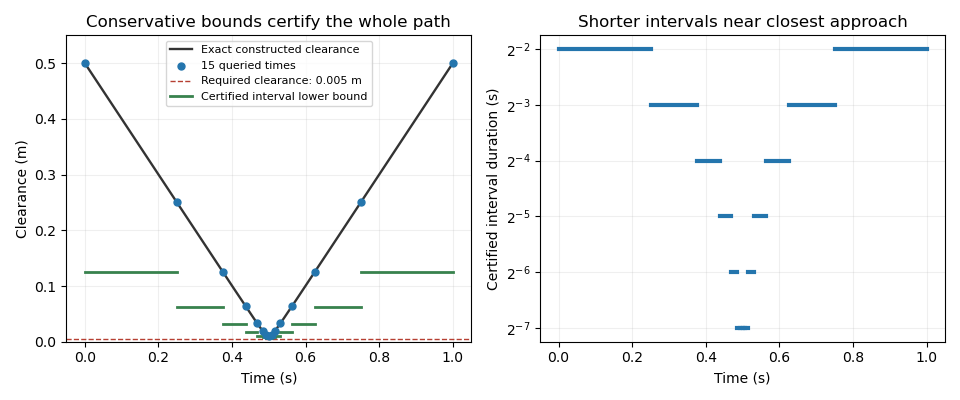
Adaptive endpoint certificates for a trajectory passing 0.01 m from a point obstacle, with a required clearance of 0.005 m. Original exact geometry and recursive midpoint calculation.
Details. 
Unresolved intervals in adaptive collision checking must remain unresolved if a chosen depth or time budget is exhausted: failure to certify positive clearance does not establish a collision. Conversely, a query with exact zero set distance establishes contact or intersection. A sampled positive distance at or below violates the requested margin but does not establish contact. With exact queries, a valid finite and a trajectory whose clearance has a positive lower bound, subdivision eventually certifies every interval for ; a positive requested margin requires a positive surplus above that margin. Without positive clearance, finite termination is not promised.
A required clearance margin is the minimum separation requested by a geometric motion specification. In adaptive clearance sampling, it is the threshold that a continuous-interval lower bound must exceed. Positive separation from an obstacle is enough to exclude contact in an exact model, but can still be less than the requested margin.
Let be the modeled nonnegative set distance between a rigid body and fixed obstacles. Using the strict convention of adaptive clearance sampling, an interval is accepted only when its guaranteed lower bound exceeds . A query with violates that requested separation without demonstrating contact. Choosing is part of the specification, not something determined uniquely by the collision detection algorithm.
Geometric uncertainty can be incorporated with explicit bounds. Suppose robot geometry, obstacle geometry and reference-point tracking error can each change the relevant sets by at most in Hausdorff distance. The triangle inequality then givesTo guarantee an actual separation greater than , a sufficient modeled threshold isThese are simultaneous deterministic bounds. No independence assumption is needed to add them conservatively. The configuration-space construction in the primary planning text similarly represents body size by enlarging forbidden regions.[ref]
For an original error budget, require and take geometric bounds of , and respectively. The modeled threshold becomes . Suppose the smaller reported endpoint distance is , the distance-query error is bounded by , the clearance Lipschitz continuity constant is , and the interval duration is . The simple interval certificate givesSubtracting the geometric budget leaves at least actual separation, exceeding the requested by in this model.
The query error was already subtracted from the interval bound and must not be subtracted again as an unrecorded duplicate allowance. Conversely, the motion term addresses unsampled motion; it does not automatically include obstacle-location error. An endpoint certificate for continuous collision clearance should state which effects are included in each quantity, while unresolved intervals in adaptive collision checking retain intervals whose lower bound is insufficient.
Unresolved intervals in adaptive collision checking are trajectory intervals for which the available queries and motion bounds prove neither the requested continuous clearance nor a violation at a known configuration. They are a computational result of incomplete information, rather than evidence that a collision occurred.
In adaptive clearance sampling, suppose endpoint distances and a valid clearance Lipschitz continuity constant are known over an interval of duration . If a lower bound such as does not exceed the required clearance margin, the interval needs further work. Its endpoints can both be clear while its interior remains undecided. The continuous-path requirement motivating this distinction is stated in the primary planning text.[ref]
Robotic Systems by Kris Hauser. Chapter 8, Stating the motion planning problem and Point-to-point path planning
An original indistinguishability example uses , and endpoint clearances . Both of the following functions satisfy the same endpoint data and motion bound:They can be realized by the height of a point moving above a fixed horizontal wall. The first path stays clear; the second reaches the wall. For a requested separation, the initial endpoint certificate is , so the shared endpoint observations cannot distinguish them. A negative lower estimate does not establish a negative physical distance.
Querying the midpoint resolves this constructed example. Model A gives another reading, and each half-interval then has the sufficient bound . Model B gives zero, demonstrating contact. More generally, a strictly positive sampled distance at or below the requested margin establishes a margin violation but not a collision. Exact zero set distance establishes contact or intersection when the modeled body is a nonempty compact set and the obstacles form a nonempty closed set.
If the chosen query, time or subdivision budget expires first, retain the undecided intervals explicitly. Accepting the whole trajectory would discard the unverified portions; labeling every undecided portion a collision would also claim information not obtained.
For exact queries, finite and a true minimum clearance at least with , subdivision eventually yields , making the simple certificate sufficient everywhere. A trajectory merely touching the required threshold has no such surplus. A clearance certificate with bounded distance-query error must also account for how conservative query bounds affect that remaining surplus.
An endpoint certificate for continuous collision clearance uses distances at two sampled configurations and a bound on intervening motion to prove separation for an entire time interval. Its guarantee concerns every intermediate configuration, rather than only the sampled poses.
Let be the set distance between a moving nonempty compact set and fixed nonempty closed set of obstacles, with . Suppose , with , and let the exact endpoint distances be . The two endpoint inequalities implyThis uses a valid clearance Lipschitz continuity constant, such as the rigid-body motion bound derived in angular clearance bound for a rotating body. The continuous-path requirement itself is fundamental to the primary planning model.[ref]
Robotic Systems by Kris Hauser. Chapter 8, Stating the motion planning problem; Chapter 9, rotational configuration-space obstacles
For and consistent endpoint data , the two sloping bounds intersect atTheir maximum is minimized there, giving the sharp general lower boundIt is sharp among nonnegative functions with that Lipschitz continuity bound and those endpoints: the displayed envelope itself satisfies the assumptions. This does not say that the unknown actual trajectory attains the lower bound.
For an original example, take , , and . Since , the simple nearest-endpoint certificate gives . The paired bounds give , with their intersection at . Thus the sharper certificate proves separation greater than a required clearance margin where the simpler one does not.
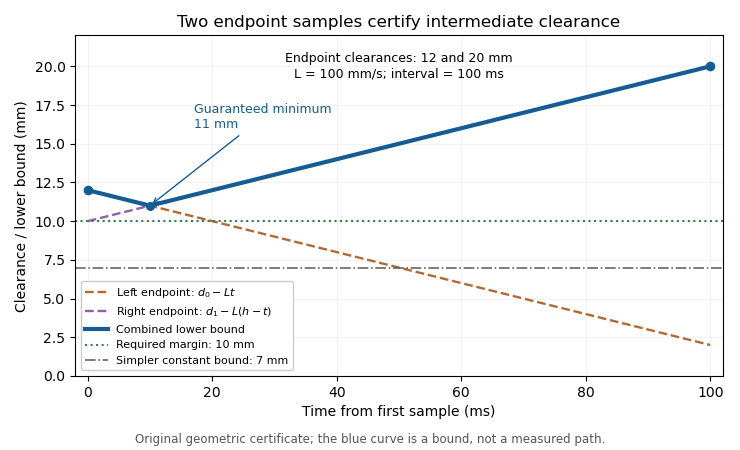
Paired Lipschitz endpoint bounds certify at least 11 mm clearance over 100 ms, while the simpler constant bound gives 7 mm. Original constructed certificate; the blue envelope is not a measured trajectory.
Details. 
For , consistency requires , and the clearance is constant. An endpoint difference larger than contradicts the exact-data assumptions; the motion bound, query errors or model must be checked. A clearance certificate with bounded distance-query error replaces exact observations with justified lower bounds and must preserve the assumptions used in minimizing their envelope.
Under the strict convention of adaptive clearance sampling, certification requires the guaranteed lower bound to exceed the requested margin. If it does not, unresolved intervals in adaptive collision checking remain undecided until additional queries or other information resolve them. Failure of this sufficient certificate alone does not establish a collision.
A clearance certificate with bounded distance-query error proves separation over a continuous motion interval when sampled distances are known only within stated error bounds. A positive returned value from collision detection is not by itself a lower bound on the true geometric distance. Approximation, floating-point error and model error must be included if they affect the intended claim.
Let true set distance satisfy on . At endpoints, assume certified query errors . DefineProvided the query bounds are consistent with nonnegative distances, . The endpoint lower bounds propagate intoThis extends the endpoint certificate for continuous collision clearance. The primary planning model requires feasibility along the whole continuous path; checking endpoint poses alone is insufficient.[ref]
Robotic Systems by Kris Hauser. Chapter 8, Point-to-point path planning; Chapter 9, rotational configuration-space obstacles
The minimum of this envelope must be computed on the actual interval. Its general closed form, including unequal lower bounds, isFor and , the two sloping bounds meet inside the interval and the average expression dominates the other nonzero candidates. If , their intersection lies before the interval; the minimum is instead . The opposite inequality exchanges the endpoints. For , the formula reduces to because true clearance is constant.
The lower bounds themselves need not satisfy the consistency condition for exact endpoint distances. For example, , and permit a true clearance rising from to . Rejecting these lower bounds because their difference exceeds would wrongly treat them as exact observations. The general certificate gives ; using only the intersecting-cone expression would give the weaker .
A second original example takes reported distances and , errors and , and . Then and , so . The error-free formula would have claimed . For a required strict margin above , the uncertain queries do not certify the interval. Tightening both errors to raises the lower bound to and supplies the requested certificate.
Compatibility of bounded endpoint distance queries also uses the upper bounds. The intervals must obey , , and . A violated condition signals inconsistent assumptions. An upper distance bound at or below a required margin can establish a sampled margin violation; failure of a lower-bound certificate alone does not establish a collision.
A proposed checker records the query’s enclosure guarantee, units and geometric model, propagates the motion bound with the actual interpolation, and leaves uncertified intervals unresolved for further subdivision or stronger queries. A standard deviation is not a deterministic query enclosure. A certificate against a nominal obstacle model also needs a separate justified relation to the actual obstacle geometry before it can be interpreted physically.
Compatibility of bounded endpoint distance queries asks whether two uncertain distance readings could arise from any nonnegative clearance function obeying a stated motion bound. It tests consistency of the observations and assumptions; it does not itself prove that the entire motion is collision-free.
Suppose endpoint queries yield intervals and for the true set distances, with . Let the interval duration be and clearance have Lipschitz continuity constant . Write . Compatibility means there exist and satisfying . The exact condition isalong with the two intervals being nonempty and nonnegative. Equivalently, the gap between the two intervals, , must not exceed .
Necessity follows because , and , with the reversed argument for the other inequality. For sufficiency, overlapping intervals allow at any common point. If they are disjoint, choose their nearest endpoints; the boxed condition bounds that separation by . Linear interpolation between the selected nonnegative endpoints has slope at most , proving that at least one admissible continuous clearance function exists.
The feasible endpoint intervals can be tightened toThese are the exact projections of the feasible endpoint-pair set onto each coordinate. A large difference between the lower bounds alone is not a contradiction: lower bounds are not exact distances.
For an original example, take , and . Their nearest endpoints differ by , so the data are compatible. Tightening gives and . By contrast, and have a minimum gap and are incompatible with the same motion bound.
Incompatibility means that some query enclosure, motion bound, timing or model assumption is wrong. It is not evidence that a collision occurred. Compatibility also need not certify separation: exact endpoint distances of over one second with permit both constant clearance and a V-shaped clearance touching zero halfway through. The clearance certificate with bounded distance-query error evaluates a lower envelope over the full interval to answer that additional question.
For , compatibility reduces to overlap of the intervals because clearance is constant. With more query times, multi-sample consistency of distance-query intervals must preserve one common clearance model rather than checking unrelated pairs with incompatible bounds. The primary motion-planning formulation requires constraints along a continuous path, motivating these between-sample checks.[ref]
Robotic Systems by Kris Hauser. Chapter 8, Point-to-point path planning; Chapter 9, configuration-space obstacles
A proposed checker retains query lower and upper bounds, the clock interval, geometry version and motion allowance. It should report inconsistent inputs separately from undecided clearance intervals and certified margin violations. Tight numerical arithmetic alone cannot turn an unsupported standard uncertainty into a deterministic distance enclosure.
Multi-sample consistency of distance-query intervals asks whether every bounded distance reading can belong to one nonnegative clearance function with the claimed Lipschitz constant. The same motion history must explain all samples. Checking each adjacent pair in isolation can select a different intermediate distance for each check and miss a contradiction.
Let strictly increasing times have nonempty intervals , with , and let bound clearance change per unit time. Necessary and sufficient conditions areNecessity follows by comparing any feasible distances using Lipschitz continuity. For sufficiency, constructEach envelope has Lipschitz constant at most . The pairwise conditions and the triangle inequality imply everywhere. At each sample time, , so itself is an admissible nonnegative clearance history. This proves existence, not that this constructed history is the robot's actual history.
The intervals are exact feasible projections at sample times. Both bounding functions are feasible and convex combinations of them remain feasible, so every intermediate value at one fixed time is attainable. The associated multi-sample clearance envelope also gives between-sample lower bounds for a clearance certificate with bounded distance-query error.
For an original counterexample to adjacent-only testing, let successive times differ by one second, take , and useThe first adjacent pair can use middle distance , and the second can use middle distance ; each pair is compatible. Yet the endpoints require a change in two seconds, exceeding the allowed . No common history exists.
An equivalent linear-time feasibility test propagates a reachable interval. Start and recursively setStop if an interval becomes empty. In the example, and the next propagated upper bound is , so is empty. Retaining the tightened interval is the key difference from independent adjacent-pair checks. If all intervals remain nonempty, select a final value and work backward through the reachable intervals; piecewise linear interpolation yields a feasible history.
Incompatibility diagnoses inconsistent readings or assumptions, not a demonstrated collision. Compatibility proves only the existence of a scalar clearance history; it does not prove that some rigid robot trajectory realizes that history or that the true clearance stays positive. Continuous collision avoidance remains a constraint along the physical path, as in the primary motion-planning formulation.[ref]
Robotic Systems by Kris Hauser. Chapter 8, Point-to-point path planning; Chapter 9, configuration-space obstacles
A proposed implementation tests synthetic histories with known bounds, deliberately inconsistent triples and timestamp errors, keeping model inconsistency separate from insufficient clearance.A multi-sample clearance envelope bounds every possible instantaneous clearance consistent with several uncertain distance queries and a known motion-rate limit. It sharpens isolated endpoint estimates by requiring one Lipschitz continuous clearance history to explain all samples. Such a bound addresses the between-sample gap in continuous robot motion planning, where valid sampled configurations alone do not guarantee a valid path.[ref]
Robotic Systems by Kris Hauser. Chapter 8, Point-to-point path planning; Chapter 9, configuration-space obstacles
At times , let , and suppose the nonnegative clearance has Lipschitz constant . Assuming multi-sample consistency of distance-query intervals, defineEvery admissible history obeys . Each lower cone follows from ; the upper cones follow by reversing the inequality. Under consistency, both envelope functions themselves satisfy the sample intervals and the same Lipschitz bound. Thus the enclosure is pointwise sharp among the scalar histories allowed by these assumptions.
A positive minimum of over a time interval certifies separation throughout it. If that minimum is zero, the assumptions permit a scalar history touching zero; this is lack of a strictly positive certificate, not an observation of collision. Some admissible scalar histories may not correspond to a realizable rigid-body path, so sharpness here concerns the stated scalar model.
The exact interval minimum is inexpensive to compute. On , all sample times lie on one side or the other. PutThen . For , its minimum occurs at the crossing if that crossing lies in the interval; otherwise it occurs at the nearer endpoint. Prefix and suffix maxima therefore allow all segment minima to be computed in linear time. For , every admissible clearance is constant and the lower envelope is .
For an original example, queries at give intervals , , , and . On the first segment, and in the corresponding millimetre/second coordinates. The crossing is and the lower bound there is . Symmetry gives a second minimum at , so the full interval is certified with margin . Using only the two outer queries would give a minimum of .
A proposed checker first tests consistency, then computes segment minima with conservative arithmetic and reports the limiting time and active queries. Keep query errors, timestamps and the bound traceable to the same geometry and motion. Clearance envelope with segment-dependent speed bounds can use more motion information, but replacing by an unsupported smaller number would invalidate the certificate.
Articles by others on the same topic
There are currently no matching articles.