Apply for and then set the drive to zero while retaining the closed primary return. By superposition, each pulse-response electric current is its equal-loop RL induction step response at minus that response at , with the step response defined as zero before its onset. All currents remain continuous at ; the drive changes their derivatives.
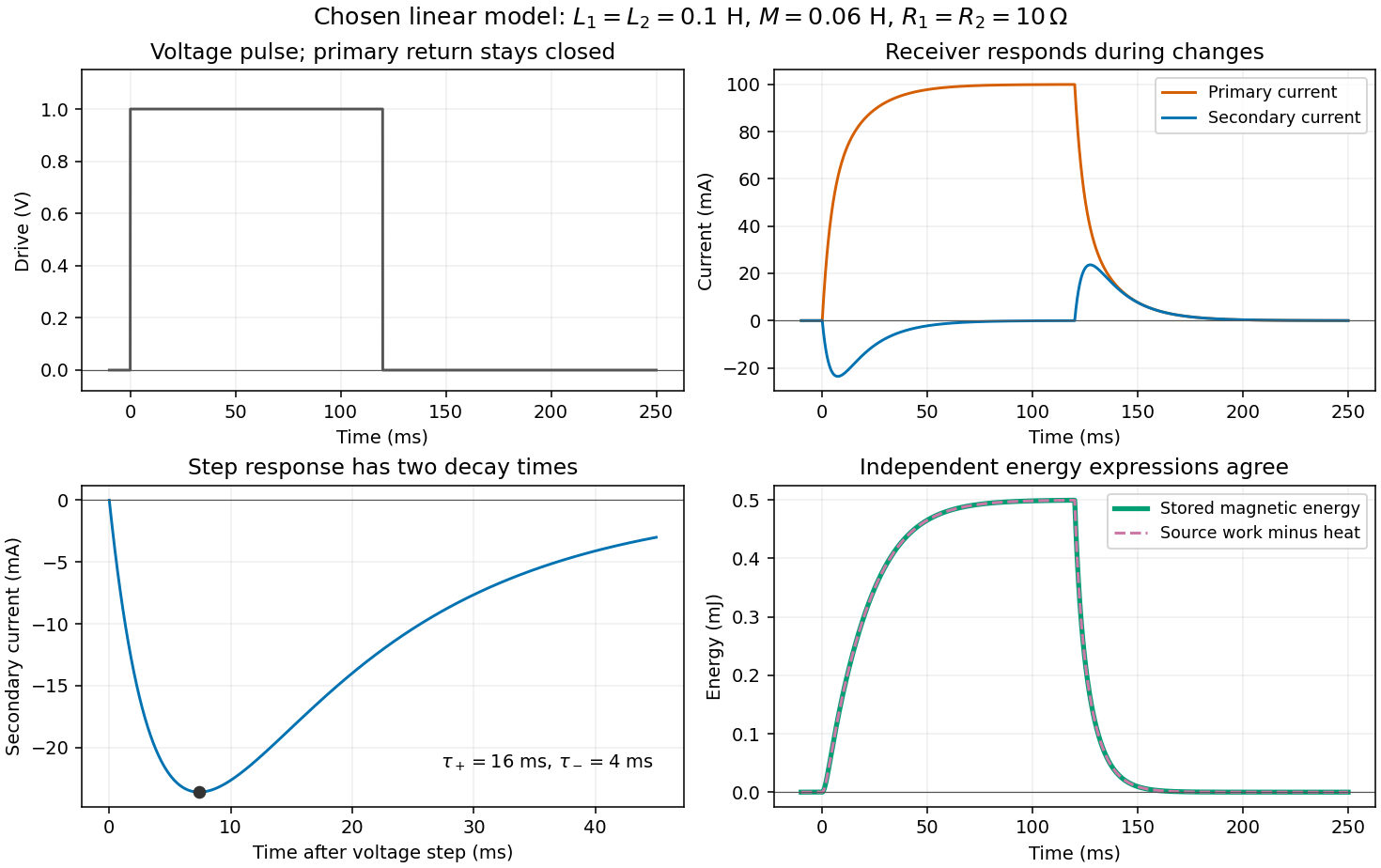

For the displayed pulse, the secondary responds negatively as the primary builds and positively as it decays. Between these transients, the primary is almost steady and the secondary is almost quiet. The energy balance of coupled RL circuits accounts for the entire process, including the energy remaining in the magnetic field when the drive changes.
Articles by others on the same topic
There are currently no matching articles.