In 2014, Gabriele Rosi and colleagues used atom interferometry: two rubidium-87 clouds prepared by laser cooling in vacuum, apart, received shared three-pulse Raman transitions spaced by . Fluorescence readout and paired-fringe ellipse fitting yielded differential wave phase. Twenty-four tungsten alloy cylinders, about total, moved between C and F. Cloud subtraction rejected shared vibration; configuration subtraction isolated the source change.[ref]
Precision Measurement of the Newtonian Gravitational Constant Using Cold Atoms by Gabriele Rosi and others. Main text pp. 3–5; Methods pp. 13–14; Fig. 1 caption p. 21
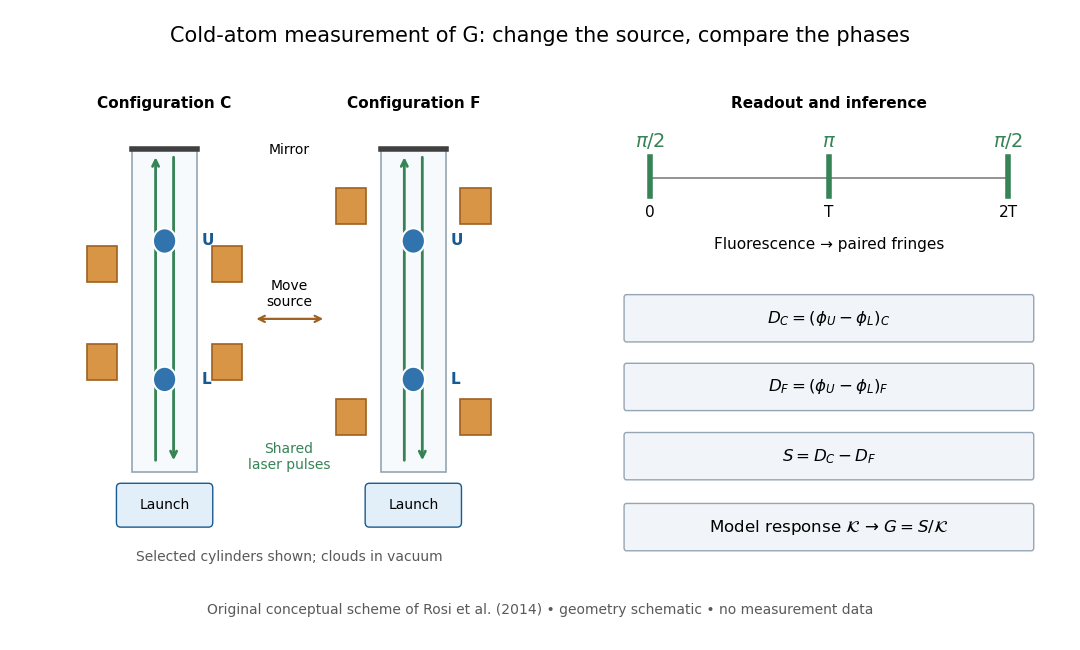
Precision Measurement of the Newtonian Gravitational Constant Using Cold Atoms by Gabriele Rosi and others. Main text pp. 3–5 and Fig. 1 caption p. 21
Details.
Calibration used timed flight and light-sheet crossings; mirror tilt compensated Earth rotation. Wave vector reversal rejected unwanted shifts. Modeling included source Newtonian gravitational potential, atom trajectories, cloud distributions and moving supports. Source positioning, mass density variation and cloud geometry limited the reported combined relative standard uncertainty to parts per million.[ref]
Precision Measurement of the Newtonian Gravitational Constant Using Cold Atoms by Gabriele Rosi and others. Main text pp. 5–6; Methods pp. 14–18; Table 1, p. 27
To understand the subtraction without reproducing that full analysis, consider an ideal atom interferometer in uniform vertical acceleration during each pulse sequence. Let be its signed effective vertical wave vector component and the pulse spacing. Its acceleration-dependent wave phase is ; labels U and L denote upper and lower clouds. The double difference is thenA background field identical in C and F cancels even if it differs between the two clouds. In a fixed-geometry, linear-response model, write , where is calculated from the source mass density, calibrated pulse sequence and atom trajectories. Thus . Measuring wave phase accurately is one part of the task; calculating accurately is another. The real nonuniform field and finite clouds require the trajectory-dependent analysis described above rather than this uniform-field approximation.
Articles by others on the same topic
There are currently no matching articles.