Take a cold, unmagnetized, collisionless plasma with uniform equilibrium electron density , fixed neutralizing ions, and a small electromagnetic wave that is a transverse wave. Cold means that thermal-motion corrections are neglected. For electron mass , elementary charge magnitude and electric field , the linear Newton's second law equation is . Thus and the current density is . Writing the induced electric polarization as gives a negative electric susceptibility. With vacuum permittivity ,The plasma frequency controls the response. For , the propagating branch has real refractive index . For , this homogeneous model has an evanescent wave, not an ordinary propagating wave with a negative real refractive index. In a slowly varying vertical profile, a normally incident ray approaches a turning region where ; the geometrical-ray approximation fails right at that region. At oblique incidence the conserved horizontal wave vector changes the turning condition. A smooth density gradient can therefore return a skywave without a mirror or a layer of metal.
For a homogeneous propagating section, direct differentiation of the dispersion relation givesA phase velocity greater than does not send information faster than . Here a narrow wave packet has group velocity , while the full causal response must still respect special relativity. Even this stripped-down plasma is strongly dispersive near its plasma frequency. In the actual ionosphere, collisions produce absorption, and the magnetic field of Earth changes the response with direction and wave polarization; a single real scalar cannot capture all of that behavior.
For a vertical outgoing and returning radio wave, define the virtual height from its round-trip group delay , after removing instrument delays. It is the height a fictitious reflector would have if both legs traveled at . It differs from both the real turning height and a height fitted to an oblique constant-path interference fringe model.
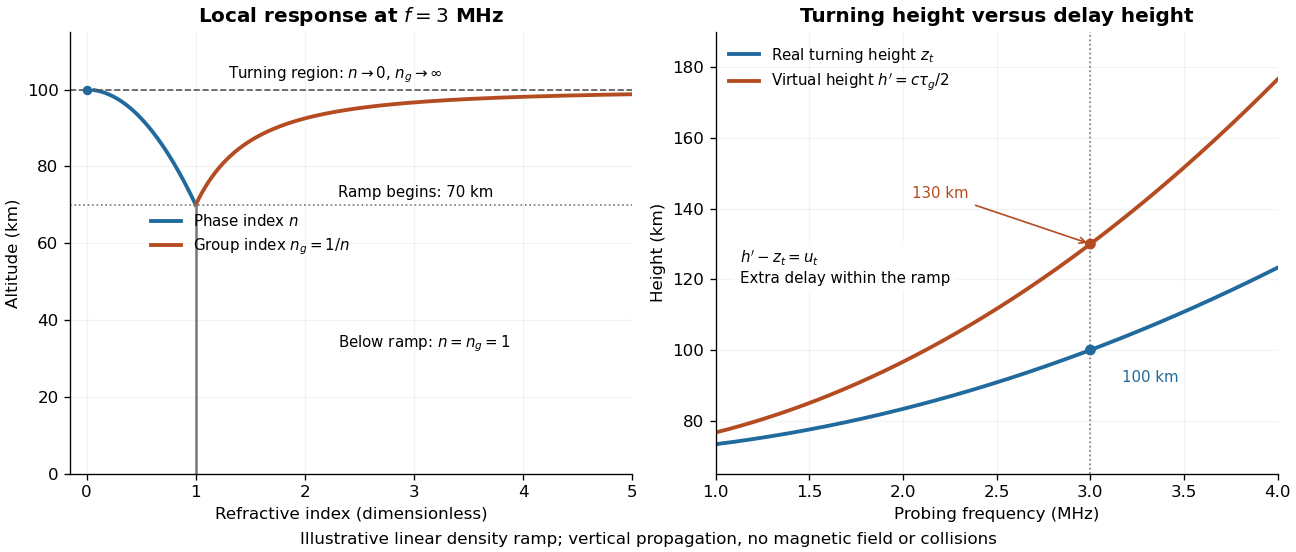
An original solvable profile makes the difference explicit. Approximate the region below by , and prescribe a linear rise of squared plasma frequency above it:Here the symbol denotes the penetration depth, and has units . In the propagating part of the ramp, . In the leading geometrical-ray delay model, with a frequency-independent turning connection wave phase, the round-trip group delay isThe endpoint singularity is integrable: substitute to obtain . This approximation does not resolve the finite-wavelength structure at the turning region. It illustrates the effect of slow group velocity before the return, rather than adding extra geometric altitude.
As an independent phase-based derivation, the propagation contribution to the round-trip wave phase isIts derivative agrees with the delay integral. Using the phase integral itself as a distance at speed would give instead of : wave phase, group delay and real turning height are three different quantities.
Choose and stipulate , where . ThenAt , the real turning height is but the virtual height is , corresponding to with . These stipulated parameters describe neither a measured profile nor a separate physical reflector at . Because the ramp has no density maximum, it also has no finite upper penetration threshold; a real bounded E layer or F layer requires a richer profile.

Articles by others on the same topic
There are currently no matching articles.