Geophysics applies physics and mathematics to the structure, composition, and evolution of planets, including Earth. It connects measurements with mechanisms: plate tectonics explains moving crust, the geodynamo explains a planetary magnetic field, and albedo connects reflected sunlight to a planetary surface energy balance. Even a small model can reveal a useful organizing principle, such as the competition between ice-ocean albedo feedback and stabilizing thermal radiation.
Weather forecasting estimates future meteorological conditions from observations and physical models. Numerical models use an approximate initial condition and equations of fluid mechanics to simulate future conditions; forecasters also compare model outputs and apply experience and research.[ref]
https://www.weather.gov/rah/virtualtourforecast. National Weather Service, The forecast process
The forecast horizon describes how far ahead a prediction remains useful at a specified accuracy; sensitive dependence on initial conditions can limit detailed predictions under deterministic evolution.Firn is compacted, recrystallized old snow that has not yet become dense glacier ice. Its porosity affects meltwater infiltration and heat transfer.
A katabatic wind is a downslope flow of cold dense air accelerated by gravity. Over Antarctic coasts its offshore component can export sea ice and maintain a latent-heat polynya.
The Atlantic meridional overturning circulation transports warm surface water northward and returns denser water at depth; its strength depends on heat loss, freshwater and mixing.
Albedo is the fraction of incident electromagnetic radiation power reflected, summed over the outgoing directions included in the measurement. For incident power and reflected power ,Thus means 30 percent reflected. For an opaque surface the remaining 70 percent is absorbed; for a transmitting layer, transmission must also be accounted for. Specify the incident wavelengths and illumination geometry: a visible-band surface albedo and a sunlight-weighted broadband surface albedo need not agree. NASA's definition explicitly allows a specified spectral band. [ref]
For a whole planet, broadband Bond albedo sums reflected power over all outgoing directions and all incident wavelengths, weighted by the illuminating spectrum. It is the fraction needed for a whole-planet absorbed-sunlight budget. A local surface albedo describes one surface under specified illumination; it cannot simply replace the Bond albedo of Earth, whose clouds and terrestrial atmosphere also reflect and absorb sunlight. Nor is Bond albedo the same as geometric albedo, which compares brightness in a particular viewing geometry. NASA's account of Earth's budget separates reflection by clouds, particles and the surface from absorption within the terrestrial atmosphere and at the surface. [ref]
The usefulness of albedo is that it turns optical behavior into an energy budget. Bright snow and sea ice usually absorb less sunlight than exposed water under comparable illumination, but their actual surface albedos depend on the spectrum and surface conditions. The ice-ocean albedo feedback makes that optical property part of the dynamics, while the following zero-dimensional planetary energy balance isolates the geometry and competing thermal radiation.
Consider an idealized planet that is a sphere of radius , illuminated by parallel sunlight of irradiance , measured on a plane perpendicular to the rays. Its intercepting projected area is , whereas its total surface area is . Therefore the incoming power averaged per unit total surface area iswhere is the broadband Bond albedo. The factor four is a sphere geometry result, not an atmospheric transmission factor. Local sunlight still varies over the illuminated hemisphere and vanishes on the dark side.
Now stipulate a single spatially uniform temperature , no atmosphere, no internal heating, and emissivity one for outgoing thermal radiation. This is a thermal blackbody model using the Stefan–Boltzmann law; the prescribed solar-band reflection is treated separately, so the body is not a perfect absorber at all wavelengths. Let be the effective heat capacity per unit surface area, in . Conservation of energy gives the ordinary differential equationHere is net heating per unit surface area, in , and is the Stefan-Boltzmann constant. Use , rounded from the exact constant reported by NIST. [ref]
https://physics.nist.gov/cgi-bin/cuu/Value?sigma%7Csearch_for=stefan+boltzmann. NIST, CODATA value: Stefan-Boltzmann constant
The uniform temperature is a model assumption: generally the surface average of differs from the fourth power of the surface-average temperature.For fixed Bond albedo , radiative equilibrium requires , givingWith the illustrative solar constant , the global incoming average is :
| Fixed Bond albedo | Reflected average () | Absorbed average () | Equilibrium temperature () |
|---|---|---|---|
Doubling albedo here lowers the equilibrium temperature by , rather than halving it: the absorbed fraction changes from to , and thermal radiation scales as . These stipulated Bond albedos are whole-planet examples, not measurements of bare water and ice. The model predicts neither Earth's modern surface temperature nor its response to actual climate change; it omits the greenhouse effect, spatial heat transfer and seasons.
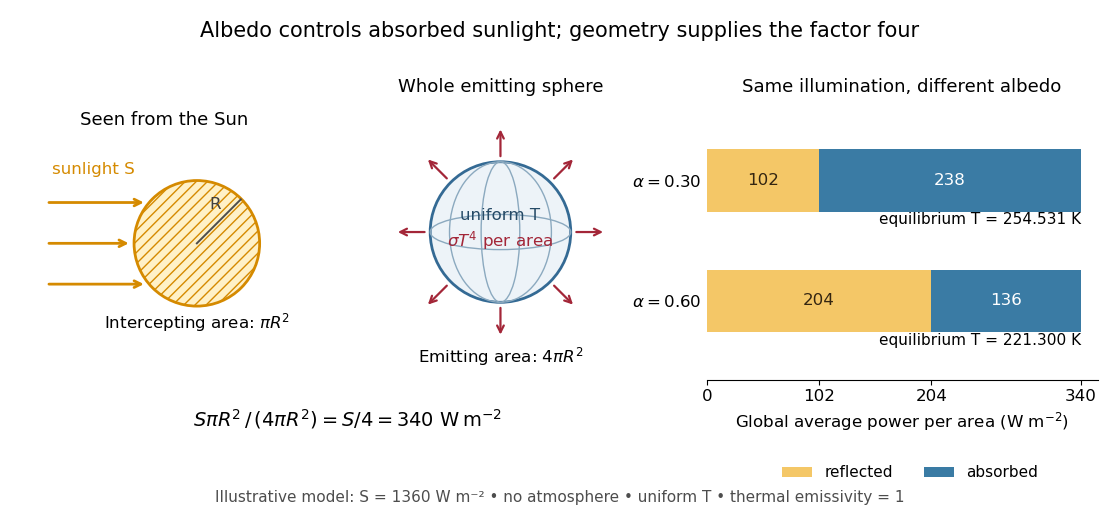
Each fixed-albedo equilibrium is a stable equilibrium: for , the derivative is . A small temperature increase produces net cooling, and a small decrease produces net heating. This is the simplest expression of the stabilizing Planck feedback. Allowing albedo to fall with temperature adds a competing term, as in ice-ocean albedo feedback.
Ocean heat flux is the upward or downward heat transfer between ocean water and an overlying ice or atmosphere system.
Ice deformation creates ridges, rubble and keels that change transport, stress and storage beneath a floe.
For an initially cold iceberg, melting to liquid at temperature requires both latent heat of fusion and sensible warming determined by the ice specific heat capacity . Spatial mass density and temperature profiles determine their mass-weighted integrals. Additional warming of the meltwater requires a separate heat contribution.
An iceberg moving toward the equator carries a thermal deficit into warmer water. Melting extracts heat there, equivalent to transport of heat toward the pole. For an annual number of similar bergs, multiply their individual iceberg melt heat budget by the rate per second. Freshwater effects on density stratification and ocean circulation are separate from this heat accounting.
For a vertical-sided floating iceberg of height , Archimedes' principle equates displaced water mass to ice mass. Its draft is and its freeboard is the remaining height above water. A depth-dependent mass density must be integrated; using the densest layer throughout overestimates the draft.
The free-drift velocity of an iceberg follows from air and water drag, the Coriolis force, pressure gradients, currents and other external forces. Large submerged area and mass make its wind response weak compared with that of a thin floe.
For a constant wind force , still water, and linear water drag force , let . The Coriolis parameter gives equilibrium . The deviation evolves as , a damped inertial oscillation. Actual drag is commonly quadratic, so this is a linear illustrative model rather than a universal iceberg speed law.
Water drag on a large iceberg can exceed a tug force by many orders of magnitude; the relevant area is the immersed horizontal base when the quoted coefficient is an equivalent water-drag coefficient.
A convective chimney is a localized deeply mixed region formed when surface buoyancy loss overcomes ocean density stratification. Small plumes, compensating flow, rotation and lateral exchange maintain its structure; it need not be a permanently uniform descending column. Brine rejection can increase its surface density forcing. A fresh summer cap can isolate a deep homogeneous core until winter forcing renews contact with the surface, so a surviving core need not imply continuous active convection.
Ice-ocean albedo feedback is the ocean-surface case of ice-albedo feedback: loss of bright sea ice, often covered by snow, exposes darker water, lowers surface albedo and increases absorbed sunlight. The extra stored ocean heat content can promote further melting and delay refreezing. Reversing the sequence can amplify cooling. This is a positive climate feedback, meaning that it reinforces the initial change; the word positive does not mean beneficial, and it does not guarantee runaway warming.
For unchanged downward solar irradiance on a newly exposed opaque patch, the extra absorbed heat flux isFor illustrative local surface albedos and , and , the patch absorbs an additional . This is a local sunlight calculation, not a whole-planet radiative forcing: newly exposed area, illumination, clouds and season determine its global contribution. With no incident sunlight this particular heating pathway vanishes. NASA's notes describe the contrast between reflective ice and snow and darker water. [ref]
https://science.nasa.gov/learn/heat/resource/explore-albedo-activity/. NASA, Explore Albedo Activity
To isolate how a positive climate feedback competes with Planck feedback, retain the assumptions of the zero-dimensional planetary energy balance and prescribe the smooth broadband Bond albedoThe exponential function makes a smooth transition from a bright cold state near to a darker warm state near . The midpoint and width are chosen to illustrate the dynamics. They are not a seawater freezing law, an observed global relation, or a calibration of modern Earth. No evolving ice thickness or latent heat is represented.
An equilibrium satisfies . For a small perturbation , linear stability follows fromSince , gives an asymptotically stable equilibrium, while gives an unstable equilibrium. With , the derivative isThus the optical term is destabilizing, while the thermal radiation term is stabilizing. Their sum, not the optical term alone, decides the linear stability.
For the same and Stefan-Boltzmann constant used above, the bisection method on the intervals , and , with temperature in kelvins, gives:
| Equilibrium temperature () | Bond albedo | () | Behavior |
|---|---|---|---|
| Asymptotically stable cold equilibrium | |||
| Unstable equilibrium | |||
| Asymptotically stable warm equilibrium |
Unrounded numerical zeros of a function have ; the table rounds them for readability. In the positive-temperature domain the sign of alternates between heating, cooling, heating and cooling across these three equilibria. The middle equilibrium separates the basins of attraction of the two stable equilibria. For example, a starting temperature of cools toward the cold state, whereas warms toward the warm state: this is bistability at identical external illumination.
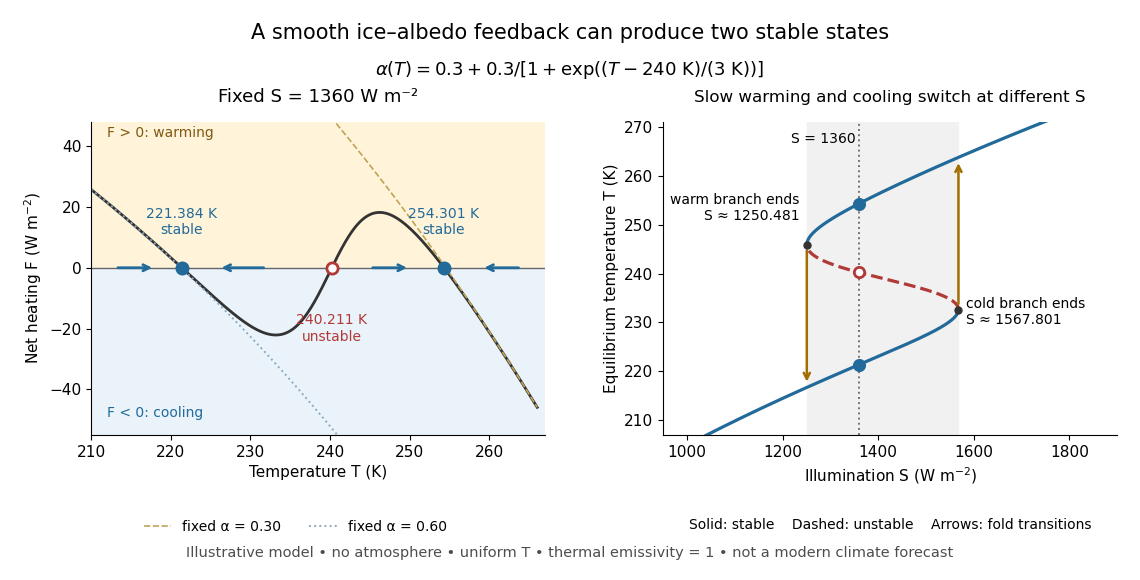
The same model illustrates hysteresis. Its equilibrium curve can be written as . The two turning points, where , are saddle-node bifurcations: approximately and . For illumination strictly between these thresholds there are two stable equilibria and one unstable equilibrium. Under sufficiently slow increase of , the cold branch ends at the upper threshold; under sufficiently slow decrease, the warm branch ends at the lower threshold. The ensuing warming and cooling transitions differ, so the state depends on its history. Finite sweep rates can delay the transitions; these thresholds describe this model's static equilibrium curve, not predicted tipping points for modern Earth.
The striking feature is that a smooth albedo law can produce distinct long-time states and abrupt transitions, although no discontinuity was inserted into the optical law. It is useful for understanding why positive climate feedback can amplify a response while stabilizing thermal radiation still limits it. Here bounds the incoming heating, whereas outgoing thermal radiation grows as ; high enough temperatures therefore cool rather than run away indefinitely.
Historically, M. I. Budyko's 1969 paper coupled changing albedo from expanding ice cover to a latitude-dependent temperature and heat transfer calculation, showing how that coupling amplified the effect of changed sunlight. [ref]
https://cdn.repub.ch/s3/republik-assets/assets/pdf/budyko_1969.pdf. M. I. Budyko, The effect of solar radiation variations on the climate of the Earth, Tellus 21(5), 611–619, 1969, pp. 614–616
William D. Sellers's 1969 paper constructed an annual energy-budget model in 10-degree latitude belts, including planetary albedo, atmospheric infrared transmission and atmospheric and oceanic exchange. [ref]https://acoustique.ec-lyon.fr/chaos/Sellers69.pdf. William D. Sellers, A Global Climatic Model Based on the Energy Balance of the Earth-Atmosphere System, Journal of Applied Meteorology 8, 392–400, 1969
These primary papers provide historical examples of ice-sensitive energy-budget modeling; the smooth single-temperature example above is a separate illustration, not a reproduction of either paper's equations or predictions.The thermodynamics of sea ice couples conductive heat transport, radiative and turbulent surface fluxes, basal ocean heat and latent heat of freezing and melting.
Melting a basal ice thickness consumes energy per unit area, ignoring sensible warming and salinity corrections. The corresponding time-averaged heat flux is this energy divided by . The actual ocean heat flux also includes heat conducted into the ice.
// Target: geophysics.bigb
A freezing degree-day accumulates air temperature below a declared reference freezing temperature, with time in days and temperature difference in degrees Celsius or kelvins. The reference temperature and averaging convention must match the empirical sea ice thermodynamics formula using it. Warming by a constant subtracts times the number of days only if those days remain below the reference threshold.
This empirical sea ice growth relation gives thickness in metres from accumulated freezing degree-days . Its coefficient includes the specified units and calibration. It is not a complete energy-balance model: snow, ocean heat and changing forcing can alter its applicability. Inversion gives .
The water-equivalent thickness expresses an ice mass per area as a depth of water at a declared reference density. With per area, . Ice at and thickness has about water equivalent at a fresh-water reference density of . The depth of seawater consumed at is instead about . A reference depth must not replace ice thickness in an ice-volume calculation or the liquid mass removed in brine rejection.
When seawater freezes, most salt remains in liquid, increasing salinity and density and potentially driving convection.
A temperature gradient can move a brine inclusion by melting its warmer wall and freezing its colder wall. This slow process can redistribute salt, but is generally much less effective at net desalination than gravity drainage of sea-ice brine or meltwater flushing of sea ice.
// Target: geophysics.bigb
Freezing within a brine inclusion expands the solid fraction and can force concentrated liquid into neighboring pores or channels. Expulsion redistributes salt internally; net desalination requires a path crossing the ice boundary.
// Target: geophysics.bigb
Surface meltwater with a positive hydraulic head can percolate through permeable sea ice, displacing brine into the ocean. Flushing can efficiently desalinate warm summer ice, but requires meltwater and connected flow paths.
// Target: geophysics.bigb
Dense saline liquid in connected pore space can drain from sea ice while fresher seawater enters. The process is controlled by buoyancy, permeability of a porous medium and network connectivity, and is a major means of growing-ice desalination.
// Target: geophysics.bigb
If a fraction of initial liquid mass freezes into salt-free ice, all original salt remains in a liquid mass fraction . Writing salinity as salt concentration per mass gives , hence . For equal initial cooling and subsequent freezing heat extraction, . The liquid specific heat capacity, rather than the ice value, determines the initial heat removal. If ice retains salt, the mass balance instead reads .
Let liquid mass freeze incrementally, and let each new ice increment retain salinity with constant , where is the instantaneous well-mixed liquid salinity. Conservation gives , hence . Integrating yields . For frozen mass fraction , . Specifying a fixed bulk ice salinity instead produces a different, though first-order compatible, finite-mass balance.
For equal heat extraction, the density increase caused by brine rejection can exceed that caused by cooling near the freezing point because the thermal density response is weak. Using conservation of salt during freezing, the ratio is , with . This is a parcel comparison, not a guarantee that freezing overcomes any ambient density stratification.
For the conversion used in the exam, rejected salt increases density about one kilogram per cubic metre per practical salinity unit. The same heat loss can therefore produce much denser water through freezing than through modest sensible cooling.
The Maykut-Untersteiner model is a seasonally forced one-dimensional sea ice thermodynamics model with snow and saline ice layers. It couples radiative and turbulent surface fluxes, heat conduction, interior shortwave absorption, brine-dependent effective heat capacity and conductivity, snowfall, and a basal Stefan condition driven by prescribed ocean heat flux. Its annual sea-ice thermodynamic equilibrium is a periodic cycle with zero net yearly thickness change. The snow insulation and summer ice protection mechanisms compete, so additional snow need not reduce annual equilibrium thickness. The transient temperature profile need not be linear.
At fixed boundary temperatures, a snow cover decreases winter conductive heat loss through the resistance and inhibits sea ice growth. Its high albedo and persistence into summer reduce ablation. Therefore annual equilibrium thickness has competing snow sensitivities. The near cancellation at modest snow depth and thickening with persistent summer snow in the original Maykut-Untersteiner model are forcing-dependent responses, not a universal monotonically decreasing snow-thickness relation.
For annually repeated forcing, a thermodynamic equilibrium is a periodic temperature field and thickness cycle. The yearly integral of net ice growth is zero, although substantial winter growth and summer ablation can each occur. Equilibrium thickness must specify an annual mean or a phase of the cycle. A change in forcing can remove a perennial-ice solution without making every transient thickness decrease at the same rate.
An oil spill beneath sea ice is transported by a rising buoyant plume, lateral currents and the evolving ice--water interface. A slick can be spread, trapped in ridges, incorporated into growing ice or released through brine channels and melt ponds.
If a buoyant plume of diameter supplies oil at volume rate to an ice floe moving at speed , the plume sweeps area per unit time. Retaining a layer of depth over that area would require volume rate , so conservation of mass gives the painted fraction . Discontinuous painting starts when . This estimate assumes all arriving oil is retained and a constant track width equal to the plume diameter; the plume's circular cross-sectional area does not enter the swept-area rate.
Permafrost is ground that remains at or below its freezing threshold for at least two consecutive years. Thaw can expose previously frozen organic material to decomposition, with methanogenesis where conditions are anaerobic.
Thawing permafrost makes previously frozen organic matter available for decomposition, releasing carbon dioxide and, in waterlogged oxygen-poor conditions, methane. These greenhouse gases amplify warming, which can cause further thaw. The amount reaching the atmosphere depends on decomposition, transport and oxidation; this feedback does not imply an inevitable abrupt release of an entire carbon reservoir.
Thermokarst is subsidence and related landscape change caused by thaw of ice-rich permafrost. Resulting lakes and saturated sediments can promote methanogenesis.
Climate change is a persistent alteration of the statistical behaviour of a planet's climate. External forcing and climate feedbacks both matter, and the timescale must be specified.
Polar amplification is greater temperature change at high latitudes than in the global mean. Ice-albedo feedback, the vertical structure of atmospheric warming, the temperature dependence of radiative cooling, ocean heat storage, clouds and energy transport all contribute; the balance differs between the Arctic and Antarctic and between seasons.
Attribution of recent climate change assesses the contributions of anthropogenic forcing, natural forcing and internal variability to observed changes. It combines the physics of radiative transfer, measured forcing agents, energy budgets and spatial, vertical and temporal response patterns. A single weather event or a single trend is insufficient by itself to identify all causes.
Global warming is an increase in Earth's global mean surface temperature. It is one aspect of climate change, which also includes changes in precipitation, circulation, extremes and the cryosphere. Warming driven by additional greenhouse gases can be amplified or moderated by climate feedbacks.
Global mean sea level can rise through changes in ocean volume at fixed mass and through additions of ocean mass. Local relative sea level additionally depends on ocean circulation, gravity and vertical motion of the land. Floating sea ice has already displaced seawater, so its melt has a much smaller direct sea-level effect than transfer of grounded land ice into the ocean.
With positive freshwater runoff , net sea ice melt and precipitation , and evaporation loss , the ocean water-mass budget is . With salt-free ice and fixed total dissolved salt mass, mean salinity satisfies . Gross regional ice melt must not be substituted for net global melt without accounting for ice formation elsewhere and the averaging period.
Eustatic sea level change is a change in global sea level associated with changes of ocean water amount or ocean-basin capacity. For contemporary climate budgets the relevant contribution is principally transfer of water between land and ocean, including melting grounded ice and changes in terrestrial water storage. It is distinct from steric sea level change.
Steric sea level change results from changes of seawater mass density at fixed ocean mass. To first order, thermal expansion gives ; changes in salinity give a halosteric contribution. The reference column, pressure and equation of state must be specified.
Thermosteric sea level change is the thermal expansion part of steric sea level change. For a uniform layer of depth , conservation of mass gives , hence .
The Arctic dipole anomaly describes a pressure pattern with opposed anomalies on the North American and Eurasian sides of the Arctic. It is distinct from the more nearly annular Arctic Oscillation; associated winds can change sea ice export and warm-air advection.
Radiative forcing is a change in the net downward radiative flux caused by an imposed perturbation, evaluated with a specified adjustment convention before the surface climate responds. State the reference period and whether the diagnostic is at the tropopause or top of the atmosphere. A local seasonal ocean heat flux is not directly interchangeable with global annual radiative forcing.
A climate feedback is a response to climate change that alters the initial warming or cooling. Positive feedback amplifies the change; negative feedback opposes it. Positive feedback alone does not prove an irreversible transition.
Lapse-rate feedback is the radiative effect of changes in the vertical temperature profile beyond a vertically uniform temperature change. In the tropics, enhanced warming aloft often increases radiative cooling and is stabilizing. In a stably stratified polar atmosphere, warming concentrated near the surface can yield less compensating cooling aloft and help produce polar amplification. The sign and magnitude depend on the profile and radiation physics.
The Planck feedback is the stabilizing increase in outgoing thermal radiation when temperatures rise, with other properties held fixed. For a blackbody the local derivative is , so a colder emitter has a smaller absolute radiation increase per kelvin. The atmospheric response requires radiative transfer, and cannot be obtained by replacing the entire climate system with a single surface blackbody.
Warming can mobilize frozen organic material or change sediment conditions, increasing methane emissions and strengthening the greenhouse effect. Production, transport and atmospheric release must be distinguished: methane can dissolve or be oxidized before reaching the atmosphere. Observed seabed bubbles alone do not establish the magnitude or timing of a global atmospheric feedback.
Replacing bright ice or snow with darker water or ground decreases surface albedo, increases absorbed sunlight and can cause further melting. Locally the extra absorbed heat flux is on the newly exposed surface. The effect depends on season, cloud cover and incident sunlight.
A moving ice keel can gouge sediment when its draft exceeds water depth. In an exponential ridge-draft model, a point crossed by ice at relative speed experiences candidate encounters at rate . Actual erosion also depends on grounding, deformation of the keel and sediment strength.
The Solid Earth comprises a planet's solid inner core, liquid outer core, viscously deforming mantle, and mechanically stronger crust and lithosphere.
A long-term carbon cycle coupling silicate weathering, carbonate formation and interior recycling with volcanic carbon dioxide supply. Its temperature- and water-dependent weathering can provide a climate feedback. Active plate tectonics can support recycling, but the effectiveness of the feedback also depends on rock exposure, water and reaction rates.
Transport and eruption or intrusion of molten rock and associated gases. Subduction, spreading and mantle upwellings can supply melt; volcanism does not require globally active plate tectonics. Outgassing couples interior evolution to atmospheric inventories.
A transient release of stored mechanical energy in the solid planet, often associated with fault motion. Plate tectonics is a major terrestrial driver, but earthquakes can also occur without an active global plate system.
The mechanically strong outer shell of a rocky planet, including crust and the colder upper mantle. It can form mobile plates in plate tectonics or a relatively stagnant lid. Its temperature, water content and damage affect its ability to yield.
Magma is molten or partially molten rock within a planet. Its dynamic viscosity, cooling and interaction with the surrounding elasticity influence transport and storage.
A geological dike is a sheet-like body or conduit formed when magma enters a fracture cutting across the surrounding rock. A vertical narrow dike can be modeled as a two-dimensional channel for coupled flow, heat transfer and wall melting.
With equal solid and liquid densities, magma entering a dike at constant flux has : melt added by the walls exactly supplies the increasing cross-sectional storage. If wall heat flux is , both walls give . Combining this with sensible-heat conservation admits , , . The shape equations are and .
New wall melt enters at the wall melting temperature . Besides supplying its latent heat, the flowing magma must warm this added melt. Relative to , conservative heat storage is , so differentiating it retains and gives the displayed dilution term. Omitting that term requires an additional approximation, such as a small sensible-to-latent heat ratio; it does not follow from equal densities alone.
A lava lake is a persistent exposed body of molten or partly molten magma. Surface radiative cooling, thermal convection, latent heat, and internal radiogenic heating can jointly control formation and melting of its crust.
For a well-mixed lava lake of depth and a thin conductive crust of thickness , put , and use the convective flux with constant heat transfer coefficient . The Stefan condition and liquid heat balance give, to leading order in ,Here latent heat is per unit mass and . Crust heating and changes of liquid depth are neglected. The linear conductive profile uses a quasi-steady approximation; thinness alone does not justify neglecting crust thermal storage. During initial growth, a small Stefan number supplies a sufficient rapid-adjustment regime. Define , , and . Scaling by the thermal diffusion time and gives and , where , , and is the Stefan number. Thus exactly. The reduction applies while , the conductive profile is approximately linear, and the thermal convection closure remains valid; it does not model complete freezing of a deep lake.
In the radiogenically heated lava-lake crust model, the thickness derivative vanishes at when the liquid superheat is positive. This moving curve balances thermal conduction and convective heat flux; it is not itself the evolving crust. Cooling raises the curve and keeps an initially absent crust below it. Warming lowers the curve, allowing lava-crust overshoot under warming. At zero superheat the stationary thickness is infinite, so its finite formula applies only after positive superheat develops.
In the radiogenically heated lava-lake crust model, initially cool liquid warms exponentially and its instantaneous stationary lava-crust thickness decreases. The actual crust can cross this moving value, reach a maximum, and melt back to . Overshoot is not automatic. Linearizing about equilibrium givesIf and , the slowly decaying forced response has positive sign, so the crust eventually approaches equilibrium from above; an initially absent crust must then have overshot. In contrast, initially hot liquid cools, its instantaneous stationary thickness increases, and an initially absent crust cannot cross it from below: at a proposed first crossing its own derivative is zero but the stationary thickness has positive derivative. The hot-start crust therefore grows monotonically. These comparisons assume nonnegative liquid superheat.
In the radiogenically heated lava-lake crust model, temperature stays constant precisely when . Then , and an initially absent crust satisfies the displayed law for . It follows by integrating from zero to . The crust starts as and tends to only at infinite time. The equilibrium remains thin only if .
A magma intrusion is the emplacement of magma into surrounding rock. A shallow, approximately axisymmetric intrusion can lift an elastic plate roof, with spreading determined by viscous peeling of an elastic plate or fracture toughness.
With the axisymmetric clamped-plate deflection and fixed front curvature , a magma intrusion hasThese relations describe the advancing fracture branch, with roof bending rather than hydrostatic pressure controlling the interior load.
Let be total magma volume shared between a reservoir and an advancing toughness-controlled magma intrusion, , and conduit conductance . With ,Equilibria satisfy . Two positive equilibria exist when ; the smaller is unstable and the larger is stable under this volume equation. An advancing solution between them approaches the larger. The singular pressure as prevents this late-time model from nucleating an intrusion by itself.
If a positive vapour-tip pressure magnitude sets , matching to the interior curvature gives . The viscous peeling of an elastic plate law then yields . For constant injected volume flux , and , henceOrder-one coefficients require solving the local peeling profile. The scaling assumes a front region much shorter than the intrusion radius.
Mantle convection is the slow buoyancy-driven motion of a rocky planetary mantle. On geological timescales the solid mantle behaves as a highly viscous Newtonian fluid to first approximation.
A mobile-lid mode of planetary evolution in which coherent pieces of the lithosphere move, form at spreading regions and can recycle through subduction. Slab pull, ridge push and mantle flow compete with deformation resistance. It affects heat transport, volcanism, earthquakes and the carbonate-silicate cycle. It is not guaranteed solely by an exoplanet's mass.
Gravitational sliding of lithospheric material away from elevated spreading regions. It supplies a driving contribution to plate tectonics together with slab pull and mantle stresses.
Downward recycling of a lithospheric plate into the mantle. A sufficiently cold, dense slab can provide slab pull, while bending and friction resist motion. The resulting material and volatile recycling connects plate tectonics with volcanism and long-term climate.
A gravitational driving force associated with a dense descending slab. The slab's buoyancy and ability to remain coherent matter, so increased planetary gravity alone does not determine whether subduction occurs.
The Rayleigh number compares buoyancy driving with viscous and thermal diffusion. For a layer of thickness , temperature drop , density , thermal expansion coefficient , gravitational acceleration , thermal diffusivity , and dynamic viscosity ,Thermal convection begins when this exceeds a geometry-dependent critical value.
A local Rayleigh-number closure estimates the thickness of a turbulent thermal boundary layer by settingwhere is an order-one or geometry-dependent critical value. Combining this with Fourier's law converts the boundary-layer temperature and density differences into a heat flux law.
Penetrative convection occurs when an unstable convecting region extends into, or is capped by, a stably stratified region. Water near its temperature of maximum density provides a common example: a cold stable layer can lie above a warmer turbulent convecting layer.
Fresh water reaches maximum mass density near at atmospheric pressure. A useful local equation of state isso water becomes less dense when its temperature moves either above or below .
In an ice-covered freshwater lake, a stagnant layer colder than the density-maximum temperature can cap a warmer turbulent region. Maximizing the boundary-layer heat flux obtained from a Local Rayleigh-number closure gives an interface temperature satisfyingand a maximum upward heat flux proportional to .
A planetary ice shell is a solid water-rich layer overlying an ocean or deeper planetary interior. Its thickness can be controlled by thermal conduction, basal heat flux, surface radiation, and solid-state mantle convection.
Sea ice is frozen ocean water. A local thermodynamic description uses thermal conduction, a surface energy balance and the Stefan condition; salinity, mechanical transport and fractional ice coverage add further physics.
The horizontal sea-ice drift momentum balance per unit area includes air and water drag forces, the Coriolis force, depth-integrated internal ice stress and the sea-surface pressure gradient. Here is ice-plus-snow mass per area and is a depth-integrated stress tensor.
// Target: geophysics.bigb
A sea-ice lead is a fracture or elongated opening in a sea-ice cover, containing open water or young thin ice. Divergence and shear create leads, while freezing and convergence close them.
// Target: geophysics.bigb
Sea-ice lead-width distributions depend on observational thresholds, resolution and whether leads are counted individually or weighted by area. Observations commonly exhibit a broad, approximately power law range, with many narrow leads and a relatively heavy tail.
// Target: geophysics.bigb
A sea-ice thickness distribution assigns fractional horizontal area to ice thickness intervals: is the fraction between and . Include open water as a mass at when normalizing over the entire ocean area. The first moment is ice volume per ocean area. With growth rate and velocity , its conservative evolution is , with mechanical redistribution of sea ice represented by .
// Target: geophysics.bigb
Mechanical redistribution of sea ice changes thickness-class area through ridging, rafting and lead formation. In the conservative thickness-distribution equation, local volume conservation gives ; area normalization including open water gives when thermodynamic boundary fluxes are accounted for consistently.
// Target: geophysics.bigb
Snow ice forms when flooded snow or a seawater-snow mixture freezes. Snow loading of a thin floe can depress the ice surface below water level and initiate flooding; wave overwash is another route.
// Target: geophysics.bigb
Nilas is a thin, flexible, relatively continuous initial sea-ice sheet. Further freezing at its underside in quiet water produces congelation ice.
// Target: geophysics.bigb
The sea-ice crystal fabric describes grain shapes and crystallographic orientations. Calm-water congelation ice tends to develop vertical columns with predominantly horizontal crystal c-axes, whereas accumulated frazil ice produces a granular texture with much less systematic orientation.
// Target: geophysics.bigb
Articles were limited to the first 100 out of 258 total.
Articles by others on the same topic



Geophysics is the study of the Earth's physical properties and processes using quantitative methods and principles of physics. It encompasses a wide range of topics and techniques to investigate the structure and dynamics of the Earth, including its interior, surface, and the atmosphere.