Cosmic expansion is the increase of physical distances between comoving observers as the scale factor grows. Its instantaneous fractional rate is the Hubble parameter.
Hubble's law states that the instantaneous rate of change of proper distance in cosmology between comoving observers is proportional to that distance:This is exact for fixed comoving distance in an FLRW metric: differentiating gives . The dot uses cosmic time, and both distances are compared on spatial slices at the same cosmic time. The rate is not a relative velocity measured in a single inertial frame of special relativity. Thus the instantaneous relation is not an exact observed redshift-distance formula. The associated Hubble flow describes the ideal expansion; peculiar velocities describe departures from it.
For nearby sources, the observed redshift approximately satisfieswhen source and observer peculiar velocities are small compared with , additional gravitational redshift is negligible, and the changes in the scale factor and Hubble parameter during light travel are small. Here can be taken as the present proper distance in cosmology; familiar distance conventions agree at leading order in small redshift. Briefly, , while , so cosmological redshift gives . At greater redshift, use an expansion history and an explicit distance convention instead.
Stipulate the illustrative Hubble constant and speed of light . A is a million parsecs. The following are computed examples, not a catalogue of observed galaxies:
- At , and the approximate cosmological redshift is .
- At , and the approximate cosmological redshift is .
- At , and the approximate cosmological redshift is .
The displayed values are exact arithmetic under the stipulated Hubble constant; the cosmological redshift estimates use the nearby approximation and become less accurate as distance grows.
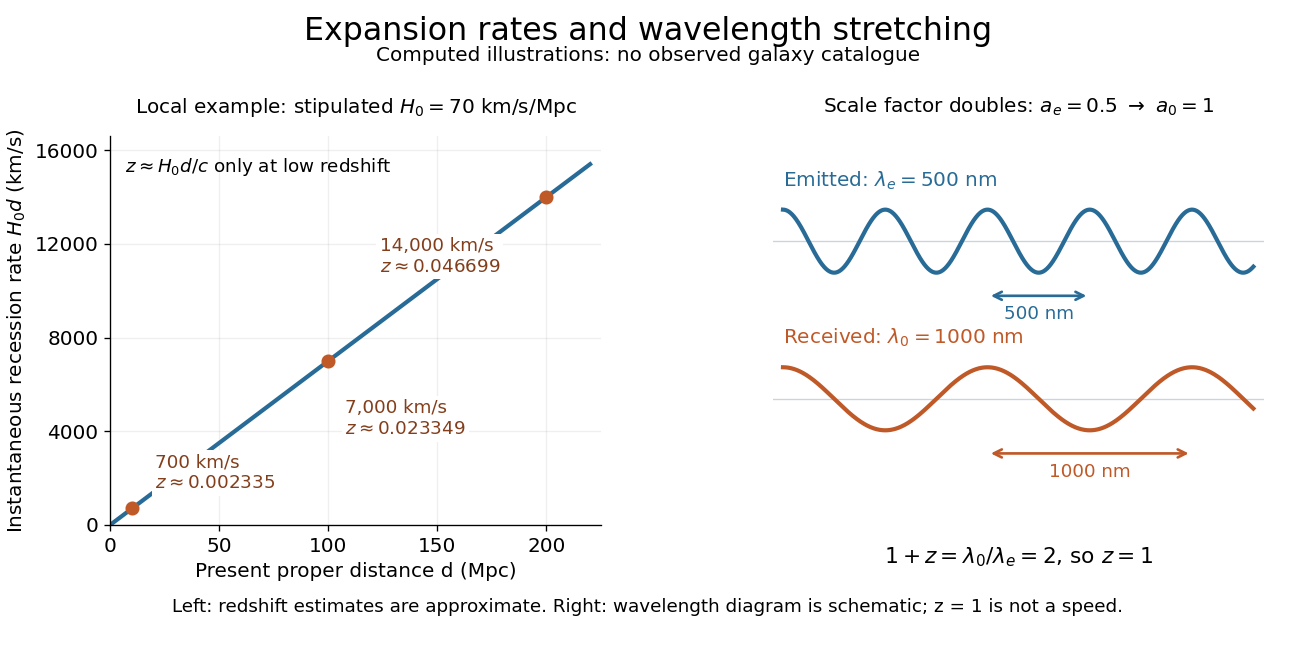
Hubble's law turns a nearby observed redshift into an approximate distance indicator and makes the uniformity of cosmic expansion tangible: twice the proper distance in cosmology means twice the instantaneous separation rate. Recentring the ideal Hubble flow on another comoving observer preserves the same proportionality, as illustrated under scale factor, so recession in every direction does not select a central observer.
In his 1929 PNAS paper, Edwin Hubble presented a relation between the distances and radial velocities of extragalactic objects. His fits gave coefficients of and for 24 individual objects and nine groups respectively, and he used about as a rounded representative value. Those historical fits used the paper's distance estimates; they are distinct from the stipulated modern-scale illustration above. [ref]
https://www.astro.puc.cl/~rparra/tools/PAPERS/hubble_1929.pdf. Hubble (1929), original PNAS paper, pp. 170-171
.The Hubble parameter is the instantaneous fractional rate of cosmic expansion:where the dot is a derivative with respect to cosmic time. Thus a short interval changes any fixed-comoving proper distance in cosmology by the fraction . Its dimensions are inverse time; describes expansion and contraction. The Hubble parameter identity gives .
For pressureless matter, a positive cosmological constant, flat spatial geometry and negligible radiation, the continuity equation gives . Substitution in the Friedmann equation yields the displayed Hubble parameter, with . radiation must be restored at early epochs; the formula does not require matter to be the largest present-day density component.
For the normal flow with zero shift vector, obeys in the negative extrinsic curvature of a spatial hypersurface convention. The expansion scalar is .
For conformal time , the conformal Hubble parameter is , where primes and dots denote conformal and cosmic time derivatives respectively. Its inverse, in units , is the comoving Hubble radius. It differs from the ordinary Hubble parameter by one factor of the scale factor.
The physical Hubble radius is , the distance at which the instantaneous Hubble law recession speed equals . Its comoving counterpart is . Neither radius is generally the same as a particle horizon or a causal boundary: those depend on integrals of the past or future expansion history.
The Hubble constant is the present value of the Hubble parameter. The word "constant" fixes the epoch; it does not mean stays unchanged throughout cosmic time. It sets the present instantaneous proportionality in Hubble's law and the approximate nearby observed redshift-distance relation.
For illustration, stipulate ; this is an example input, not a claim about a measured consensus value. A million parsecs is , givingHere a year means days of , and denotes a billion such years. The parsec conversion follows [ref]
https://arxiv.org/pdf/1510.06262. IAU 2015 Resolution B2, note 4
. This Hubble time is a present expansion timescale; the age of an FLRW universe also depends on the earlier evolution of the scale factor and need not equal .Differentiating gives
The comoving Hubble radius is . It grows during ordinary decelerating expansion and shrinks during sufficiently accelerated inflation, allowing modes to cross from sub-Hubble to super-Hubble scales.
With , the Friedmann acceleration equation givesThe coefficient is positive when , and . Thus growth of the comoving Hubble radius and linear growth of departures from flatness have the same sign criterion in an expanding universe. This local criterion is distinct from a global particle horizon, which depends on the whole past history.
Hubble friction is the damping term proportional to the Hubble parameter in a field or fluid equation in an expanding universe. A homogeneous scalar field, for example, has the term in its equation of motion.
The velocity-distance relation is Hubble's law; a peculiar velocity is a departure from this homogeneous flow.


