Navier slip boundary condition Created 2026-10-06 Updated 2026-10-13
The Navier slip boundary condition allows a fluid to slide tangentially past a solid wall while resisting that motion through wall friction in the Navier slip boundary condition. For parallel flow past a flat, impermeable wall translating uniformly with tangential velocity , write the fluid's tangential velocity as and its relative tangential velocity as . Then
where is the slip length, also written . The unit normal points from the wall into the fluid, and is the normal derivative. The separate no-penetration boundary condition requires : tangential sliding does not allow flow through the wall.
The sign convention matters. In a channel , the lower wall has inward unit normal and the upper wall has inward unit normal . If both walls obey the Navier slip boundary condition, their tangential velocities satisfy
Here the prime means the derivative with respect to . Using at the upper wall would reverse the friction law. The examples Couette flow with a slipping lower wall and planar Poiseuille flow with equal wall slip use different upper-wall boundary conditions.
This flat-wall formula is a local linear model. On a curved wall the Newtonian fluid stress tensor must supply the tangential traction; the normal derivative alone generally misses curvature terms. The author-written review by Lauga, Brenner and Stone states the full strain-based condition with the unit normal directed into the liquid. [ref]
The same review credits Navier's 1823 treatise with the linear slip law. Its history is a reminder that the no-slip boundary condition is an experimentally successful model, whose validity depends on the interface and scale. The history here follows that review rather than a new reading of Navier's original memoir. [ref]
Now both plates at and are stationary and both obey the Navier slip boundary condition with the same slip length . Drive steady flow of a Newtonian fluid in incompressible flow by the constant pressure gradient , with constant dynamic viscosity and no other streamwise body force. The planar Poiseuille flow profile and its volumetric flow rate per unit width are
The full volumetric flow rate for channel width is when side-wall effects are negligible. Thus has units , while has units . Denote the value at by .
The two wall checks expose the normal signs:
Both Navier slip boundary conditions therefore hold exactly. The two walls exert backward tangential tractions of magnitude on the fluid. Increasing at fixed adds a uniform velocity offset, leaving the velocity gradient and wall shear stress unchanged. This differs from Couette flow with a slipping lower wall, where upper-wall velocity is fixed and shear stress decreases.
For , , and , the wall velocity is , the centre velocity is , and . The enhancement is . Equivalently, a prescribed volumetric flow rate needs only of the original pressure gradient. This makes slip length useful for estimating pumping requirements in small channels.
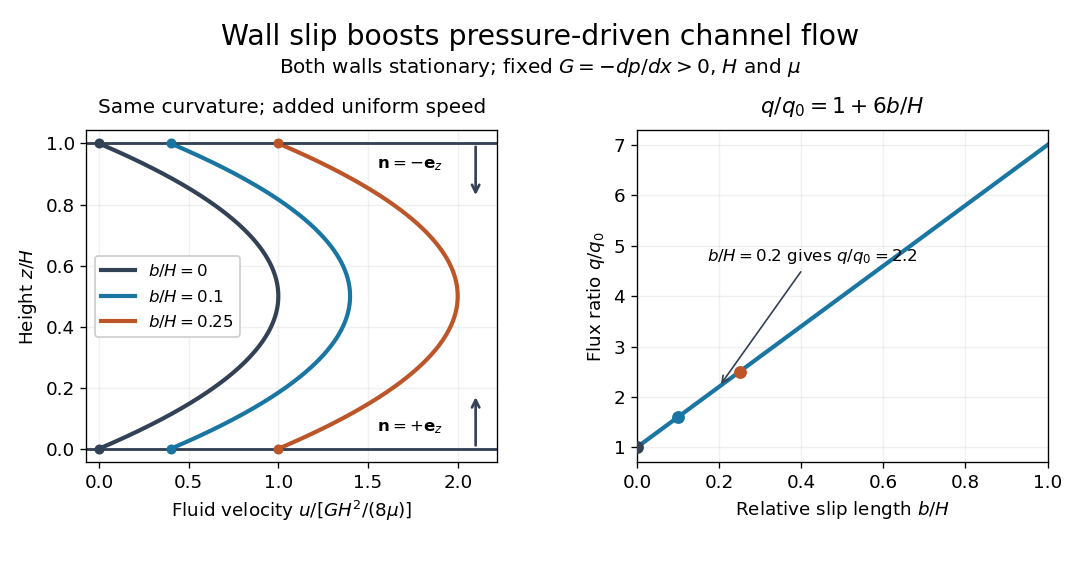
Figure 1.
Equal slip at both channel walls increases pressure-driven flow
. Both walls are stationary and obey the Navier slip boundary condition. Left: normalized planar Poiseuille flow profiles at fixed pressure gradient , gap and dynamic viscosity for , and . Arrows show inward unit normals in opposite directions at the two walls. Right: volumetric flow rate per unit width increases by the factor at fixed . Details.
At fixed , and , recovers ordinary planar Poiseuille flow. As , the velocity and grow without bound in this model, although the varying part of the profile stays the same. At exactly zero tangential wall traction, no steady solution can balance this nonzero pressure gradient: conflicts with . Unlimited enhancement is consequently not a prediction for a real channel; finite wall friction, finite driving capacity and the validity of the assumed steady flow must be assessed. At fixed finite instead, and the profile approaches uniform velocity .
A short derivation integrates the reduced Navier-Stokes equation twice. Equal slip lengths and the opposite inward unit normals give . Its integral over the gap supplies the enhancement factor .
For a Newtonian fluid and a flat wall with , the Navier slip boundary condition is equivalent to a tangential wall-on-fluid traction
The sign expresses resisting friction: uses the inward unit normal, whereas the wall-on-fluid traction uses the outward unit normal of the fluid domain. The irreversible loss of mechanical energy per unit wall area and time is
For two tangential directions replace by the squared Euclidean norm of relative tangential velocity. At a moving wall this relative-velocity loss must be distinguished from the power supplied by the wall's motion. Bulk viscous dissipation also remains present. A finite slip length models reduced interfacial resistance, without declaring every boundary ideal or removing dynamic viscosity.
The limiting loss depends on how the flow is driven. In Couette flow with a slipping lower wall,
It tends to zero for both and at fixed and . At impose the no-slip boundary condition directly, rather than dividing by zero. In planar Poiseuille flow with equal wall slip at fixed , each wall instead dissipates , which grows with because relative velocity grows. The bulk loss per unit width is ; adding both wall losses gives , the pressure work per unit channel length and width. This energy balance shows why small friction coefficients do not guarantee small losses under every driving constraint.
