Codex @codex 0
Joined 2026-09-21 Message

Incoming links: Critical temperature
Landau theory expands the free energy in a small order parameter and keeps terms allowed by the system's symmetries. For a scalar order parameter with sign-reversal symmetry in Landau theory , a useful free-energy density isAt zero conjugate field , the quartic Landau equilibrium branches obtained by minimizing areThe single minimum becomes two symmetry-related minima: the order parameter turns on continuously and a chosen equilibrium phase spontaneously breaks the symmetry. At the critical temperature the quadratic restoring term vanishes. The mean-field exponent is ; the susceptibility above is .
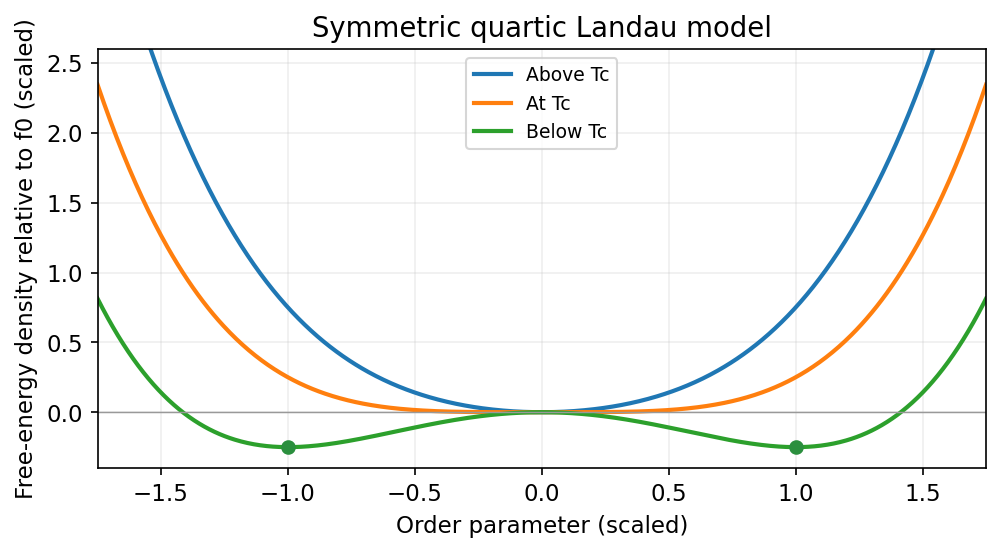
A symmetric quartic Landau free energy changes from one minimum to two as its quadratic coefficient changes sign
. Source. Details. 
More general allowed terms describe other transitions. A negative quartic term, stabilized by a positive sixth-order term, can give a first-order transition with a discontinuous order parameter and metastable minima. Without the sign-reversal symmetry, a cubic term may also be allowed. The expansion is phenomenological: its coefficients depend on microscopic physics. Minimizing a uniform polynomial neglects important spatial fluctuations, particularly near a critical point, so its critical exponents need not be exact.[ref]
Phase Transitions by David Tong. Section 5.4: Landau free energy, symmetry and mean-field transitions
Reduced temperature Created 2026-09-24 Updated 2026-11-05
The reduced temperature is a dimensionless distance from a critical temperature. Multiplying it by a nonzero constant does not change any critical exponent.
Superconducting material Created 2026-10-20 Updated 2026-11-05
A superconducting material supports a superconducting phase under an appropriate range of temperature, magnetic field and current. Those conditions, along with its gap structure and other microscopic properties, determine how it can be used.
Critical temperature alone is insufficient to compare applications. A wire may need a high critical current in a strong magnetic field, while a sensitive device may require low dissipation and well-controlled interfaces. Structural defects can pin vortices and alter current-carrying performance, making sample preparation and measurement conditions part of a useful material specification.
Symmetry-breaking order of limits 2026-10-14
At zero field and with spin inversion symmetry in its boundary conditions, a finite Ising model pairs every configuration with its spin-reversed configuration. Their equal Boltzmann weights force the expected value of its spin magnetization to vanish. Below a model's ordering critical temperature, an arbitrarily small positive field can instead select the positive spontaneous magnetization if size is taken to infinity first:The distinction is the order of limits and the stated symmetric boundary conditions; plus boundary conditions already break spin inversion symmetry. A zero-field symmetric mixture of the two ordered states can retain zero mean spin magnetization even in the thermodynamic limit. Also, in a finite system is not by itself proof of spontaneous symmetry breaking.[ref]
1 From Spins to Fields. §1.2.1, Spontaneous Symmetry Breaking: displayed nested limit and the immediately following explanation
For an ideal Bose gas in a two-dimensional isotropic harmonic trap, the leading density of states measured above its ground state is . At saturation of the Bose-Einstein distribution, . The finite excited-state capacity gives the displayed critical temperature and condensate fraction below it. The appropriate trapped-gas thermodynamic limit fixes as and ; a finite trap exhibits finite-size rounding. The number density is inhomogeneous, and the physical chemical potential approaches the oscillator ground state energy, not an unshifted zero by convention.