The differential geometry of smooth surfaces studies their induced Riemannian metrics and intrinsic or extrinsic curvature. The first fundamental form measures lengths, while the second fundamental form and shape operator describe bending in an ambient Euclidean space. A regular parametric surface must have linearly independent tangent vectors : otherwise its parameters cannot provide a manifold chart with two independent directions.
For a sphere of radius , use colatitude and longitude :Thus a change has arc length : equally spaced longitudes draw closer together toward a pole. The coordinate degeneracy at the poles belongs to this parametrization, not to the smooth surface.
Both principal curvatures of the sphere have magnitude and the same sign, giving Gaussian curvature . A plane has , and a circular cylinder also has because one principal curvature vanishes. These three familiar shapes show why visible bending alone cannot measure intrinsic Gaussian curvature.
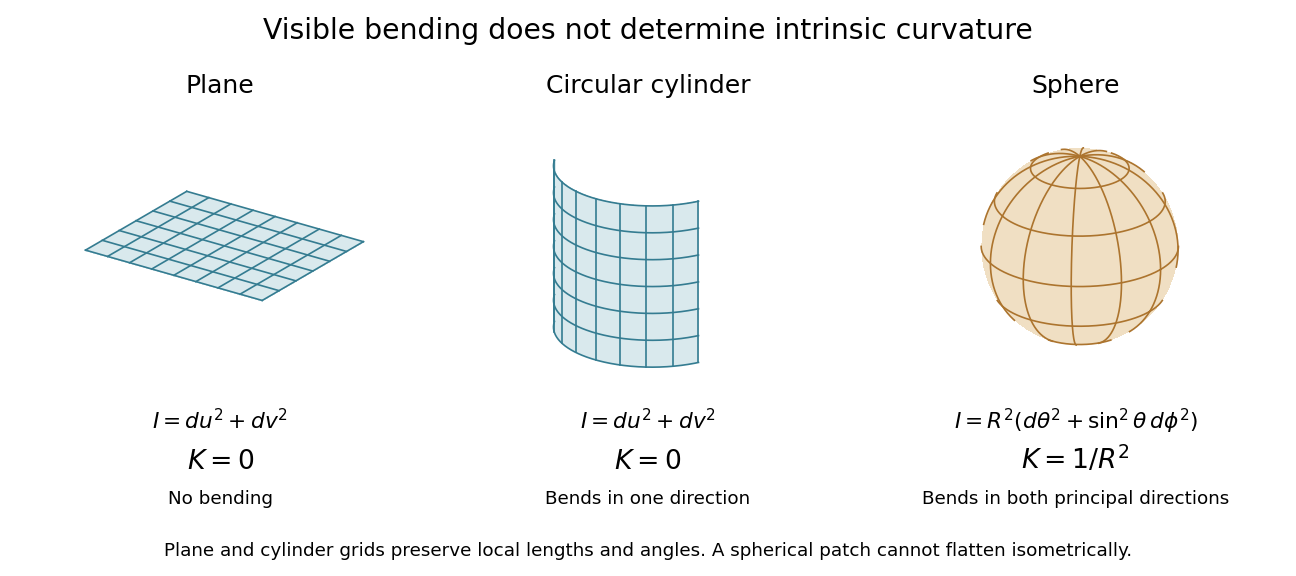
Visible bending and Gaussian curvature are different measurements
. Details. Articles by others on the same topic


Differential geometry of surfaces is a branch of mathematics that studies the properties and structures of surfaces using the tools of differential calculus and linear algebra. It focuses on understanding the geometric characteristics of surfaces embedded in three-dimensional Euclidean space (though it can extend to surfaces in higher-dimensional spaces).