Suppose a perturbation satisfies , with . Absolute homogeneity of a norm and the dual norm definition giveFor nonzero , divide it by its norm to obtain an input in the unit ball; for zero perturbation the inequality is immediate. This is an exact error bound for a linear functional, for every perturbation in the stated input set.
For and a budget , the sharp output-error bounds are for , for , and for . Scale the maximizing vectors from the preceding example by to attain the positive endpoints; their negatives attain the negative endpoints. The L1 norm budget constrains a total absolute error; the maximum norm budget permits each coordinate to have that error separately. These budgets define nested sets and carry different information.
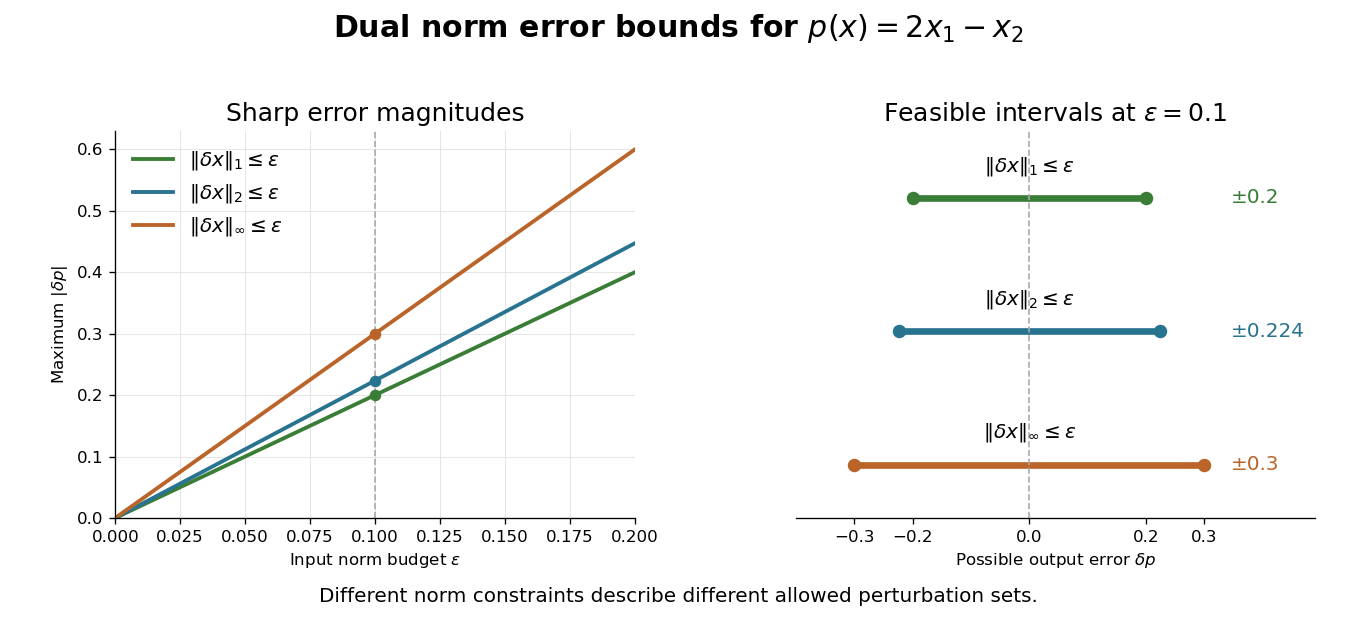
Dual norms give exact worst-case errors for the same linear functional
. Original bounds for . Lines show the sharp error magnitude as the stated input norm budget increases. The right panel gives the full possible error intervals at ; these are the full feasible intervals for the stated deterministic bounds. Details.
The coordinates must use the stated scale and units. Rescaling one coordinate changes both its coefficient in and the meaning of its input budget. For a nonlinear differentiable function with scalar values, its Fréchet derivative at the base point is a linear functional governing the first-order response. An exact finite-perturbation error bound additionally needs control of the Taylor remainder or of the Fréchet derivative along the path.
Articles by others on the same topic
There are currently no matching articles.