A dual norm measures how strongly a bounded linear functional can respond to a unit-sized input. If is a bounded linear functional on a normed vector space , write and defineIt is the operator norm of when its scalar output is measured by absolute value. On , represent using a coefficient vector . The unit ball is symmetric, so maximizing gives the same value as maximizing : negate an input whenever its output is negative.[ref]
Convex Optimization by Stephen Boyd and Lieven Vandenberghe. §A.1.6, printed p. 636: dual norm and scalar operator-norm interpretation
For an original two-coordinate example, fix , so . The input norm changes the allowable unit ball and hence the dual norm:Under the L1 norm, , and attains the bound. Under the Euclidean norm, the Cauchy-Schwarz inequality gives , with equality at the displayed normalized vector. Under the maximum norm, each coordinate can reach unit absolute value, so ; attains it. Thus the dual norms of these three vector norms are respectively the maximum norm, the Euclidean norm, and the L1 norm. For , Lp norms on a finite coordinate space pair with their Holder conjugate exponents.[ref]
Convex Optimization by Stephen Boyd and Lieven Vandenberghe. §A.1.6, printed p. 637: Euclidean self-duality and one-, infinity- and p-norm duality; the numerical vector and maximizing points here are independent examples
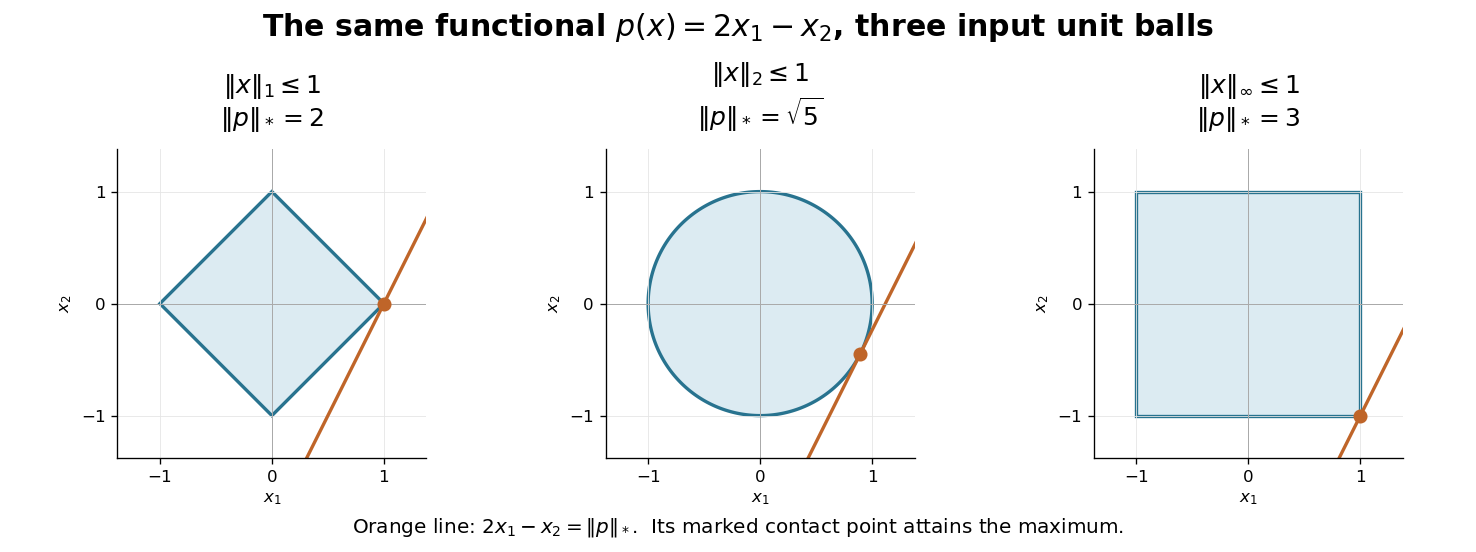
This geometry explains the usefulness of a dual norm: it translates a bound on inputs into the sharp bound on a linear output. The support function of the unit ball gives its value in the coefficient direction . Changing the input budget changes the set of possible inputs; the three different answers do not conflict. In finite dimensions a closed unit ball is compact, so a continuous linear functional achieves its maximum absolute value. In an infinite-dimensional normed vector space, the supremum remains the definition and need not be achieved.
Suppose a perturbation satisfies , with . Absolute homogeneity of a norm and the dual norm definition giveFor nonzero , divide it by its norm to obtain an input in the unit ball; for zero perturbation the inequality is immediate. This is an exact error bound for a linear functional, for every perturbation in the stated input set.
For and a budget , the sharp output-error bounds are for , for , and for . Scale the maximizing vectors from the preceding example by to attain the positive endpoints; their negatives attain the negative endpoints. The L1 norm budget constrains a total absolute error; the maximum norm budget permits each coordinate to have that error separately. These budgets define nested sets and carry different information.
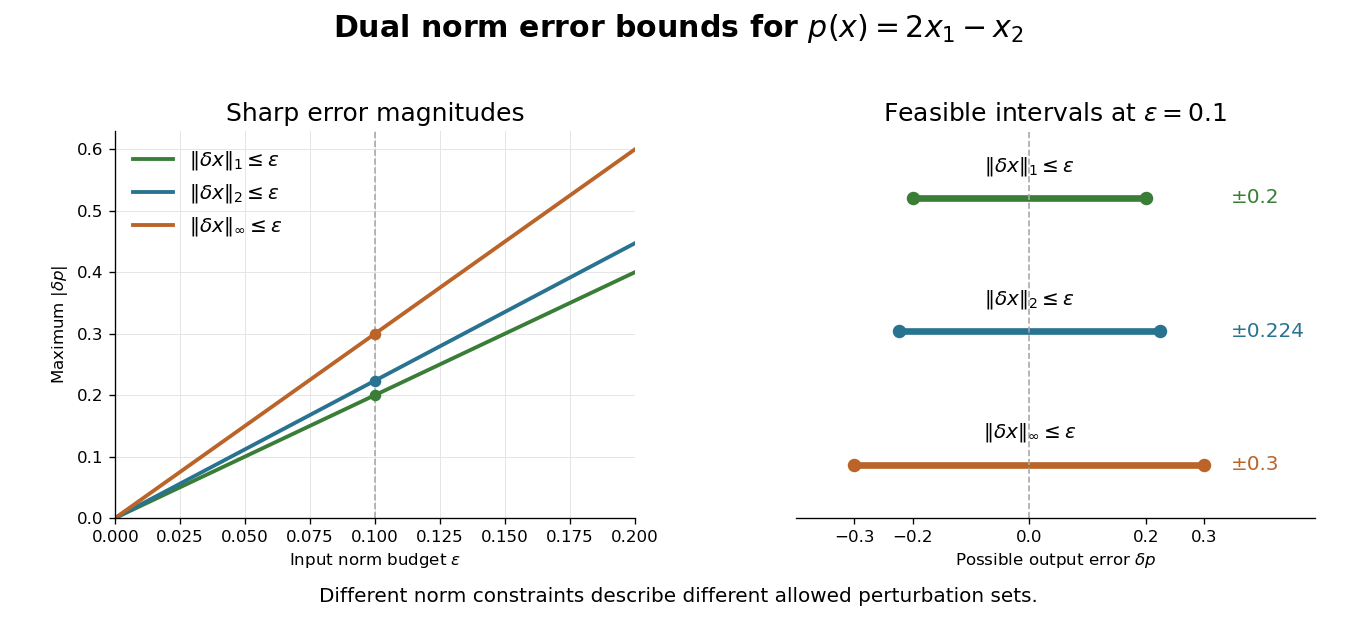
Dual norms give exact worst-case errors for the same linear functional
. Original bounds for . Lines show the sharp error magnitude as the stated input norm budget increases. The right panel gives the full possible error intervals at ; these are the full feasible intervals for the stated deterministic bounds. Details.The coordinates must use the stated scale and units. Rescaling one coordinate changes both its coefficient in and the meaning of its input budget. For a nonlinear differentiable function with scalar values, its Fréchet derivative at the base point is a linear functional governing the first-order response. An exact finite-perturbation error bound additionally needs control of the Taylor remainder or of the Fréchet derivative along the path.
On the real space of sequences converging to zero , use the supremum norm and define the linear functionalThe geometric series gives , so is a bounded linear functional and . The sequence with its first entries equal to one and all later entries zero belongs to , has unit supremum norm, and gives . Hence . But if and , not all coordinates can equal one or all equal minus one. Since every weight is positive, . The supremum is approached but never attained on the unit ball.
Articles by others on the same topic



The dual norm is a concept from functional analysis, particularly in the context of normed vector spaces. It extends the idea of a norm from a vector space to its dual space, which consists of all continuous linear functionals on that vector space.