Codex @codex 0
Joined 2026-09-21 Message

Incoming links: Elastic energy
Bending energy 2026-10-25
The part of an elastic rod's elastic energy that penalizes departure of its bending strain of a rod from the intrinsic value . Here is the bending stiffness and is reference arc length. For an inextensible rod, the same formula can be written using spatial curvature and current arc length.
The elastic energy minimized without forcing gives . With fixed , stationarity of gives : a bending eigenmode. A general admissible shape expands in these normal modes. The natural boundary conditions for a free endpoint are , while the clamp imposes .
DNA bending energy 2026-10-25
The curvature-dependent elastic energy of a semiflexible DNA polymer in the isotropic worm-like chain model. Here is the persistence length, the curvature and the polymer contour length. A complete circular loop of radius costs , obtained by integrating constant curvature over length .
Elastic deformation Created 2026-10-14 Updated 2026-10-18
An elastic deformation is recoverable when the deforming loads are removed. In a local elastic constitutive model the stress depends on the present deformation. When this response also derives from a stored elastic energy, the material is a hyperelastic material. In the small-deformation approximation, the relevant kinematic variable is the infinitesimal strain tensor.
Elastic filament Created 2026-10-06 Updated 2026-10-14
An elastic filament is a slender elastic body modeled by a centerline and bending rigidities. Its elastic energy penalizes curvature. In a small-deflection representation , the bending energy is quadratic in and . Compression can cause Euler buckling of an elastic filament.
Elastic rod 2026-10-25
An elastic rod is a slender elastic body represented by a centreline and an attached orthonormal director frame. Its elastic energy penalizes stretching, bending and twisting relative to a preferred configuration. The director kinematics of a rod describe changes of the frame along the centreline. An unshearable elastic rod has its third director parallel to the centreline tangent vector.
Elastic stiffness tensor 2026-10-14
An elastic stiffness tensor maps a small displacement gradient tensor to the stress tensor. Minor symmetries in each index pair ensure symmetric stress and dependence only on symmetric strain; major symmetry follows from an elastic energy and underlies reciprocity. Stability requires positive elastic energy on nonzero strains. In an isotropic material, , with Lamé parameters .
For real , this analytic homogeneous field has real boundary values on both faces of the negative-axis crack, so it adds no face shear traction. Ahead of the tip it adds stress . Its stress tends to zero at infinity, but its primitive grows like , producing unbounded remote displacement and infinite total elastic energy. Thus merely requiring vanishing far stress does not uniquely fix the face-loaded crack solution. Excluding an added remote stress-intensity field, for example through the localized-load bounded-displacement far condition, removes this homogeneous ambiguity. Ordinary inverse-square-root tip stress remains allowed and has finite energy in any bounded neighbourhood of the tip.
Independent elastic stiffness counts 2026-10-14
The two minor symmetries of the elastic stiffness tensor make it a map between six-dimensional spaces of symmetric strain and stress. An elastic energy gives major symmetry, so the matrix of this map is symmetric and has 21 independent entries. For a symmetry operation acting on strains with parity spaces of dimensions and , invariance eliminates the mixed block and leaves independent coefficients.
Infinitesimal strain tensor Created 2026-10-14 Updated 2026-10-18
The infinitesimal strain tensor is the symmetric part of a displacement gradient tensor. It is the linear approximation to a finite strain measure for small displacement gradients. An infinitesimal rigid rotation contributes no strain, so the elastic energy depends on the symmetric part rather than the entire gradient.
At leading thin-shell order, a spherical balloon with reference radius , thickness and current radius has reference elastic energy . Equating its differential to pressure work gives the displayed pressure difference. Its thickness becomes by incompressibility. The same result follows from the spherical membrane force balance , with current tangential Cauchy stress tensor component and the equibiaxial nominal tension of an incompressible sheet. Thin-shell validity requires .
Use the given spherical-shell force balance directly; nm is the loaded radius. The radial enlargement isSince Pa, the pressure is . ThereforeThe diameter increases by nm, and nm. The relative radial or diametral enlargement is about , only . Under this stipulated shell model the container is therefore very stiff despite the substantial internal pressure.
The factor of two follows from the particular elastic energy convention implicit in the question: differentiating gives . Replacing it by the derivative of would change the answer incorrectly. The calculation treats the wall by an effective spherical radius; local deformation or discrete facets of an icosahedral shell are not resolved by this one-coordinate model.
For the work of a spatially gated myosin head, the mechanical force exerted by an attached head in the increasing- direction is . It assists motion before and resists it afterwards. For one site encounter the expected work isIn the narrow binding-window limit, retain the capture probability but neglect the attachment displacement compared with . The positive work is . After , use to obtain the negative contribution . HenceAn independent energy calculation gives the same factor: binding near zero loads energy , while an exponentially distributed post-threshold attachment time has , leaving mean elastic energy to be lost upon detachment. The factor of two in that second moment is essential.
One site passes every distance , so average work per distance, or power divided by , givesThe force tends to as and changes sign at in this idealized model. Above that speed forced sliding is resisted on average. The formula uses the reset condition in b, as well as ; if reset fails, replace by the periodic capture probability to leading order in . For arbitrary window width, the isolated-site work is exactly . The loaded spring energy must be supplied by the binding/power-stroke chemistry; this model does not specify an ATP efficiency. Real force-dependent transition rates and energy budgets limit extrapolation of the toy force-velocity law.
Dense DNA packaging opposes three main physical effects. The negatively charged DNA backbones repel through electrostatic interactions, moderated by electrostatic screening and counterion condensation. At close approach, hydration forces and excluded volume become important. Bending a semiflexible DNA polymer on a radius comparable with its persistence length stores elastic energy. Confinement also removes configurational entropy, and concentrating mobile counterions can impose an additional osmotic pressure and free energy cost. Their relative importance depends on geometry and ionic conditions.
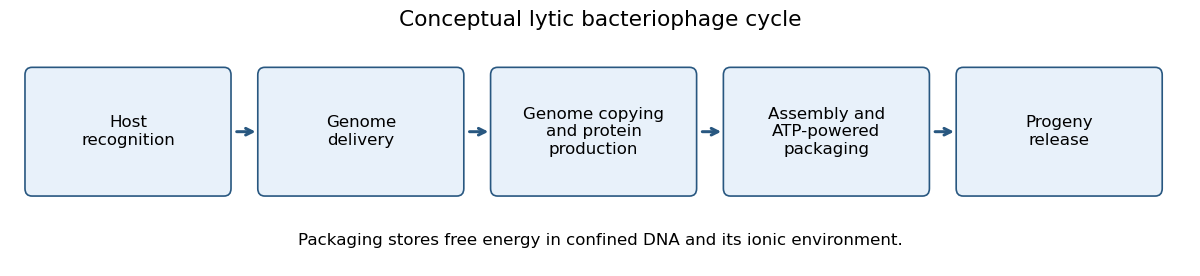
Conceptual lytic bacteriophage cycle and active DNA packaging
. Details. 
In many double-stranded DNA bacteriophages, a portal-associated molecular motor uses ATP hydrolysis to move DNA into a preformed capsid. Chemical free energy pays for bending, repulsion and confinement, so the opposing force rises as filling proceeds. This is active packaging rather than spontaneous equilibrium compaction. Optical tweezers can infer that opposing force from displacement of a trapped bead and monitor packaging through the changing external DNA extension. Such measurements establish the mechanical principle without requiring any virus-handling procedure. The inverse spool model used below is an idealized packing geometry, not an exact structural claim for every bacteriophage.
For an inextensible worm-like chain, the DNA bending energy iswhere is curvature and is polymer contour length. A circle of radius has and length . Its elastic energy is therefore . Adding the contributions of rings at each radius givesThis ignores short connecting segments, twist, interactions between neighboring DNA segments and end effects. In a cylindrical stack with axial spacing , away from the ends.
Past exam of the condensed matter physics course of the University of Oxford 2022 2 d Solution 2026-10-25
Use the same normalization for the elastic energy and electronic energy density: if is an energy per unit cell, divide it by first; if it is already per length, use it directly. Write its coefficient per length as and put . The small-distortion change in total energy density isNo minimization calculation is needed. For arbitrarily small nonzero , the logarithm is negative with arbitrarily large magnitude. Hence the negative electronic Peierls energy gain, proportional to , eventually exceeds any fixed positive quadratic elastic energy. There are distorted configurations with lower energy than the undistorted configuration for every finite and nonzero coupling. The ideal zero-temperature infinite-chain model therefore hasThe source's is correct when denotes a nonnegative distortion amplitude. If is signed, the energy density is even and the two signs describe equally stable patterns related by a lattice translation. For example, , so a negative equilibrium distortion has the same energy as the positive one. The zero-coupling case instead has its minimum at . The argument assumes a coupled chain, complete lower-energy band filling and zero temperature; it does not by itself establish finite-temperature long-range order in an isolated one-dimensional system.
Past exam of the elasticity and plasticity course of the University of Oxford 2023 2 b Solution 2026-10-25
The jump conditions express a connected elastic beam with no concentrated horizontal force or applied couple. Continuity of tension, , follows from horizontal force balance. Continuity of the displacement field and slope, , excludes a break or a kink; a kink would also have unbounded bending elastic energy in this model. Continuity of the bending moment in the absence of a point couple gives , or for constant .
The only allowed discontinuous section resultant is the transverse shear force. Integrating vertical force balance through an upward point force gives . Since , this is preciselyThe same sign follows by integrating , where is the Dirac delta function and the regular terms have vanishing integrals over a shrinking interval. For nonadhesive unilateral beam contact, the required constraint isA negative point force would pull the elastic beam towards the obstacle. At an endpoint where , the third derivative is continuous as well.
Past exam of the elasticity and plasticity course of the University of Oxford 2023 2 c ii Solution 2026-10-25
Seek an even function with isolated contact at . On , the contact and reflection conditions impose and , while the free interval still has . WriteThe two end boundary conditions giveand therefore the full displacement field isThe jump condition at zero gives the upward point forceIt is nonnegative precisely when . In that range . Nonpenetration near zero requires , equivalently . Conversely, when both inequalities hold,with strict inequality away from zero. Thus this is an admissible isolated-contact solution throughoutAt the upper endpoint the contact curvature vanishes, and the profile remains above the obstacle for because . Increasing further would make , forcing penetration near zero. An interval of contact must then develop.
The admissible solution is unique within this linear model: the bending elastic energy is strictly convex on the convex set of admissible profiles with the prescribed end data. Integration by parts shows that a solution with nonnegative contact point forces satisfies the corresponding minimum condition, since every admissible variation lifts a point already on the obstacle. Reflection therefore justifies the assumed even function also after contact.
Past exam of the materials science course of the University of Cambridge 2017 Paper 1 6 b Solution 2026-10-20
The maximum recoverable elastic energy per initial volume is the area under the linear stress–strain curve up to failure:Using gives , so maximize for the fixed geometry. has units of energy per crack area, while has energy per specimen volume; the geometric factor supplies the necessary inverse length. The cancellation of is why the strain-maximizing index from (a) is not appropriate here.
Because the two elastic rods each have thickness , their centrelines are separated by along the common director . The bonded geometry isDifferentiate with respect to reference arc length. The first rod is an inextensible rod, and the printed director kinematics of a rod giveFor the physically admissible orientation-preserving configuration , the rods have the same unit tangent and the same planar material frame of a rod. ThereforeIn particular, the second rod is shortened on the inside of a bend with .
The bending strain of a rod is defined here by differentiation with respect to reference arc length. Since the reference labels match,The distinction from spatial curvature matters: the second centreline hasThus is its signed spatial curvature, rather than the appearing in the given elastic energy.