
The Rayleigh quotient measures the quadratic form of a self-adjoint operator per unit squared norm. For a nonzero vector and a finite-dimensional Hermitian matrix ,For a real symmetric matrix, replace the conjugate transpose by . More generally, for a self-adjoint operator on a Hilbert space, use for nonzero in its operator domain. On an eigenvector it returns the exact eigenvalue. Multiplying the vector by any nonzero scalar leaves the quotient unchanged, so it measures a direction rather than a chosen length.
For the symmetric matrix from the finite-dimensional spectral theorem example,The first value is not an eigenvalue: it is an average of the two directional responses. To see every direction, write the unit vector in the orthonormal eigenbasis. ThenThe largest value is along ; the smallest is along . A direction halfway between them has quotient . In the left panel, the color on the unit circle represents the quotient; in the right panel, the same values are plotted against the angle measured from .
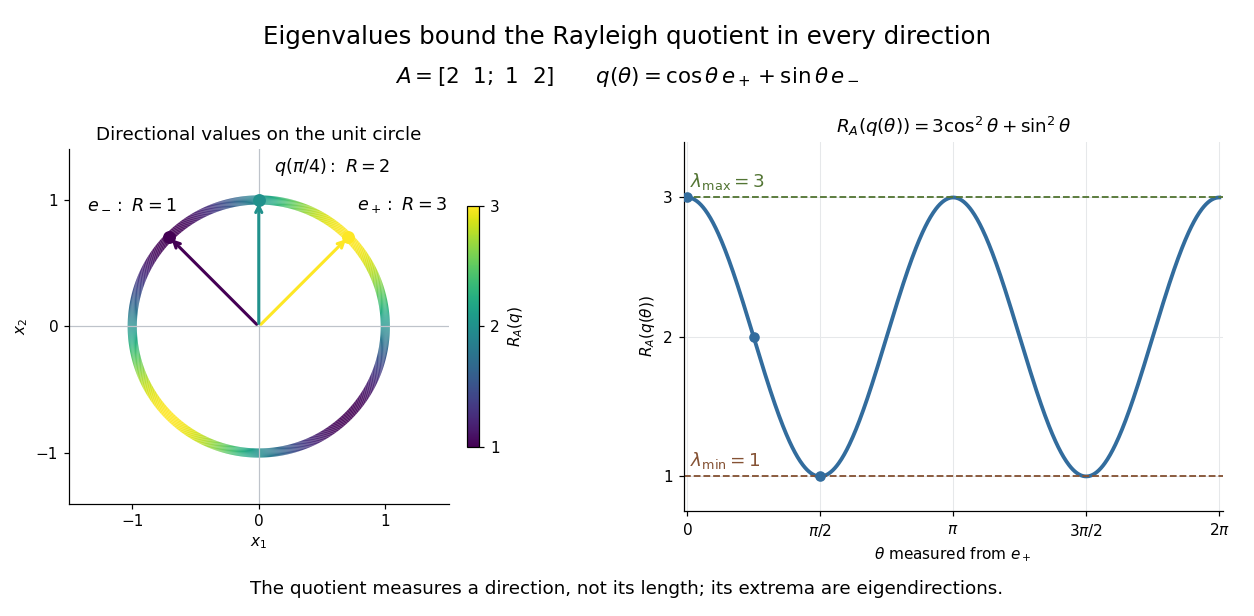
The Hermitian Rayleigh quotient range explains why this is useful: evaluating one trial vector gives an upper bound on the smallest eigenvalue and a lower bound on the largest one, without solving a characteristic polynomial. At an extreme eigenvector, a small angular error changes the quotient only quadratically. Near in this example, . This is the geometric reason for quadratic Rayleigh-quotient improvement for the power method and motivates the Rayleigh-Ritz method.
There is a concrete historical link with normal modes. In The Theory of Sound (1877), Volume I, Sections 88–89, Lord Rayleigh studies the period of a constrained trial vibration. He shows that the period has a stationary point at a normal mode and that a trial type bounds the longest natural period. These energy ratios are a mechanical setting for the modern Rayleigh quotient and generalized Rayleigh quotient; the book describes the result through vibration periods, rather than today's matrix notation.[ref]
https://archive.org/details/theorysound06raylgoog. Rayleigh, The Theory of Sound, Volume I, 1877, Sections 88–89, printed pp. 84–87


The Rayleigh quotient is a mathematical concept used primarily in the context of linear algebra and functional analysis, particularly in the study of eigenvalues and eigenvectors of matrices and linear operators.
New to topics? Read the docs here!