For the ideal Wannier-Mott exciton in energy bands whose edges occur at the same crystal momentum, the pair excitation energy, measured from the unexcited crystal, isHere is the pair's total crystal momentum; the last term is center of mass kinetic energy. For a permitted photon absorption transition with negligible recoil energy, . An electric-dipole selection rule and a nonzero transition matrix element are still needed: a bound state need not produce an observable spectral line. If the relevant energy band edges have different values of crystal momentum, a phonon can also be needed to conserve crystal momentum; subtracting a binding scale from a band gap alone does not specify the optical threshold.
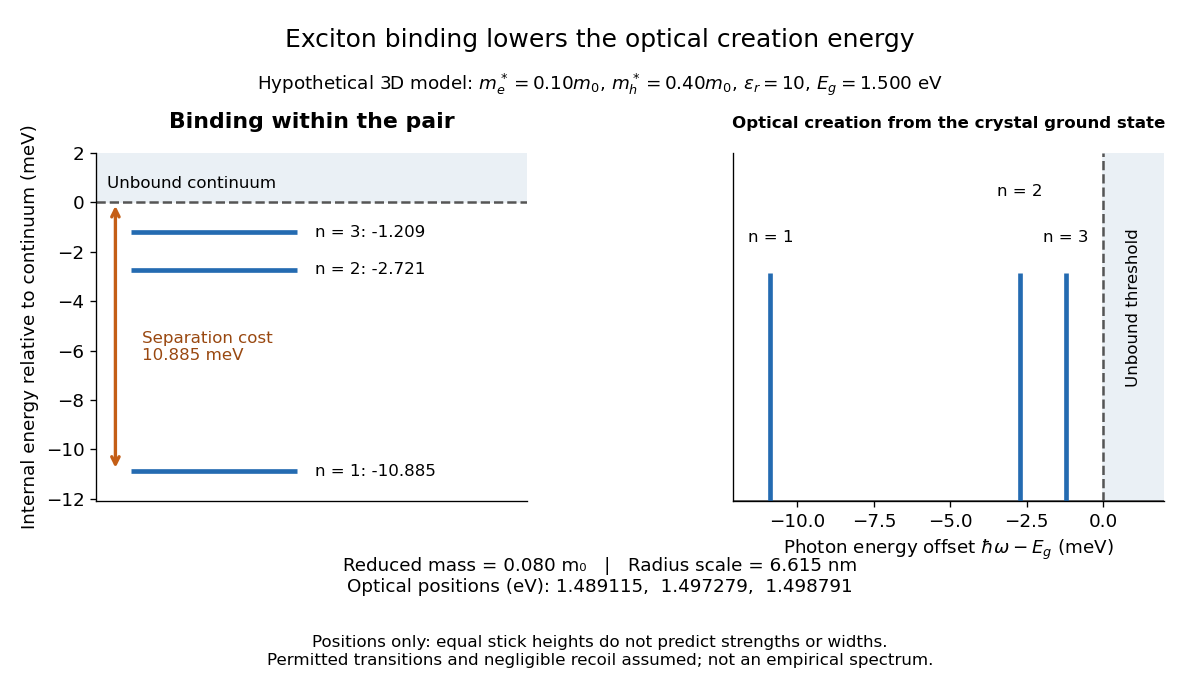

For example, the lowest internal bound state in this hypothetical model costs to create optically, yet needs only more to dissociate. The large creation energy and the small exciton binding energy answer different physical questions. An electron-hole recombination event can instead release excitation energy by photon emission or to other degrees of freedom; an emitted photon need not reproduce the original absorption energy if relaxation intervened.
In Giant Rydberg Excitons in Cuprous Oxide by Tomasz Kazimierczuk and others, a polished copper(I) oxide crystal was mounted without strain at . A tunable single-frequency dye laser scanned photon energy; balanced detection compared transmitted light with a reference beam. Transmission dips resolved spectral lines assigned to bound excitons through principal quantum number . Their convergence towards an unbound threshold supports a hydrogen-like internal series, with small systematic deviations.[ref]
Controls mattered: restricting broadband illumination improved resolution of high- excitons; lowering laser power or expanding its spot reduced interaction-induced suppression. Balanced detection suppressed source fluctuations. The measurement probes optical resonances, not individual Electron-electron hole trajectories or directly imaged radii. Electric-dipole selection rules favor P-envelope states in this material, unlike the hypothetical permitted lowest-state transition above. Finite resolution and crystal inhomogeneity affect spectral lines; the inferred binding series requires a continuum threshold and a model.[ref]
Giant Rydberg Excitons in Cuprous Oxide by Tomasz Kazimierczuk and others. pp. 3–5; supplement pp. 2–4 and 6–7, figure S3: selection rules, illumination tests, line corrections and deviations
Articles by others on the same topic
There are currently no matching articles.