The expected value premium principle charges the expected value of the covered loss plus a proportional margin. For a nonnegative random variable L with finite expected value, and a fixed dimensionless loading θ≥0, it setsHere θ=0 gives the expected claim cost alone; θ>0 gives a positive margin when E[L]>0. The loading is a fraction of the expected value, not of the largest possible claim size. Specify the covered period and use a consistent monetary valuation date. The rule itself does not determine θ. [ref]
Π(L)=(1+θ)E[L]=expected claim costE[L]+loading amountθE[L].
https://www.stats.ox.ac.uk/~winkel/bs4b11.pdf. Matthias Winkel, Actuarial Science II, §16.1, Definition 68 and Example 70
.Consider an explicitly toy one-year policy: it pays £1,000 with probability p=0.1, and zero otherwise. Write L=1000B, where B has the Bernoulli distribution with parameter p. The expected value is 1000(0.1)=£100. A loading θ=0.2 adds £20, making the premium £120. Neither the £100 expected value nor the £120 premium is a possible realized claim: the actual payment is £0 or £1,000. The first diagram separates these quantities. All numerical examples and both diagrams here are exact consequences of invented assumptions, not measured insurance data.
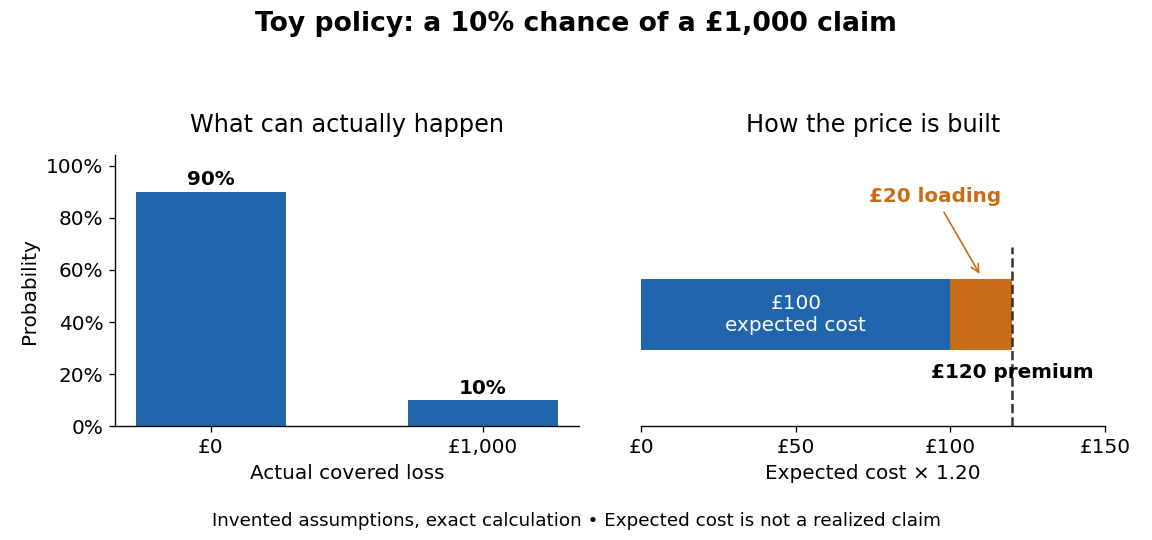

Why pay £120 for a loss whose expected value is only £100? Conditional on the insurer meeting its obligation, the policyholder replaces an uncertain £1,000 bill with a known £120 payment. The insurer can combine many such policies, so a few claims are funded by premiums from the whole pool. Winkel develops this motivation and the importance of independence in §15.2 of [ref].
To see the pooling mechanism precisely, suppose there are n toy policies with mutually independent Bernoulli random variables B1,…,Bn, each of parameter 0.1. Every claim size is £1,000, with at most one claim per policy. The aggregate claims model isUsing linearity of expectation and addition of variances for independent random variables, the expected value and standard deviation of this binomial distribution aggregate areThus 100 policies have expected aggregate claims £10,000 and aggregate standard deviation £3,000; 10,000 policies have expected aggregate claims £1,000,000 and aggregate standard deviation £30,000. Total uncertainty grows, but much more slowly than the expected value. Per policy, Sn/n has expected value £100 and standard deviation £300/n. Equivalently, the aggregate coefficient of variation, its standard deviation divided by its positive expected value, isIt falls from 300% for one policy to 30% for 100 policies and 3% for 10,000. This is the useful beauty of independent pooling: an erratic individual cost becomes a comparatively stable average cost. The law of large numbers describes the corresponding convergence of the average toward its expected value.
Sn=1000∑i=1nBi,∑i=1nBi∼Binomial(n,0.1).
E[Sn]=100n,Var(Sn)=10002n(0.1)(0.9)=90000n,SD(Sn)=300n.
E[Sn]SD(Sn)=np1−p=n3.
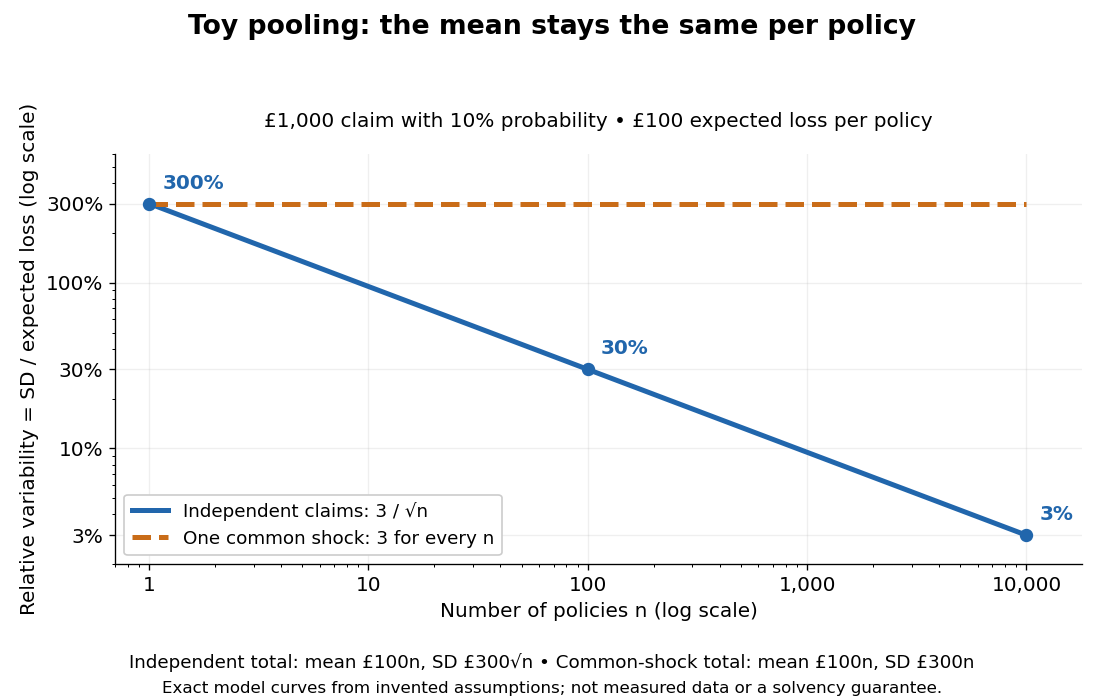
Toy claim pooling: relative variability falls with independence but survives a common shock
. Details. 
At the same fixed loading θ=0.2, total premium is Π(Sn)=120n, with expected surplus before other outgoings 120n−100n=20n. The loading margin divided by the aggregate standard deviation is 20n/(300n)=n/15. This ratio rises with n under our independence assumption; it is not a specified loss probability. For n=100, premiums total £12,000, but 13 claims cost £13,000. The one-year probability that claims exceed collected premiums is exactlyA positive loading therefore leaves about a 19.8% chance of a one-year claims deficit in this toy pool. A claims deficit need not mean insolvency if capital is available. This calculation assumes premiums are collected before claims and ignores expenses and investment income; it is not an ultimate ruin probability.
Pr(S100>12000)=∑k=13100(k100)(0.1)k(0.9)100−k≈0.19818.
The expected value premium principle also has a revealing limitation. With a common fixed θ, linearity of expectation gives Π(L1+L2)=Π(L1)+Π(L2) even without independence. Pooling therefore does not automatically reduce the premium per policy under this rule, and two losses with the same expected value receive the same premium regardless of their variance or large-loss probabilities. Any decision to change the loading after pooling requires information beyond the formula.
Dependence can remove the stability benefit. For arbitrary square-integrable losses, the aggregate variance includes their covariances:In the extreme toy common-shock model, every policy has Li=1000B for the same Bernoulli random variable B. Each policy still has expected value £100, so total premium is still 120n, but Sn=1000nB has standard deviation 300n and coefficient of variation 3 for every n. With probability 0.1, all policies claim together and losses exceed premiums by 880n. The second diagram compares this model with independent pooling. Real shared events can invalidate independence; Winkel uses flood claims as an example in §15.2 of Actuarial Science II. The common-shock curve is an illustrative limiting model, not a fit to flood data.
Var(∑i=1nLi)=∑i=1nVar(Li)+2∑i<jCov(Li,Lj).
The earlier n−1/2 relative-variability calculation needs finite variance and the stated model of independent and identically distributed random variables. A finite expected value alone suffices to define the premium but does not imply finite variance. The rule makes no promise of solvency: losses, available capital and the timing of payments must be modelled separately. In the classical risk model, claim arrival rate λ and mean claim size μ give premium rate c=(1+θ)λμ; relative safety loading is then θ. That model tracks capital through time and asks for ultimate ruin probability, a different question from calculating an expected margin. [ref]
https://www1feb-uva.nl/ke/act/people/kaas/Recap123456.pdf. Rob Kaas's Modern Actuarial Risk Theory formula sheet, page 2, Ruin theory
. Under quota share reinsurance, the reinsurer can apply the expected value premium principle to its ceded fraction (1−α)S using its own loading, which need not equal the direct insurer's loading. Articles by others on the same topic (0)
There are currently no matching articles.