Retain the first number states of a quantum harmonic oscillator. Let be the orthogonal projection onto their span and compress , , restricted to this span. The compressed annihilation operator satisfiesFor , the two products give and ; on the top state they give and . Thus, with ,On every quantum superposition of , this commutator acts exactly as . For a normalized retained state with coefficients ,Small probability at the cutoff must therefore be judged relative to for this expectation. For , the diagonal of is , with zero trace.
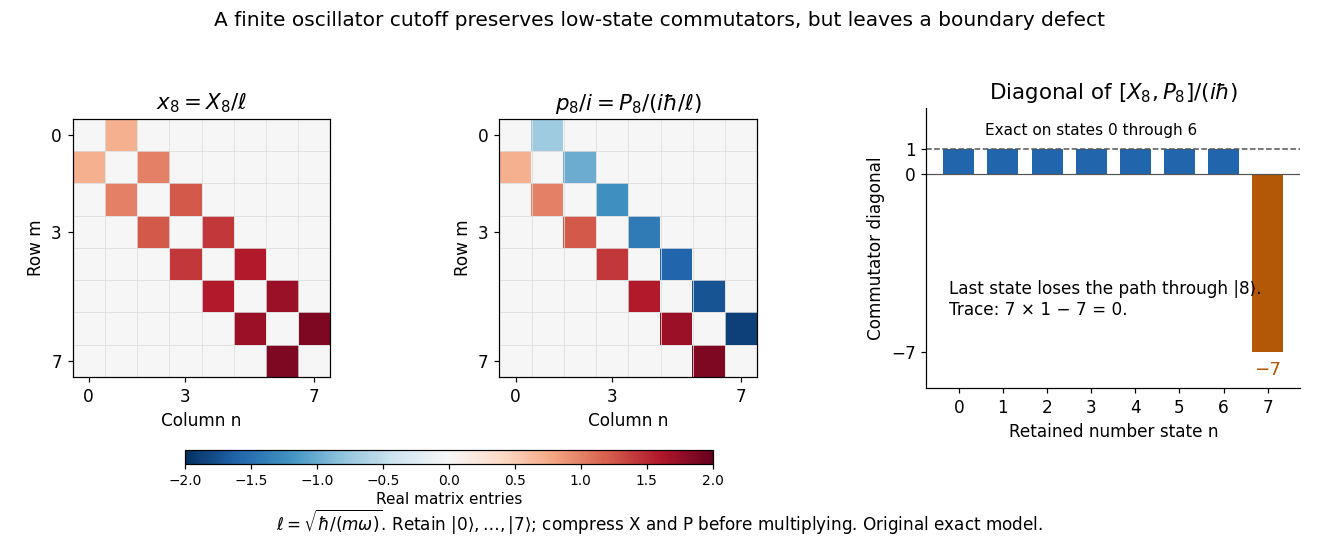

This is unavoidable for finite matrices: trace of a matrix commutator gives , whereas . Compression does not preserve products: can use intermediate states outside the retained span, while cannot. Accordingly, compressing the full oscillator Hamiltonian operator gives , but building it from the compressed squares givesThe two prescriptions agree on lower number states and disagree at the boundary. In the infinite oscillator, the canonical commutation relation holds on the common invariant dense subspace of finite number state combinations. Its unbounded position and momentum operators do not admit the finite trace argument; writing the formal identity does not assert that both products act on every vector of the Hilbert space.
Articles by others on the same topic
There are currently no matching articles.