The operator formalism describes a quantum system using states in a Hilbert space and observables represented by self-adjoint operators with suitable domains on that Hilbert space. Evolution and correlation functions are computed from Hamiltonian operators and their time-ordered products. For free quantized fields, the oscillator construction gives a Fock space. The operator-path-integral equivalence relates these matrix elements to integrals over field histories.
Matrix mechanics represents an observable by an array of matrix elements between chosen quantum states. In an orthonormal basis of energy eigenstates, each a stationary state, the diagonal entries of the Hamiltonian operator are the energy levels; off-diagonal entries of other observables describe couplings between those states. The same array can therefore answer two different questions: which values can a measurement return, and which pairs of energy eigenstates can a specified interaction connect? The eigenvalues answer the first question; the relevant matrix elements, together with the energy differences, answer the second.
This makes linear algebra a practical language for atomic physics. One can calculate energy levels, electric-dipole selection rules and probability amplitudes for transitions without assigning an electron an unobserved classical orbit. The three-state example below separates a missing optical coupling from a missing energy level; the finite oscillator commutator boundary defect explains why a finite array requires care when approximating a quantum harmonic oscillator.
Choose normalized energy eigenstates of a time-independent Hamiltonian operator, with , and assume first that they form a complete orthonormal basis. For a pure state and an observable ,The column index labels the input basis vector, and row labels the output component. Self-adjointness gives , so a finite example is a Hermitian matrix. A matrix element can be negative or complex; by itself it is not generally a probability. The Born rule assigns measurement probabilities using the eigenstates of , which need not be energy eigenstates. For an unbounded observable, these expressions require a suitable operator domain; a system with continuous spectrum also needs the corresponding spectral integrals.
In the Heisenberg picture, an observable without explicit time dependence hasHere is the reduced Planck constant. An emitted photon on a transition with has positive angular frequency . The sign of the array's quantum phase follows its index convention; it is not a negative measured photon frequency. The frequencies involve differences of energy levels, rather than the absolute values . Adding a constant to leaves these frequencies unchanged.
Insert the complete orthonormal basis between two linear operators:The sum runs over intermediate states. The second identity follows by cancellation of ; it makes every term in the product acquire the same time factor . This is a useful reason for matrix multiplication: it composes the two indexed arrays consistently with the addition of transition frequencies. It does not multiply matching entries independently. Swapping and generally changes the intermediate-state sum and hence the result.
Consider an original ideal quantum system with positive scales andInterpret as one component of an electric dipole moment, so its coupling to the corresponding electric field is the electric-dipole interaction . The gaps are , but : this interaction has no direct first-order coupling. The nonzero squared matrix elements are and . These are coupling weights; actual spectral line intensities also depend on populations and radiation factors. In particular, there is no promise that an experiment populates the upper state of every allowed transition.
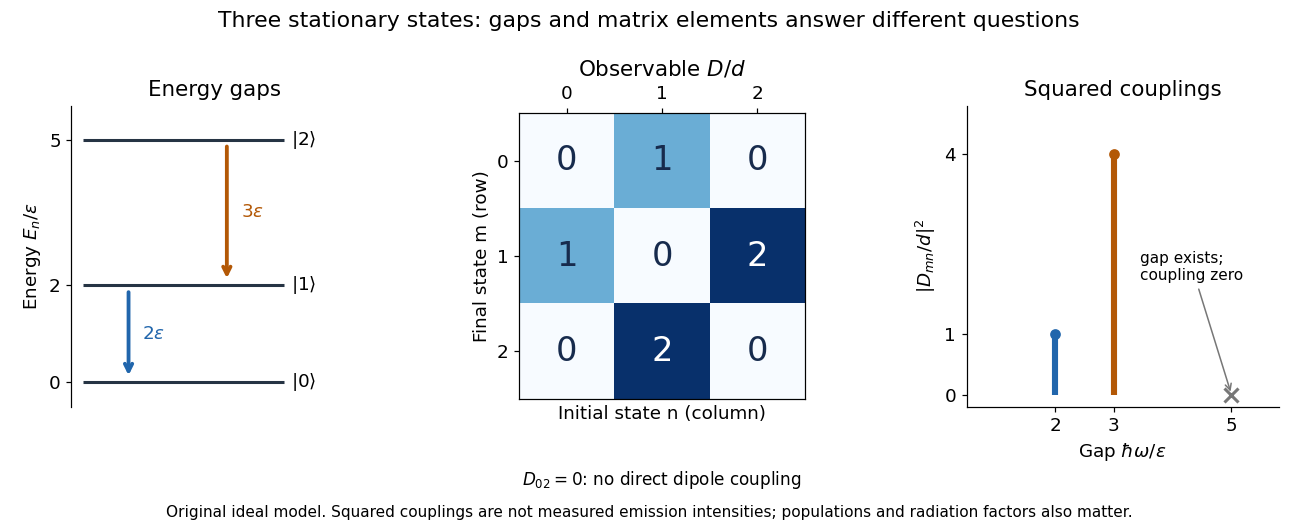

A measurement of itself has possible outcomes , sinceThese are eigenvalues of , not the energy eigenvalues . Moreover, although : two factors connect through . This algebraic statement does not turn into a nonzero direct coupling. Higher-order probability amplitudes for transitions require the appropriate dynamical calculation.
For two dimensionless observables on a two-level system, takeBoth are Hermitian matrices: has eigenvalues and has eigenvalues . YetFor instance, whereas . In , acts first. Neither product is self-adjoint, so the product of two observables is not automatically another observable. The commutator records this dependence on order. These operator products by themselves do not specify the outcomes of consecutive measurements; that additionally requires measurement in quantum mechanics.
In 1925, Werner Heisenberg proposed replacing classical orbital quantities with arrays of transition amplitudes and frequencies. His paper's opening demanded relations between quantities observable in principle; section 1 built products by summing over an intermediate state and noted their dependence on order. The formulas above express that construction in modern linear operator notation.[ref]
On the quantum reinterpretation of kinematical and mechanical relationships by Werner Heisenberg. Heisenberg, 1925; introduction and section 1, equations (5), (8), (15), (20), (24)–(25); Doria translation
Pumping and a heated bath prepared Mercury vapor around a hot platinum wire, mesh and collector in the original Franck-Hertz experiment. A galvanometer read collector electric current while accelerating voltage varied at fixed retarding voltage. Retarding scans distinguished outgoing electron energies.[ref]
Über Zusammenstöße zwischen Elektronen und den Molekülen des Quecksilberdampfes und die Ionisierungsspannung desselben by James Franck and Gustav Ludwig Hertz. 1914, pp. 459–461, Figs. 1–2
The losses constrain excitation of chemical atoms; they do not determine every optical coupling. The Franck-Hertz experiment explains the original mistaken ionization interpretation.Such excitation and spectral line evidence motivated a mechanics of discrete energy levels and transitions. Replacing one representation by another was a theoretical construction; the Franck-Hertz experiment does not measure a matrix product or establish a unique representation of an observable.
Later in 1925, Max Born and Pascual Jordan developed the array calculus systematically. Their section 3 states , equivalently the modern canonical commutation relationThis relates position and momentum through an intrinsically noncommuting product.[ref]
Zur Quantenmechanik by Max Born and Pascual Jordan. Born and Jordan, Zur Quantenmechanik, 1925; section 3, equation (38), translation p. 14
For the quantum harmonic oscillator, the canonical commutation relation and creation and annihilation operators give , recovering both the spacing and zero-point energy algebraically. One must retain infinitely many number states for the exact relation: the finite cutoff below reveals the obstruction explicitly.
In 1926, Erwin Schrödinger constructed arrays from differential operators and complete orthogonal function systems, showing how their products reproduce the array calculus. His paper connected wave mechanics with matrix mechanics; the translation's sections 2–3 develop the product and commutation rules.[ref]
On the Relation between the Quantum Mechanics of Heisenberg, Born, and Jordan, and that of Schrödinger by Erwin Schrödinger. Collected Papers on Wave Mechanics, On the Relation between the Quantum Mechanics of Heisenberg, Born, and Jordan, and that of Schrödinger, pp. 48–51, equations (6)–(10)
The modern proof is a change of orthonormal basis. If form a complete orthonormal basis of the physical Hilbert space, map a wavefunction to its coefficients:Completeness makes this map unitary: it preserves the inner product and reconstructs from its coefficients. Inserting the complete orthonormal basis proves the matrix multiplication rule. The Schrödinger equation becomesFor a time-independent Hamiltonian operator, the Heisenberg picture transfers the same evolution to the observables, preserving measurement predictions. Unitary equivalence requires matching operator domains as well as formal entries. A finite selection of eigenfunctions gives a compression, not an exact replacement of the full Hilbert space; a continuous spectrum needs its spectral integrals. This equivalence concerns representations of specified operators, and does not remove the ordering question when quantizing an arbitrary classical expression, as Weyl ordering illustrates.
Retain the first number states of a quantum harmonic oscillator. Let be the orthogonal projection onto their span and compress , , restricted to this span. The compressed annihilation operator satisfiesFor , the two products give and ; on the top state they give and . Thus, with ,On every quantum superposition of , this commutator acts exactly as . For a normalized retained state with coefficients ,Small probability at the cutoff must therefore be judged relative to for this expectation. For , the diagonal of is , with zero trace.
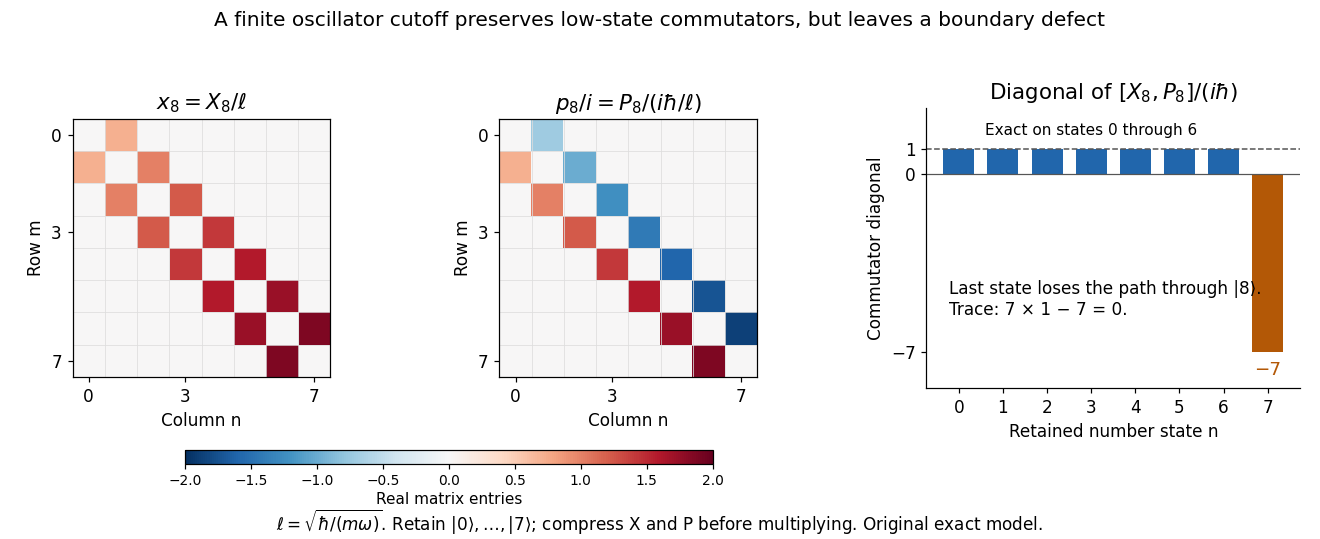

This is unavoidable for finite matrices: trace of a matrix commutator gives , whereas . Compression does not preserve products: can use intermediate states outside the retained span, while cannot. Accordingly, compressing the full oscillator Hamiltonian operator gives , but building it from the compressed squares givesThe two prescriptions agree on lower number states and disagree at the boundary. In the infinite oscillator, the canonical commutation relation holds on the common invariant dense subspace of finite number state combinations. Its unbounded position and momentum operators do not admit the finite trace argument; writing the formal identity does not assert that both products act on every vector of the Hilbert space.
Articles by others on the same topic
There are currently no matching articles.