Frequency modulation carries a message by changing the instantaneous frequency of a carrier wave. In the ideal model the wave amplitude stays constant: information changes the rate at which the wave phase advances. Write a real electrical signal and its chosen complex representation asThe wave envelope in this representation has modulus throughout, although continually passes through zero. A smaller instantaneous value of therefore does not mean a smaller wave amplitude. The continuously unwrapped wave phase is measured in radians; its derivative is an angular frequency, while division by gives frequency in cycles per second, or hertz.
For a message expressed as an electric potential difference, an ideal voltage-controlled oscillator has sensitivity in hertz per volt and obeysThe integral is essential: putting the message directly into the wave phase gives phase modulation, whose instantaneous frequency instead depends on the message's derivative. Amplitude modulation changes the multiplying wave amplitude. These are different ways to encode the same kind of message signal.
An original slow illustration uses , message frequency , frequency deviation , and FM modulation index . With zero initial wave phase,Here is in seconds. The instantaneous frequency stays positive, between and ; the wave phase always advances. The oscillations bunch up where is large and spread out where it is small, while the wave envelope remains at .
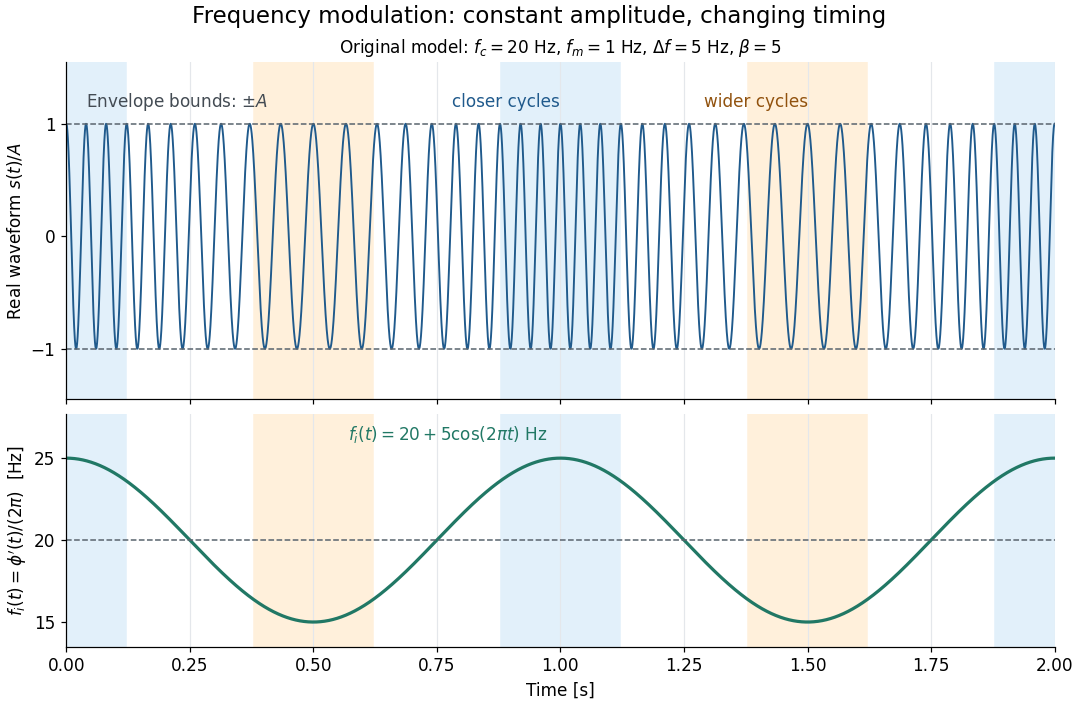
This separation is useful in a receiver: changing a positive multiplying wave amplitude does not change the zero crossings of , so their timing still carries the message. Noise that moves those crossings, a vanishing wave amplitude, and frequency response distortion can still damage it. The surprising beauty of FM is that a constant wave envelope can conceal a rich frequency spectrum: the components interfere to change timing instead of the envelope's height.

