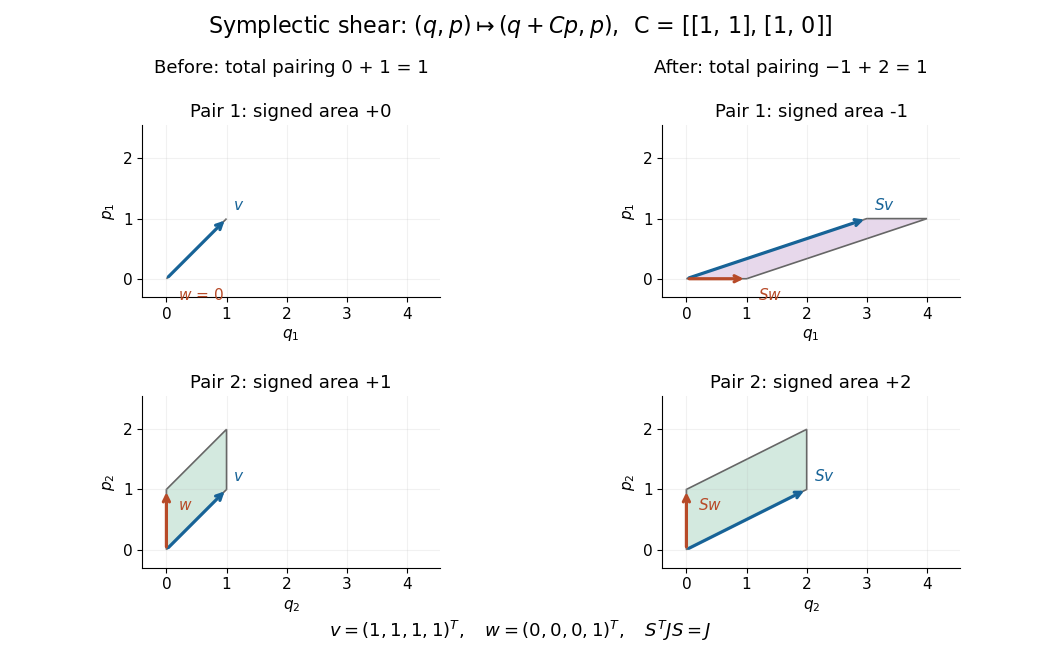
On , use the standard basis and the alternating bilinear form with matrix above for . A second symplectic basis isFor instance, , while and the cross-pairings vanish. The change of basis matrix, whose columns are these new basis vectors in , isThe symmetric matrix makes , so is a symplectic matrix. Explicitly, multiplying the blocks gives a lower-right block ; the other blocks agree with . For a fixed vector, change of basis means , henceTheir symplectic form gives in , and in . The separate coordinate-plane contributions change, but their sum does not.
The same matrix also represents an active symplectic linear map: keeping one basis fixed, it sends to . The following diagram shows this active interpretation over the real numbers. Its preserved total pairing is precisely the test used for linear canonical transformations.

Articles by others on the same topic
There are currently no matching articles.