Gouy phase interferometry compares a focused field with a coherent reference to recover the additional Gouy phase. Beam brightness alone discards the phase. An interferometer converts a relative field phase into intensity modulation, but the optical paths and reference wavefront curvature must be modeled.
A published 2023 experiment by Lyubomir Stoyanov and colleagues used a Mach-Zehnder interferometer to study Bessel-Gaussian beams. Its setup included a 532-nanometre laser, beam expansion, two spatial light modulators, focusing lenses and a CCD camera on a rail to follow propagation after the focus. Its Figure 3 also describes a single-lens interferometer arrangement for stronger focusing.[ref]
Gouy phase of Bessel-Gaussian beams: theory vs. experiment by Lyubomir Stoyanov and others. Figure 3, printed p. 13691, apparatus caption
Structured modes need their own phase model; that experiment should not be silently interpreted as a fundamental-Gaussian measurement.A separate original protocol illustrates four-step phase retrieval. At one detector point, apply controlled signal-arm phases while the beam intensities remain fixed. Write
This phase-shifting interferometry formula removes the unknown common intensity background and positive modulation amplitude . It returns phase modulo ; phase unwrapping requires continuity information between sampled positions. If the interference visibility vanishes, the phase is not observable by this formula.
This phase-shifting interferometry formula removes the unknown common intensity background and positive modulation amplitude . It returns phase modulo ; phase unwrapping requires continuity information between sampled positions. If the interference visibility vanishes, the phase is not observable by this formula.
For a synthetic coherent Gaussian/reference pair, use reference intensity 1 and signal intensity , with . Then , and after common path phases are removed. At , the four intensities are , giving . At , the first intensity is still , but the quadratures reverse and the retrieved phase is .
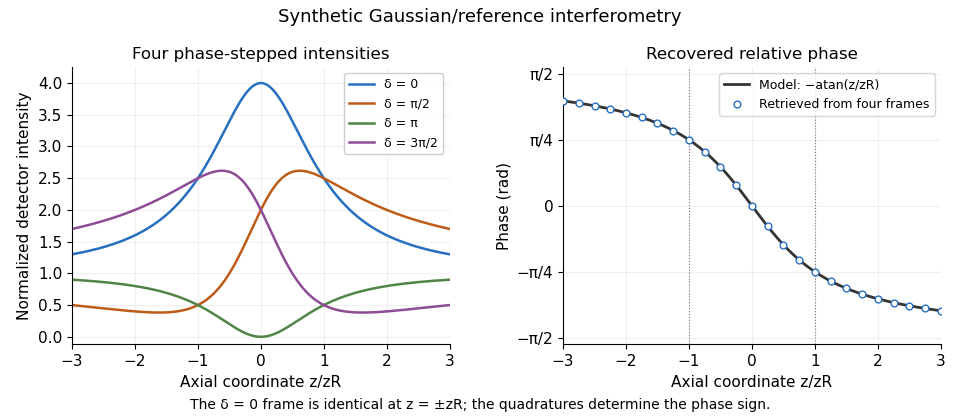
Original synthetic four-step interferometry of a Gaussian beam: symmetric single-frame readings become distinguishable through phase quadratures. No experimental data are shown.
Details. 
Curvature bias in Gouy-phase measurements is important away from the axis: the signal adds to its spatial phase. Fit or remove that term when using multiple pixels, retain calibrated phase steps and account for drift between frames. The recovered phase combines all coherent optical-path contributions until those controls isolate the Gouy phase.
Curvature bias in Gouy-phase measurements occurs when a spatially varying wavefront-curvature wave phase is mistaken for the axial Gouy phase in an interferometric comparison. For a fundamental Gaussian beam with time convention , the signal wave phase containsA curved reference contributes its own quadratic wave phase. After subtracting common axial path terms, the measured relative wave phase isThus a phase-retrieval algorithm can work exactly while the subsequent physical interpretation is biased. The Gaussian confinement wave phase and its arctangent dependence are derived in the primary theoretical treatment.[ref]
Physical origin of the Gouy phase shift by Simin Feng and Herbert G. Winful. Equations 4–12, Gaussian field phase and confinement
For an original example with a planar reference and stable path wave phase, let and . At and fixed detector radius , the curvature term is 0.5 radians. The true axial contribution is , whereas that off-axis pixel gives radians. At the curvature term reverses. Comparing those two axial planes at this fixed radius gives a wave phase change , differing from the axial Gouy change by one radian.
The effect is observable even where the signal is appreciable: at , is inside the plane's Gaussian radius . Avoiding only dim pixels does not remove curvature bias.
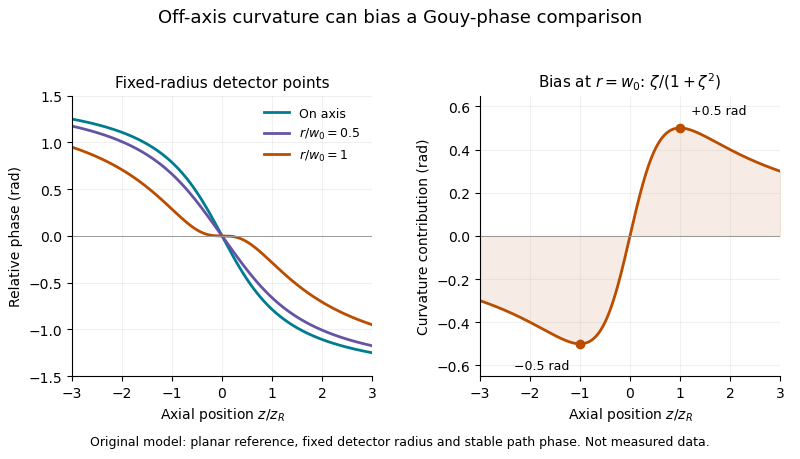

A useful measurement fits the spatial quadratic wave phase, identifies the beam center and reference curvature, and extrapolates the relative wave phase to the axis. Tilt, decentering and path drift require their own terms; averaging several pixel phases is not automatically equivalent to measuring the on-axis wave phase. Phase unwrapping can be required before fitting a wave phase profile.
The primary 2023 Bessel-Gaussian experiment documents focusing optics and a rail-mounted camera in its interferometer.[ref]
Gouy phase of Bessel-Gaussian beams: theory vs. experiment by Lyubomir Stoyanov and others. Figure 3, p. 13691
It motivates tracking both propagation position and wavefront geometry, but its structured-mode observations must not be silently reclassified as measurements of the illustrative fundamental-Gaussian model above. Articles by others on the same topic
There are currently no matching articles.