The ATLAS experiment and CMS experiment searched proton-proton collisions at the Large Hadron Collider at collision energies of and . The ATLAS experiment used silicon tracking, a solenoid, liquid-argon electromagnetic calorimeters and an external muon spectrometer. Its July 2012 paper reported a combined local statistical significance of standard deviations near ; this paper result is distinct from the initial 4 July announcement.[ref]
The CMS experiment used silicon tracking in a solenoid, lead-tungstate electromagnetic calorimeters and external muon chambers. Electrons combine tracks and particle showers; muons combine tracking and chamber hits; photons supply shower energies and directions. Selected and candidates, with , yielded invariant mass peaks. It checked lepton efficiencies with Z boson decays, estimated fake-lepton backgrounds from control samples with relaxed identification, and fitted the smooth diphoton background from data. Its combined local statistical significance was standard deviations near .[ref]
The ATLAS experiment compared signal-plus-background and background-only hypotheses with a profile likelihood, accounting for systematic uncertainties and correlations between decay channels. Diphoton and four-lepton candidates gave precise invariant masses; decays supplied additional evidence with poorer mass reconstruction because of escaping neutrinos. A local p-value concerns one specified mass; scanning masses requires a look-elsewhere effect correction.[ref]
Two-photon decay excludes spin one under the usual assumptions, but does not prove spin zero. A mass peak does not determine every Higgs boson coupling. Production rates, branching fractions and angular correlations require additional tests.[ref]
The bridge from detector readout to a particle resonance is four-momentum conservation. In units , sum the measured final-state four-momenta:For two photons separated by angle , gives the displayed diphoton formula. Two back-to-back photons of each have . A four-lepton candidate instead uses four four-momenta in the same sum. Collision debris outside the selected decay is not included. Since the partons carry unknown fractions of the incoming proton momenta, reconstructing the decay products is more informative than assigning the full beam energy to each candidate.
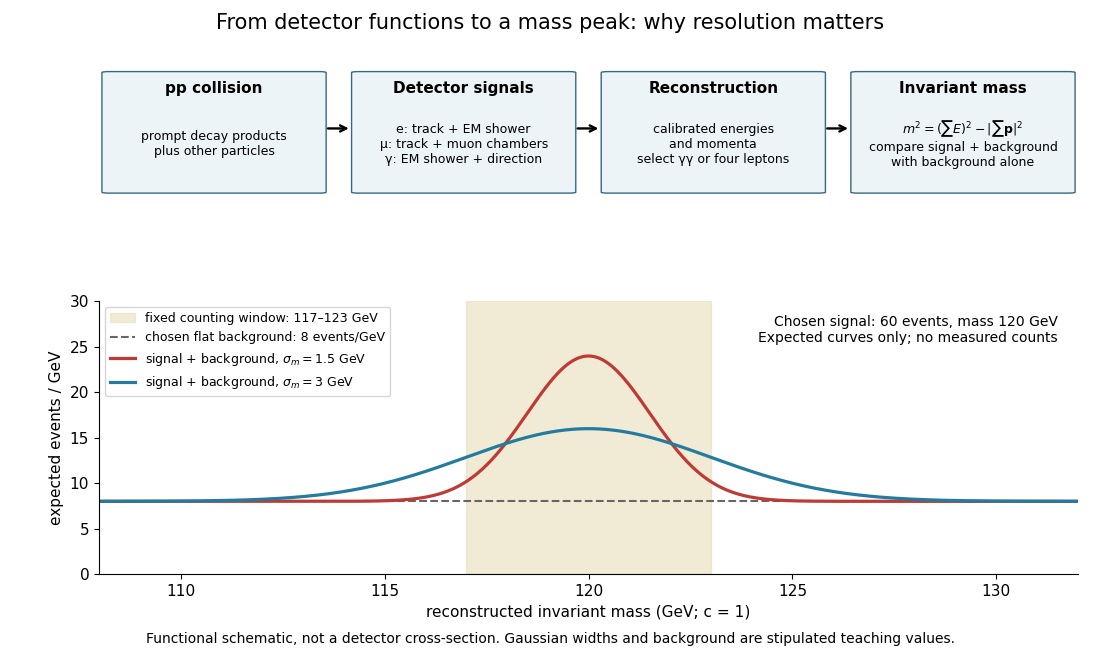

Suppose the intrinsic decay width is negligible compared with the stipulated detector spread. Let the reconstructed signal mass follow a normal distribution with mean and standard deviation . For a total expected selected signal and flat background density events per electronvolts, the expected count density isThis is a deliberately chosen response model, not a fit to either experiment. In the fixed window with , direct integration givesThe expected signal counts are for and for . Doubling the spread lowers the fraction in the same window without changing the total signal. Detector resolution can therefore change the visibility of a peak even with identical particle production.
As a separate counting example, stipulate an observed integer count and an exactly known background mean . The Poisson distribution gives a likelihood for nonnegative signal mean . Its maximum-likelihood estimator is , and the likelihood ratio statistic against isThis tests a specified window with a specified background, and is not either experiment's discovery significance. If the background mean is allowed to vary freely, background alone can choose and fit that count exactly. Control samples, a defensible mass-shape model, nuisance parameters and corrections for searching many masses are therefore essential to the experimental inference.
Articles by others on the same topic
There are currently no matching articles.