The Homestake experiment, led by Raymond Davis Jr., used electron neutrino capture on chlorine to produce argon subject to radioactive decay. The 1968 paper reported an upper limit, rather than a resolved positive signal.[ref]
Search for Neutrinos from the Sun by Raymond Davis Jr. and others. Abstract: chlorine reaction and upper-limit result
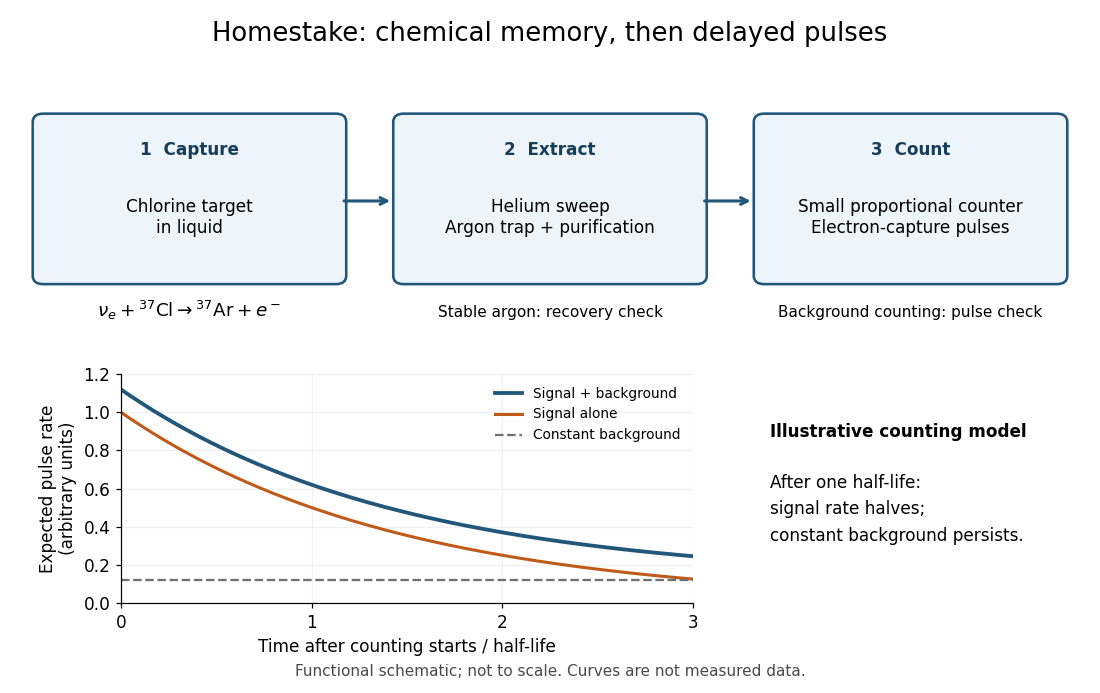
The underground target contained tetrachloroethylene. Circulated helium swept out argon, which was trapped on cooled charcoal, purified, and put into tiny proportional counters. Electron capture back to chlorine supplies the delayed readout. Added stable argon checked extraction recovery; background counting checked spurious pulses. The capture threshold is and the product's half-life is about 35 days. The chemical extraction retains neither the original neutrino's arrival time nor its direction.[ref]
Nobel Lecture: A half-century with solar neutrinos by Raymond Davis Jr.. pp. 986, 988–991; Figs. 9–14
The reaction selects electron neutrinos, and its threshold excludes the lowest-energy part of the solar neutrino spectrum. A low count alone cannot distinguish a low source neutrino flux, a changed neutrino flavor mixture, or an underestimated loss in extraction or counting. This is why chemical recovery tests and an independent water Cherenkov neutrino reconstruction are scientifically valuable.
An idealized radiochemical neutrino counting model separates production, survival, recovery and readout. Suppose a freshly cleared target produces atoms at a constant rate during exposure . Each atom has nuclear decay constant , where is its half-life. The expected surviving population obeysThe proof is to multiply the differential equation by and apply integration. The expression also follows by summing the exponential decay survival probabilities of atoms produced at every earlier time. Production does not imply eventual recovery: atoms can decay during exposure.
Let be the fraction recovered instantaneously at extraction, the subsequent delay before counting, the probability of recording a decay, and the counting duration. The expected signal pulses areWith constant background rate , the expected total is . During counting, the expected instantaneous pulse rate is , with . Equal time windows therefore lose signal by the factor while a constant background stays unchanged. Fitting the time dependence helps distinguish radioactive decay from that background; it does not recover individual capture times.
For an original worked example choose , , , , and . These are illustrative assumptions. Then , andDoubling the exposure does not double the surviving inventory: . A delay of one half-life halves the signal. At , ; at long exposure it saturates at . These limits explain why a large target and repeated extraction can matter more than simply waiting longer. The model neglects time-dependent production, finite extraction duration, residual atoms between runs and time-dependent backgrounds.
Articles by others on the same topic


The Homestake experiment was a pioneering neutrino detection experiment conducted by physicist Raymond Davis Jr. and his collaborators in the late 1960s. It took place in the Homestake Gold Mine in Lead, South Dakota, which is one of the deepest mines in North America. The main goal of the experiment was to detect solar neutrinos, which are produced in the nuclear fusion reactions that power the Sun.