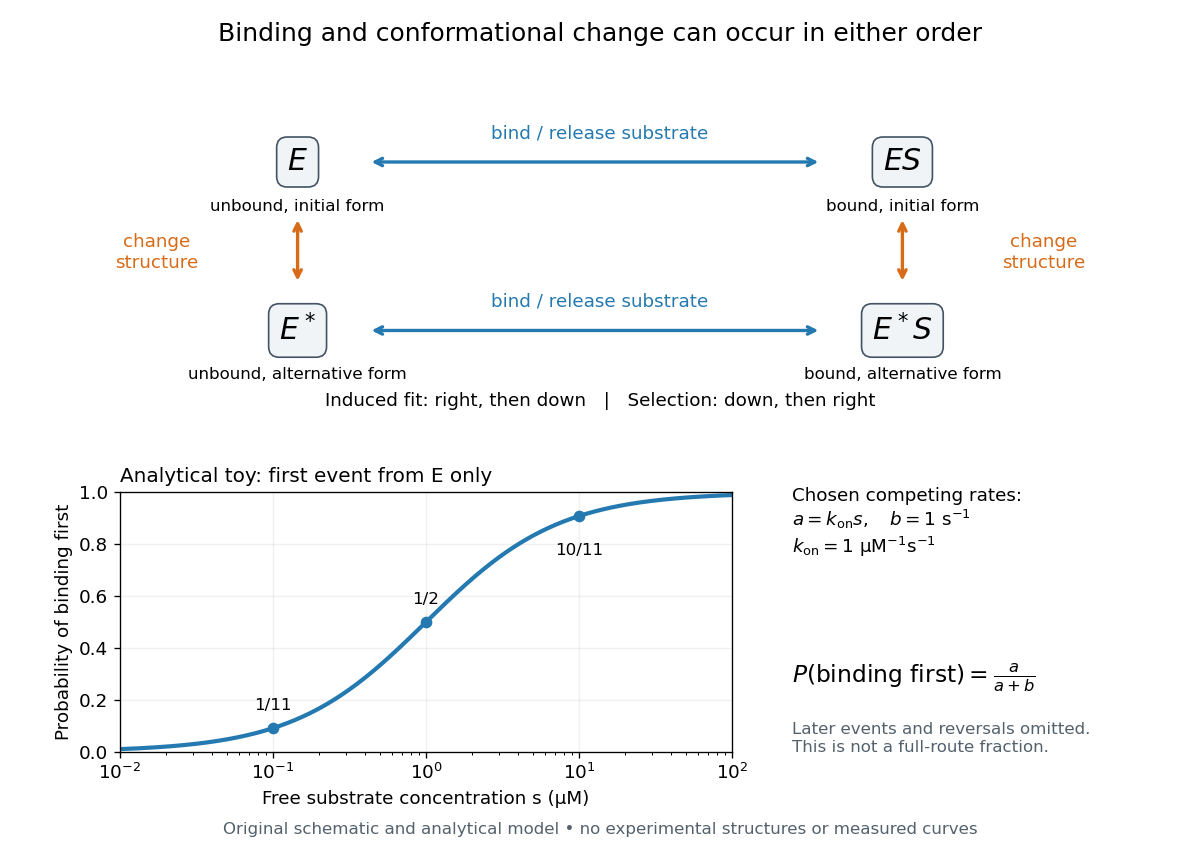
In induced fit, a substrate binds to an enzyme and the resulting enzyme-substrate complex subsequently changes its protein structure. This adjustment can position interacting groups at the active site for catalysis. The mechanistic claim concerns order: binding precedes the relevant change. In conformational selection, the unbound enzyme already visits an alternative protein structure, which the substrate preferentially binds. Both processes can occur in one system. Let and denote two structures of the same enzyme, and a substrate. The limiting routes areThe star labels a structure, not a different protein primary structure, and does not by itself mean catalytic activity. Each reversible arrow abbreviates a step, not the whole catalytic cycle. See Gordon G. Hammes, Yu-Chu Chang and Terrence G. Oas, Conformational selection or induced fit: a flux description of reaction mechanism, PNAS 106 (2009), 13737–13741.
A rigid lock-and-key cartoon usefully suggests selective substrate recognition, but it suppresses movement of the protein and chemical changes at the active site. Replacing it with two static drawings, “open” and “closed”, still does not establish induced fit: both routes above can end at . Also, if complete closure prevents a substrate entering, the pre-existing structure selected in conformational selection might be partly open and undergo further induced fit after binding. The usefulness of the distinction is that it turns an attractive shape story into questions about enzyme kinetics. Relative traffic through the routes depends on populations, rate constants and free substrate concentration, rather than affinity alone. See Hammes, Chang and Oas, 2009: coupled pathways, their concentrations and the limitations of endpoint structures.
Induced fit and conformational selection: two orders, one bound endpoint
. Original reaction-order schematic and an analytical first-event model, not a hexokinase structure or measured data. In the upper square, horizontal steps bind or release a substrate; vertical steps change protein structure. In the lower plot, an initially unbound can bind with rate or change structure with rate , for chosen and . The plotted probability concerns only the first event from , not the fraction completing either full route. Subsequent binding, reversals and catalysis are not modelled by that curve. Details.
For this analytical illustration, hold the free substrate concentration constant and assume independent waiting times with exponential distributions of constant rates. The law of mass action gives the binding rate ; the competing change has rate . The probability density function for binding to happen first at time is , because neither event has happened earlier. Its integral isWith the stated invented rate constants, gives , respectively. Raising free substrate concentration makes binding more likely to win this initial competition. This probability is deliberately narrower than a full-route fraction: returns to , later changes and the binding properties of would all matter for the latter. The illustration explains why timing and concentration must accompany structural evidence, without assigning a binding mechanism to a real enzyme.
A motivating experiment tested the crystal interpretation in solution. McDonald, Steitz and Engelman prepared solutions of monomeric yeast hexokinase B and compared the unbound preparation with sugar-bound preparations. Their apparatus measured small-angle scattering of X-rays; the spatial extent inferred from that readout was the radius of gyration, rather than a catalytic reaction rate. Binding glucose reduced the radius of gyration by ; binding the phosphorylated glucose product reduced it by , as reported by the authors. The glucose change agreed with the reduction calculated from the crystal coordinates. See Robert C. McDonald, Thomas A. Steitz and Donald M. Engelman, Yeast hexokinase in solution exhibits a large conformational change upon binding glucose or glucose 6-phosphate, Biochemistry 18 (1979), 338–342: primary abstract.
The comparison without added substrate supplies a baseline within the same form of hexokinase; the second bound preparation tests another binding condition. Together with the crystal comparison, solution compaction supports closure beyond crystal packing. It still gives an average spatial readout, not a movie of individual binding events, and product-associated compaction does not demonstrate ongoing catalysis. Neither experiment alone proves that binding precedes movement. To distinguish induced fit from conformational selection, structural comparisons must be combined with measurements sensitive to timing and with a model of the relevant populations and enzyme kinetics.
Articles by others on the same topic
There are currently no matching articles.