On , the event of infinitely many heads isIt says that after every index there is another head. For each , the same intersection can start at , so ; therefore is a tail event. This verifies measurability directly using countable unions and intersections.
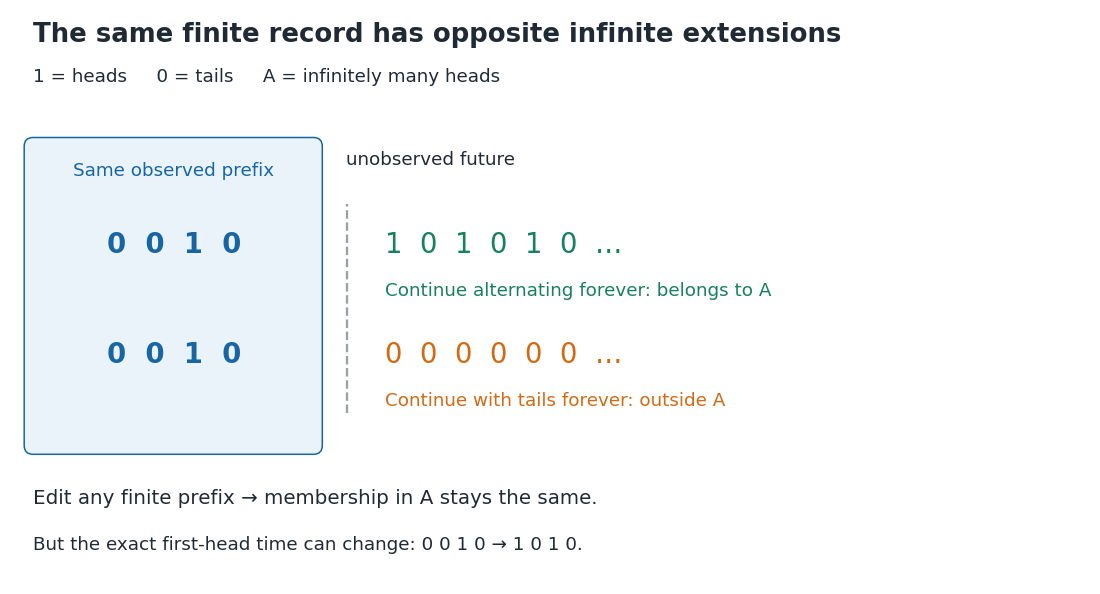
A finite prefix admits both infinitely many heads and only finitely many heads
. The two illustrated extensions have the same initial observations. An alternating continuation belongs to the tail event of infinitely many heads; an all-tails continuation does not. Changing the highlighted finite prefix cannot change that infinite property, but it can change the exact first-head time. Details.
Assume now that the coordinates are fair independent Bernoulli trials. For fixed , let be the event of at least one head among . Its complement requires tails, soThe last equality follows from continuity of probability. Now , a countable intersection of almost sure events, and hence . This determines which of the two possibilities in Kolmogorov's zero–one law occurs. Equivalently, the Borel-Cantelli second lemma applies to the independent events .
Nevertheless, no finite prefix certifies membership in : every finite record can be extended by all tails or by alternating heads and tails. Under the fair independent model, conditioning on any exact finite prefix leaves , since is independent of the initial sigma-algebra. The excluded all-tails continuation has probability zero, but remains a possible member of the sample space. Logical determination by a finite record and a conclusion holding almost surely are different statements.
Articles by others on the same topic
There are currently no matching articles.