For a sequence of random variables on a probability space , defineThe decreasing sigma-algebras are generated by the listed random variables. Their intersection consists of events expressible after discarding every finite prefix. No independence is required.[ref]
Probability: Theory and Examples (fifth edition) by Rick Durrett. Probability: Theory and Examples (fifth edition), §2.5 Convergence of Random Series, printed p. 81: definition of the tail sigma-field
The point is to distinguish a long observation record from a property of an infinite sequence. The event of seeing infinitely many heads and the event that sample means converge survive any finite change, while an exact first-head time does not. Kolmogorov's zero–one law adds the striking conclusion that under independence each tail event has probability zero or one; the tail sigma-algebra itself can still contain many nonempty sets.
On the full Cartesian product with its product sigma-algebra, take the coordinate random variables . A product-measurable set is a tail event if and only if membership is unchanged whenever two sequences differ in finitely many coordinates. The measurability condition is essential: invariance alone is not a license to assign a probability to an arbitrary subset.
For the forward implication, fix . An event in cannot distinguish points with the same remaining coordinates. Since a tail event belongs to this sigma-algebra for every , every finite change preserves membership.
For the converse, freeze the first coordinates to zero. The insertion mapis a measurable function for the product sigma-algebras. Thus is a measurable set. Invariance gives , where the coordinate projection discards the first entries. Hence for every . The same argument works on . On a general probability space, coordinates need not admit arbitrary replacements, so the defining intersection of sigma-algebras remains the reliable formulation.
Let be a sequence of finite real random variables, and write for its sample mean. For fixed and , put . Then, at each outcome,Consequently . The right-hand limit superior is a measurable function of for every , so the extended-real random variable is measurable with respect to the tail sigma-algebra. The same holds for the limit inferior. Thus the event of convergence to a finite limit of a sequence, and the event for any specified real , are tail events.
For a worked deterministic example, let alternate , and replace its first three entries by . For every the two sample means differ by exactly , so both converge to . Finite edits can change small-sample answers while preserving the infinite limit of a sequence.
Under independence, Kolmogorov's zero–one law makes each specified convergence event have probability zero or one. It does not select which value occurs. If a finite random variable measurable with respect to the tail sigma-algebra exists, the events for rational each have probability zero or one; continuity of probability and their nesting force to be constant almost surely. For fair independent Bernoulli trials, the strong law of large numbers establishes almost surely; the zero–one conclusion alone proves neither convergence nor the value .
A tail event is an event , where is the tail sigma-algebra of the chosen sequence of random variables. It concerns information available arbitrarily far along the sequence. In the measurable coordinate models described in finite-prefix invariance of tail events, any finite edit preserves whether it occurs.
This is stronger than merely needing a long waiting time. On , with denoting heads, let , taking if there is no head. The eventis not a tail event: changing only from zero to one changes membership. Under fair independent Bernoulli trials its probability is . Even the event , of probability one in this model, is not a tail event as a literal set: the all-zero sequence and the sequence with just one initial head differ in one coordinate. A probability of zero or one does not characterize tail events.
On , the event of infinitely many heads isIt says that after every index there is another head. For each , the same intersection can start at , so ; therefore is a tail event. This verifies measurability directly using countable unions and intersections.
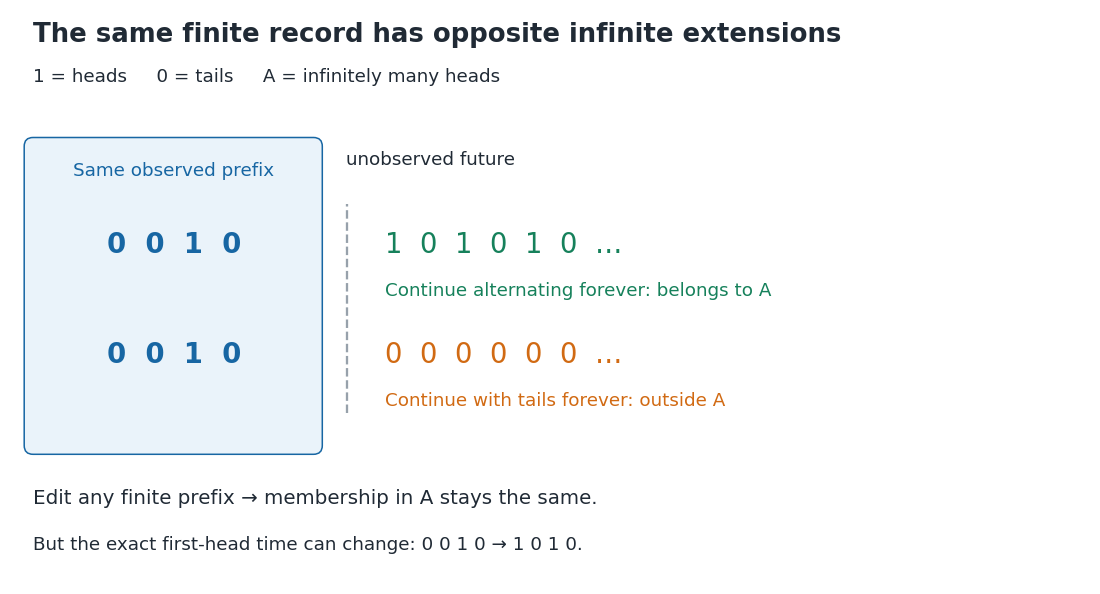
A finite prefix admits both infinitely many heads and only finitely many heads
. The two illustrated extensions have the same initial observations. An alternating continuation belongs to the tail event of infinitely many heads; an all-tails continuation does not. Changing the highlighted finite prefix cannot change that infinite property, but it can change the exact first-head time. Details.
Assume now that the coordinates are fair independent Bernoulli trials. For fixed , let be the event of at least one head among . Its complement requires tails, soThe last equality follows from continuity of probability. Now , a countable intersection of almost sure events, and hence . This determines which of the two possibilities in Kolmogorov's zero–one law occurs. Equivalently, the Borel-Cantelli second lemma applies to the independent events .
Nevertheless, no finite prefix certifies membership in : every finite record can be extended by all tails or by alternating heads and tails. Under the fair independent model, conditioning on any exact finite prefix leaves , since is independent of the initial sigma-algebra. The excluded all-tails continuation has probability zero, but remains a possible member of the sample space. Logical determination by a finite record and a conclusion holding almost surely are different statements.
For mutually independent random variables, every tail event has . Identical probability distributions are unnecessary. The tail sigma-algebra is trivial in probability: its events have probability zero or one, though it can contain nonempty proper sets.[ref]
Probability: Theory and Examples (fifth edition) by Rick Durrett. Probability: Theory and Examples (fifth edition), §2.5, Theorem 2.5.3, printed pp. 81–82
For a proof, set and . Independence extended from generating pi-systems makes independent of , hence of each tail event . The increasing union is a generating pi-system for . For fixed , the events satisfying form a Dynkin system. The pi-lambda theorem extends this equality to all . Taking givesThus is independent of itself, forcing the two stated values.[ref]
Probability: Theory and Examples (fifth edition) by Rick Durrett. Probability: Theory and Examples (fifth edition), proof of Theorem 2.5.3, steps (a) and (b), printed pp. 81–82
The useful feature is the absence of intermediate probabilities for infinite properties that ignore every finite prefix. It reduces some calculations to showing that a tail event has positive probability, or that its complement does. The theorem supplies no finite observation deadline, and an extra argument such as the calculation in infinitely many heads as a tail event is needed to decide which value occurs.
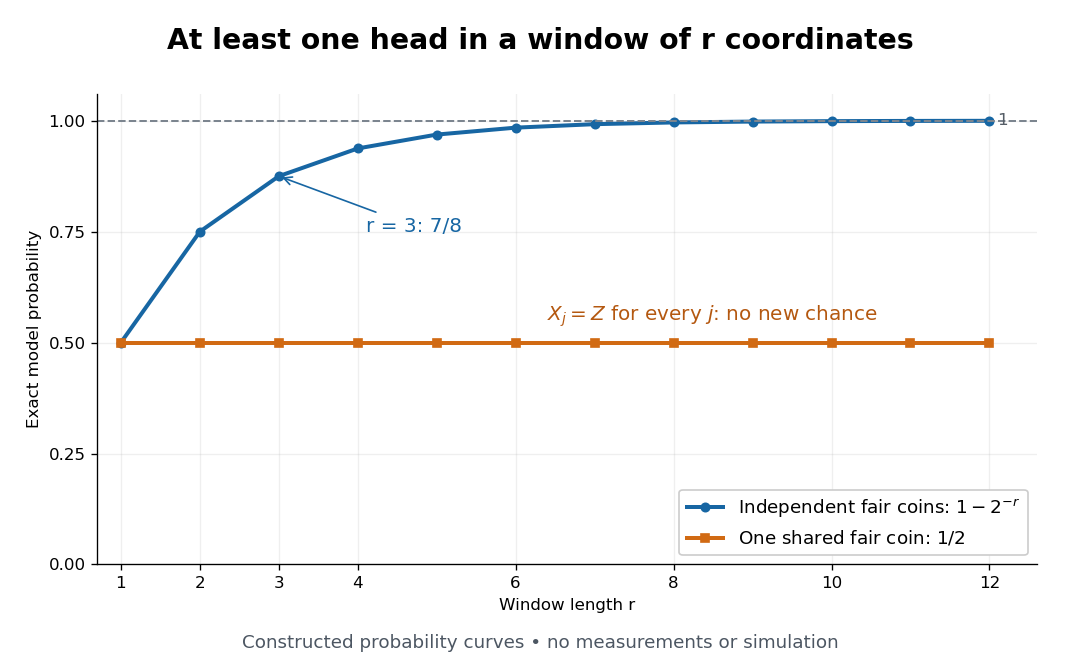
More independent trials increase the chance of a head; repeated copies of one coin do not
. Exact constructed probabilities for at least one head in a window of coordinates. The independent curve is and tends to one; the shared-coin curve stays at . These are calculations from the two specified probability measures, not measurements or simulated frequencies. Details.
Articles by others on the same topic
There are currently no matching articles.