A circular cylinder of radius has induced metric locally equal to with . Its Riemann curvature tensor therefore vanishes, despite its nonzero extrinsic curvature. With outward unit normal and convention , its trace is and its principal curvatures are and zero. Its averaged mean curvature is . The angular identification changes global topology, not local flatness.
In coordinates on a circular cylinder of radius , the induced metric is . Its coefficients are constant, so the Christoffel symbols vanish and the affinely parametrized geodesic equation is . The nonconstant solutions are generators when , circular parallels when , and helices when both are nonzero. Unrolling the cylinder with coordinate makes all these curves straight lines in the Euclidean metric. Unit-speed parametrization additionally requires .
For a worked helix on a circular cylinder of radius , choose for . Unrolling gives the straight segment , so its arc length is . Its acceleration in space points normally to the surface, consistent with the geodesic equation.
This geodesic is not globally shortest between its endpoints: they share the same angular position, and the vertical generator has length . The helix minimizes length among paths with the same endpoints and one full winding, because their unrolled lifts join to . In general, geodesics minimize sufficiently short subarcs; changing winding can produce a shorter route. Keeping this local/global distinction makes unrolling useful without mistaking every straight lift for an unrestricted shortest path.
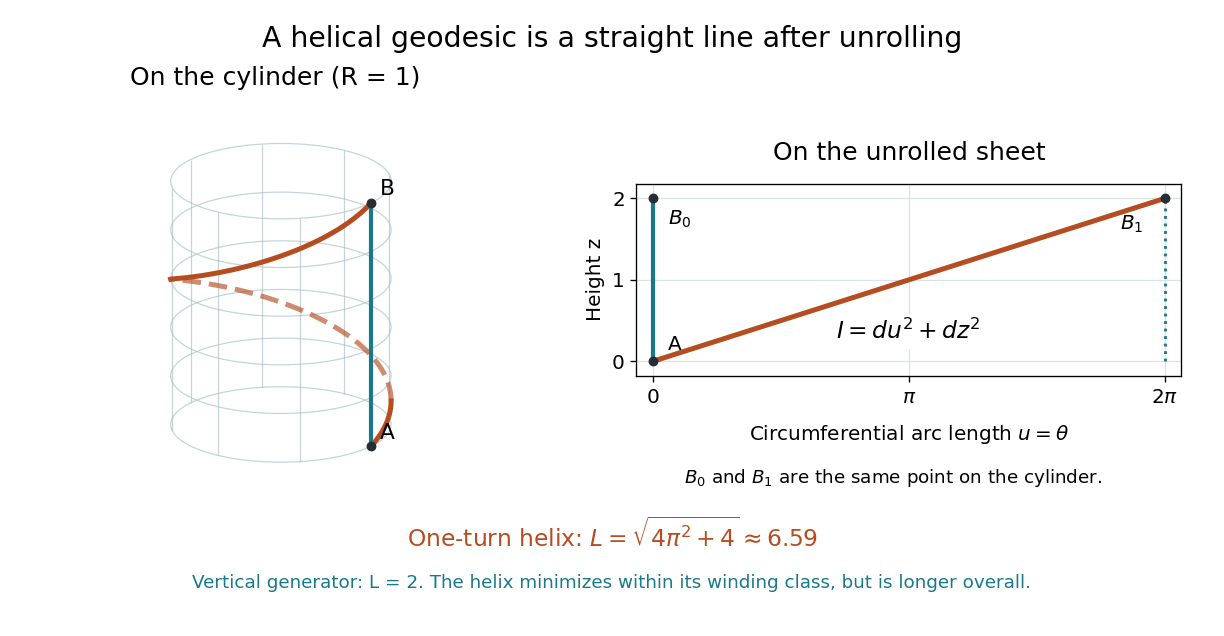

Unroll a circular cylinder of radius using the coordinate . Its line element becomes , so a geodesic lifts to a straight line in the plane. An endpoint has infinitely many lifts differing by . Minimize the ordinary Euclidean distance over those lifts to obtain the unrestricted shortest path. A fixed lift instead specifies a winding class and need not give the global shortest path.
For angular difference , put . Then . At , two different geodesics have the same shortest length. This is the source of the corner in the distance-versus-angle graph at the opposite generator of the circular cylinder.
Articles by others on the same topic
There are currently no matching articles.