Judah Folkman (1933–2008) was a surgeon and investigator who developed an influential experimental and therapeutic hypothesis about tumour angiogenesis. His 1971 article treated tumour cells and capillary endothelial cells as interacting populations and explored the possibility that restricting new vessel growth could restrict tumour growth.[ref]
Tumor Angiogenesis: Therapeutic Implications by Judah Folkman. Publisher preview and article, pp. 1182–1186
This was not a claim that he first observed every association between tumours and blood vessels.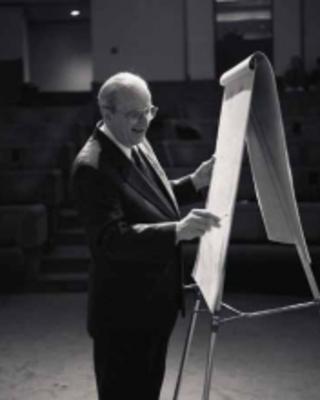
Judah Folkman, portrait linked by Harvard Medical School Department of Ophthalmology
. A motivating primary experiment separated tumour cells from host tissue with membrane chambers. Folkman and collaborators described new-vessel outgrowth near chambers containing melanoma or carcinoma cells in rat dorsal air sacs. The separation supported an explanation involving material that could pass from the tumour compartment, rather than requiring direct tumour-cell contact with every responding vessel. Their paper also reported an active tumour-derived fraction.[ref]
Isolation of a Tumor Factor Responsible for Angiogenesis by Judah Folkman and others. Printed p. 275, chamber observations and experimental motivation; abstract, isolated activity
The logical distinction matters: an angiogenic response to a fraction is evidence of biological activity, not by itself identification of one pure molecule that explains every tumour. The work made host blood vessel growth an experimental variable to investigate alongside tumour-cell proliferation.
An original supply model illustrates the geometric motivation. Suppose a spherical avascular cell mass of radius consumes a resource at constant rate per volume and can receive it only through its outer surface at flux . Its total demand and maximum stipulated supply areDemand does not exceed supply only when . Doubling radius increases demand eightfold but surface supply only fourfold. Adding internal vessels changes the supply geometry and therefore changes this model's assumptions.
This is a deliberately simplified volume-versus-surface calculation, not Folkman's measured tumour-size law or a universal clinical threshold. Real oxygen transport, diffusion, consumption, perfusion and cellular adaptation are more complex. It explains why growth of the supporting vasculature can be mechanistically important rather than merely a visual accompaniment to growth.
Harvard's institutional biography verifies his dates and portrait and places the 1971 proposal in its historical context.[ref]
Judah Folkman profile by Harvard Medical School Department of Ophthalmology. Heading, dates, portrait and biography
The lasting scientific contribution was a testable connection between tumour behavior and the surrounding vascular response; evaluating a particular treatment still requires evidence specific to that disease and intervention. Articles by others on the same topic
There are currently no matching articles.