A surgeon is a physician with specialized training in evaluating and treating conditions for which surgery may be appropriate. The role includes deciding whether an operation is justified, performing the relevant operative work, and directing perioperative care. The American College of Surgeons describes competence in terms of education, training, experience and demonstrated proficiency, rather than the ability to perform an isolated manual maneuver.[ref]
Surgical reasoning connects anatomy with physiology. Knowing where structures lie is different from knowing how an intervention will change their function. The response of living tissue also connects biomechanics, healing and the condition of the surrounding tissue. An operation can achieve an immediate geometric objective while its later biological outcome still depends on these processes.
An original mechanical example illustrates why local geometry matters. If a tensile force is carried uniformly through load-bearing area , nominal stress isA chosen force over gives ; the same force over half that area gives . This idealized calculation explains a geometric sensitivity, rather than specifying a tissue's actual strength or a surgical technique. Real tissue can be anisotropic and nonlinear, so a nominal stress alone does not determine its biological response.
Evaluating outcomes also requires scientific judgment. In a hypothetical audit, 20 adverse outcomes among 200 cases give a crude rate , while 5 among 100 give . The difference does not by itself identify a difference in surgical skill or treatment effect: the groups may differ in underlying illness, operation complexity and follow-up. Causal inference requires a comparison that addresses how the groups were formed, rather than treating every outcome percentage as a controlled experiment.
The decision is shared with the patient. Informed consent includes the proposed operation, its risks and benefits, alternatives including nonoperative care, and the roles of the treating team. Responsibility also extends beyond the operation through postoperative and continuing care.[ref]
Statement on Principles by the American College of Surgeons. Sections II.A–B, informed consent and alternatives; Sections II.E–F, postoperative responsibility and continuity
Thus operative skill, biological understanding and evaluation of evidence are connected parts of the profession.Ryozo Omoto was a cardiovascular surgeon and a coauthor of the 1985 real-time Color Doppler paper with Chihiro Kasai, Koroku Namekawa and Akira Koyano. Its author biography identifies his surgical work at Saitama Medical School. The paper includes cardiac flow images alongside instrument and phantom experiments.[ref]
Real-Time Two-Dimensional Blood Flow Imaging Using an Autocorrelation Technique by Chihiro Kasai and others. Printed pp. 458, 461–462 and 464: full name, clinical tests and author biography
A central interpretive distinction is between the displayed beam-direction component and the full blood flow velocity. In an ideal projection model, . For a constructed speed , a beam at measures a component, whereas a perpendicular beam has zero component. Zero Doppler shift does not imply zero flow.
Likewise, a sign-coded color indicates motion relative to the ultrasound beam, rather than automatically identifying oxygenated blood or a particular vessel. Turning a frequency estimate into a cardiac observation therefore requires geometry and timing, not just a color scale. Omoto's coauthored work connects that measurement problem with observing intracardiac flow; the paper's case observations do not by themselves establish universal diagnostic accuracy.
Bartley P. Griffith coauthored the 1994 experiment comparing image-derived ventricular area with a balloon-based pressure-volume reference. The publisher's full byline directly verifies the identity. The study used perfused dog hearts, a micromanometer catheter and automated echocardiography to investigate estimates of ventricular compliance.[ref]
His university profile identifies his professional field as surgery, including heart and lung transplantation and the development of circulatory-support devices.[ref]
Bartley P. Griffith faculty profile by University of Maryland School of Medicine. Primary Appointment and Biosketch, Personal Statement
A central issue is the conversion between a geometric surrogate and the mechanical quantity of interest. If volume and area are linked by a differentiable relation , the chain rule givesThe reciprocal slope has area-per-pressure units, whereas ventricular compliance has volume-per-pressure units. They require a geometric conversion before being interpreted as the same physical quantity.
For an original local example, suppose and . Then mmHg/mL and mL/mmHg. Simply copying the area-pressure inverse slope would give 0.5 square centimetres per mmHg, a different observable.
This illustrates why an experimental reference is valuable even when the surrogate and reference curves have similar shapes. The paper's abstract explicitly confines its conclusion by noting that clinical application remains to be validated.[ref]

Bartley P. Griffith, identified portrait linked from his University of Maryland faculty profile
. Andrea Salica is a surgeon whose published work connects aortic root anatomy with aortic valve repair. His European Hospital profile identifies his specialty as cardiac surgery, and his full name appears beside Ruggero De Paulis on their 2019 anatomical exposition.[ref]
Andrea Salica profile at European Hospital. Named physician page, Cardiochirurgo
[ref]Surgical anatomy of the aortic valve and root—implications for valve repair by Ruggero De Paulis and Andrea Salica. Byline and General considerations
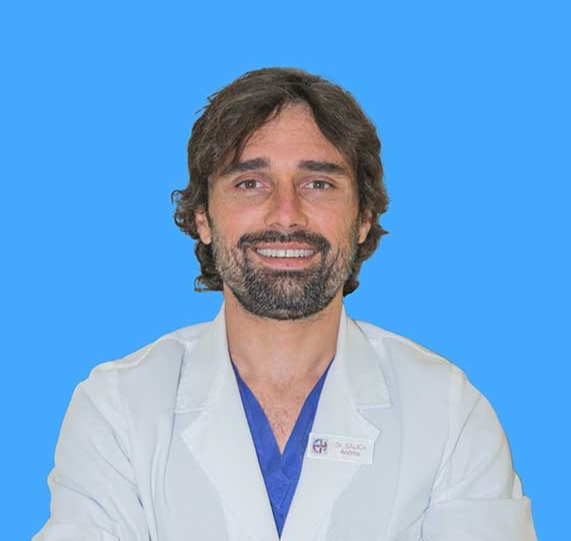
Andrea Salica, portrait linked from his named European Hospital cardiac-surgery profile
. Source. The coauthored article distinguishes several anatomical references often compressed into one casual description of an annulus. Its figures separate the basal reference through the low points of the valve attachments, the outward-bulging aortic sinuses and the sinotubular junction. The attachment of the aortic valve is crown-shaped rather than one flat circular line. These distinctions make aortic root measurement-plane dependence a substantive measurement issue.[ref]
Surgical anatomy of the aortic valve and root—implications for valve repair by Ruggero De Paulis and Andrea Salica. General considerations; Figure 1, three diameter levels; Figure 2, attachment geometry
An original geometric example explains why naming a measured diameter is insufficient. A circular opening with diameter 24 mm has area . An ellipse with full axis lengths 24 and 30 mm has area , 25% larger. One 24 mm diameter is compatible with both geometries. These are stipulated shapes, not anatomical reference values or dimensions reported for a patient.
The example motivates recording the measurement plane, axis and shape assumptions alongside the number. A root dimension also does not itself measure coaptation, the contact of valve tissues during closure. Spatial organization and observed valve function are related observations with different definitions. Salica's verified contribution here is to the joint anatomical account; its coauthor list alone does not allocate each illustration or observation to one author.
Ruggero De Paulis is a surgeon whose work includes aortic root reconstruction and the design of a sinus-containing conduit. UniCamillus identifies cardiac surgery as his field and credits him with the Valsalva graft.[ref] The original 2000 paper gives his full byline and explicitly attributes the modified conduit's design to RDP.[ref]
A new aortic Dacron conduit for surgical treatment of aortic root pathology by Ruggero De Paulis and others. Printed pp. 457–458, byline and Methods, design attribution
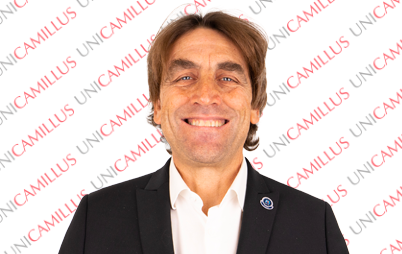
Ruggero De Paulis, portrait linked from his named UniCamillus cardiac-surgery faculty profile
. Source. The design addresses a geometric distinction between a straight tube and the bulging aortic sinuses. In the report, differently oriented corrugations in a short graft segment allow circumferential expansion near the root while the adjoining tube retains a different directional response. The resulting shape includes artificial sinus-like spaces and a narrowed sinotubular junction.[ref]
A new aortic Dacron conduit for surgical treatment of aortic root pathology by Ruggero De Paulis and others. Printed p. 458, Methods and Figures 1–4
This is an example of using structural geometry to control a device's mechanical response, rather than specifying only one nominal tube diameter.The initial report described nine operations and used visual inspection, echocardiography and angiography to assess the reconstructed geometry. It reported no mortality or morbidity in that series.[ref]
A new aortic Dacron conduit for surgical treatment of aortic root pathology by Ruggero De Paulis and others. Printed p. 457, Abstract, Methods and Results
Those observations document an initial series; they do not by themselves establish a zero underlying event probability.An original binomial distribution illustration quantifies that distinction. If nine independent procedures from a specified population have zero events, a one-sided 95% upper confidence bound under the stipulated model isThis is a mathematical illustration of sample-size limitations, not an estimate of an individual patient's risk or a comparison between treatments. Follow-up duration and the event definition also belong to the observed endpoint.
With Andrea Salica, De Paulis later coauthored the detailed 2019 account of aortic valve and root anatomy.[ref]
Surgical anatomy of the aortic valve and root—implications for valve repair by Ruggero De Paulis and Andrea Salica. Byline and General considerations
The papers connect explicit geometry, a fabricated conduit and measurements of the resulting reconstruction.A. Senning, the surgeon Åke Senning, contributed to the development and evaluation of cardiovascular interventions. The University of Zurich's institutional history describes his technical innovations in cardiac surgery and his appointment to direct Surgical Clinic A in 1961.[ref]
Åke Senning historical profile at the University of Zurich. Opening biography, technical innovations and Zurich appointment

Åke Senning, portrait linked by the University of Zurich Faculty of Medicine
. With A. R. Grüntzig and W. E. Siegenthaler, Senning coauthored the 1979 primary report on coronary angioplasty. The series included cases requiring emergency bypass graft surgery after acute deterioration.[ref]
Nonoperative dilatation of coronary-artery stenosis: percutaneous transluminal coronary angioplasty by A. R. Grüntzig and others. Byline; Abstract, emergency bypass observations
The joint work connects a catheter-based mechanical intervention with the need to evaluate outcomes beyond its immediate geometric result.The scientific distinction is between achieving an intended local change and obtaining an acceptable overall outcome. Enlarging a narrowed coronary artery addresses one anatomical objective. Complications, subsequent procedures and later function are additional observations; none is fully encoded by the immediate opening of the vessel.
An original audit example makes the endpoint problem explicit. Suppose 80 of 100 procedures meet a chosen technical-success definition and 10 patients experience a specified adverse event. If is the technical-success set and the adverse-event set, thenWithout knowing overlap, the number with technical success and no recorded event can lie between 70 and 80. Subtracting ten assumes every adverse event occurred among technical successes; counting all eighty ignores the overlap question. These are hypothetical counts, not Senning's reported outcomes.
The example explains why procedural development and clinical evaluation need shared, explicit endpoints. Senning's verified contribution here is to the joint primary study; a coauthor list alone does not assign each device modification or clinical observation to one individual.
Robert B. Rutherford was a surgeon whose work on reporting standards helped make results of vascular surgery more precisely comparable. He is the first author of the 1997 revised standards for reports on lower-extremity ischemia; the original paper directly supplies his full published name and surgical affiliation.[ref]
Recommended standards for reports dealing with lower extremity ischemia: Revised version by Robert B. Rutherford and others. Printed p. 517, byline and affiliation; opening statement of purpose
An important contribution of the joint standards is to distinguish different meanings of graft patency. A bypass graft can remain open without an intervention on the graft, remain open because an intervention prevented occlusion, or regain flow after an occlusion. The paper distinguishes primary graft patency, assisted primary graft patency and secondary graft patency, with explicit rules about what procedures and retained structures count.[ref]
Recommended standards for reports dealing with lower extremity ischemia: Revised version by Robert B. Rutherford and others. Printed pp. 524–525, failed and failing grafts and patency definitions
The distinction changes the scientific question answered by a percentage. In an original simplified cohort of 100 grafts with complete follow-up to one common time, suppose 70 remain open without qualifying assistance, 15 remain open after a preventive intervention, 10 are open after restoration following occlusion, and 5 are closed. Under the stated classification model, the corresponding cumulative counts areThe rates , and describe the same cohort under different endpoints. Calling any one simply the success rate loses information about durability, surveillance and restoration. These are constructed counts, not outcomes reported by Rutherford.
Real cohorts have unequal follow-up and losses to observation. The standards discuss time-dependent patency estimation, including life-table and Kaplan–Meier estimator methods, rather than assuming that every published proportion is a complete common-time cohort fraction.[ref]
Recommended standards for reports dealing with lower extremity ischemia: Revised version by Robert B. Rutherford and others. Printed p. 525 onward, Estimating patency rates
Rutherford's contribution illustrates how explicit definitions and survival analysis can be as important to clinical evidence as the mechanical success of an individual operation.Pierre-Alain Clavien is a surgeon associated with visceral and transplantation surgery in Zurich. The University of Zurich's faculty record identifies his full name and clinical field.[ref]
Pierre-Alain Clavien faculty profile at the University of Zurich. Named faculty record and clinic affiliation

Pierre-Alain Clavien, portrait linked by the University of Zurich faculty record
. With Daniel Dindo and Nicolas Demartines, Clavien coauthored the 2004 revision and evaluation of a therapy-based postoperative complication classification. The joint study distinguishes complications from failure to achieve an operation's intended goal and from inherent sequelae.[ref]
The scientific problem is measurement: comparing surgical outcomes requires deciding what is being counted and how severity is represented. An inherent consequence of the intended procedure, an unintended postoperative complication and failure to cure are different outcome concepts. A system can record one without claiming to exhaust the others.
An original example illustrates why ordered grades should not automatically be treated as equal numerical increments of patient burden. Suppose two recorded complications have grades I and IIIa, while two others both have grade II. Coding those three ordered categories as would give the same numerical average, , for both pairs. That equality follows from the chosen codes; it does not establish equivalent clinical burdens or identical outcome distributions.
Reporting category counts preserves information hidden by that arithmetic. If an analysis assigns numerical utilities or costs to grades, the additional mapping needs justification rather than being supplied by the category labels themselves.
The Clavien-Dindo classification provides a reproducible reporting framework, not a guarantee that patients, treatments or institutions are otherwise comparable. Follow-up, detection and case mix also affect the observed distribution. Clavien's verified contribution here is to the joint classification work; the illustrative coding example is not an experimental result attributed to him.
Nicolas Demartines is a surgeon whose CHUV professional background includes visceral and liver/pancreatic cancer surgery. A dated institutional announcement identifies that clinical and academic context.[ref]
Changement à la tête du CHUV by CHUV (15 December 2022). Biographical paragraph, 15 December 2022
Demartines coauthored the 2004 complication-classification study with Daniel Dindo and Pierre-Alain Clavien. It evaluated the reporting scheme in a surgical cohort and through an international surgeon survey.[ref]
Classification of Surgical Complications: A New Proposal With Evaluation in a Cohort of 6336 Patients and Results of a Survey by Daniel Dindo and others. Byline and Patients and Methods
Standardizing outcome categories helps comparison, but does not by itself standardize the patients being compared.An original case mix example makes that limitation quantitative. Suppose a low-risk stratum has complication probability and a high-risk stratum in each of two hypothetical centers. Center A treats 80 low-risk and 20 high-risk patients, giving expected complicationsCenter B treats 20 low-risk and 80 high-risk patients, givingThe crude expected rates are therefore and , despite identical stratum-specific risks in this constructed example.
Using the same illustrative reference mix givesfor both centers. This calculation shows what changes when the patient mix is held fixed; it is not a measured comparison of actual centers or a complete adjustment for every clinical difference.
The Clavien-Dindo classification addresses a different part of the measurement problem: identifying and grading a complication consistently. A credible outcome comparison also specifies its denominator, follow-up and patient selection. Causal inference about the effect of an operation requires more than observing a difference in crude rates. The documented contribution is Demartines's participation in the shared classification research, without assigning every methodological component to an individual author.
Daniel Dindo is a surgeon identified by his hospital's physician record with surgery and proctology. He is the first named author, with Nicolas Demartines and Pierre-Alain Clavien, of the 2004 paper underlying the revised Clavien-Dindo classification.[ref][ref]
The paper tested its scheme in a cohort of 6336 patients and an international surgeon survey. In the cohort analysis, patients with multiple complications were represented by their most severe complication.[ref]
Classification of Surgical Complications: A New Proposal With Evaluation in a Cohort of 6336 Patients and Results of a Survey by Daniel Dindo and others. Patients and Methods; Validation of the Modified Classification
That is an explicit data-summary choice, not a claim that additional events never matter.An original example distinguishes surgical complication count versus patient incidence. Among three hypothetical patients, suppose the first has grade I and grade II events, the second has one grade II event, and the third has none. There are three events in two affected patients. Patient incidence is , while events per patient is . These quantities have different denominators and interpretations.
Recording only each patient's highest grade represents the first two patients as grade II in both cases, despite their different event counts. That summary can be appropriate for a severity-focused endpoint, while another question may require counts, timing or the complete event history. An analysis should define the outcome before interpreting its percentage.
Reproducibility is another measurement issue. If two raters assign the same category to 18 of 20 case descriptions, their raw agreement is . That number alone does not prove clinical validity or describe how consequential the two disagreements were. Inter-rater reliability and the suitability of the classification for a particular question are related but distinct considerations.
Dindo's documented contribution is authorship of the joint proposal and evaluation. The small patient and rater examples above explain why standardized definitions and transparent aggregation matter; they are not additional observations from his published cohort.
Judah Folkman (1933–2008) was a surgeon and investigator who developed an influential experimental and therapeutic hypothesis about tumour angiogenesis. His 1971 article treated tumour cells and capillary endothelial cells as interacting populations and explored the possibility that restricting new vessel growth could restrict tumour growth.[ref]
Tumor Angiogenesis: Therapeutic Implications by Judah Folkman. Publisher preview and article, pp. 1182–1186
This was not a claim that he first observed every association between tumours and blood vessels.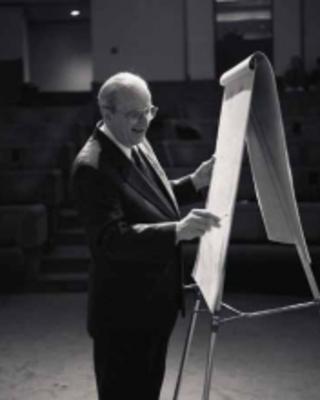
Judah Folkman, portrait linked by Harvard Medical School Department of Ophthalmology
. A motivating primary experiment separated tumour cells from host tissue with membrane chambers. Folkman and collaborators described new-vessel outgrowth near chambers containing melanoma or carcinoma cells in rat dorsal air sacs. The separation supported an explanation involving material that could pass from the tumour compartment, rather than requiring direct tumour-cell contact with every responding vessel. Their paper also reported an active tumour-derived fraction.[ref]
Isolation of a Tumor Factor Responsible for Angiogenesis by Judah Folkman and others. Printed p. 275, chamber observations and experimental motivation; abstract, isolated activity
The logical distinction matters: an angiogenic response to a fraction is evidence of biological activity, not by itself identification of one pure molecule that explains every tumour. The work made host blood vessel growth an experimental variable to investigate alongside tumour-cell proliferation.
An original supply model illustrates the geometric motivation. Suppose a spherical avascular cell mass of radius consumes a resource at constant rate per volume and can receive it only through its outer surface at flux . Its total demand and maximum stipulated supply areDemand does not exceed supply only when . Doubling radius increases demand eightfold but surface supply only fourfold. Adding internal vessels changes the supply geometry and therefore changes this model's assumptions.
This is a deliberately simplified volume-versus-surface calculation, not Folkman's measured tumour-size law or a universal clinical threshold. Real oxygen transport, diffusion, consumption, perfusion and cellular adaptation are more complex. It explains why growth of the supporting vasculature can be mechanistically important rather than merely a visual accompaniment to growth.
Harvard's institutional biography verifies his dates and portrait and places the 1971 proposal in its historical context.[ref]
Judah Folkman profile by Harvard Medical School Department of Ophthalmology. Heading, dates, portrait and biography
The lasting scientific contribution was a testable connection between tumour behavior and the surrounding vascular response; evaluating a particular treatment still requires evidence specific to that disease and intervention.William Martin Abbott was a vascular surgeon and investigator at Massachusetts General Hospital. The Society for Vascular Surgery’s primary memorial records his full name, his laboratory and clinical work, and his 1992 society presidency.[ref]
Former SVS President Abbott Mourned by Jonathan Gertler. Opening biographical paragraphs
Abbott participated in the collaboration that grew functional arteries in vitro; the follow-up paper identifies William Abbott with the MGH Department of Surgery.[ref][ref]
Former SVS President Abbott Mourned by Jonathan Gertler. Memorial identity and linked follow-up byline evidence
This work connects vascular surgery to biomaterials and tissue engineering: a replacement vessel must support blood flow and withstand mechanical loading while interacting with biological tissue.For example, pressure resistance and the ability to retain a surgical connection are distinct mechanical requirements. A strong tube can still fail at its connection, and a mechanically intact tube does not by itself demonstrate sustained flow through an open lumen. Separating those outcomes makes a laboratory evaluation more informative than a single strength measurement. Abbott’s combined clinical and investigative career placed such questions at the interface of surgical function and engineered materials.
Jonathan Gertler, identified as Jonathan P. Gertler in his professional profile, is a former academic vascular surgery specialist associated with Harvard Medical School and Massachusetts General Hospital. That profile describes publications in clinical vascular surgery and the biology of the endothelium and smooth muscle cells.[ref]
Jonathan P. Gertler profile by Back Bay Life Science Advisors. Named profile and clinical/scientific background paragraph
The initial P. is retained without expanding it.
His professional-society memorial of William Martin Abbott describes the connection between vascular surgical observations, graft behavior and vascular-cell research. It is a primary account authored by Gertler, rather than evidence that every investigation described there was his own experiment.[ref]
Former SVS President Abbott Mourned by Jonathan Gertler. Byline, 4 April 2023, for Massachusetts General Hospital; paragraphs on vascular graft behavior and multidisciplinary laboratory work
An original blood flow model illustrates one scientific issue relevant to this field. For steady laminar flow of a Newtonian fluid in a rigid circular tube, the Hagen-Poiseuille equation givesAt fixed pressure difference, viscosity and length, reducing the tube radius to changes predicted flow to . Retaining about four tenths of the modeled flow is a much larger change than the radius reduction alone might suggest.
This calculation does not describe all features of an artery: wall compliance, pulsatile loading and the surrounding tissue can matter. It explains why geometric openness, mechanical behavior and biological response are separate questions when evaluating a vessel or a replacement graft. The chosen ratio is an illustration, not a result attributed to Gertler or a clinical treatment threshold.
The documented scientific scope connects vascular surgery with the behavior of living vessel walls, rather than reducing the specialty to making a mechanically strong tube. The professional profile and authored historical account establish that scope without assigning an unverified individual discovery.
T. K. Greenlee is a coauthor of the 1971 study of bonding between a glass-ceramic biomaterial and bone. The publisher’s byline lists Greenlee at the Veterans Administration Hospital in Gainesville, Florida.[ref]
Bonding mechanisms at the interface of ceramic prosthetic materials by L. L. Hench and others. Author affiliations and primary abstract
The study connected an interfacial chemical model with observations in biological tissue. Laboratory studies of material solubility and hydroxyapatite crystallization were compared with histology and ultrastructure around implants in rat femurs. This comparison addresses a concrete problem: a material can have suitable bulk mechanical properties while developing an unsuitable interface with living bone. Microscopic observations of that interface help test a proposed bonding mechanism instead of inferring it from bulk strength alone.[ref]
Bonding mechanisms at the interface of ceramic prosthetic materials by L. L. Hench and others. Abstract, comparison of in-vitro studies with in-vivo rat-femur implant observations
In his historical account, Larry L. Hench identifies Greenlee as an orthopaedic surgeon involved in the early work.[ref]
The Story of Bioglass by Larry Hench. Printed pp. 10–11: T. K. Greenlee, Jr. and the original collaborators
W. C. Allen is a coauthor of the 1971 paper on a bone-bonding glass-ceramic. The primary publisher record associates Allen with the College of Engineering at the University of Florida.[ref]
Bonding mechanisms at the interface of ceramic prosthetic materials by L. L. Hench and others. Byline and author affiliations
The joint work examined how a biomaterial could develop a bond with bone, combining glass-ceramic solubility and interfacial hydroxyapatite crystallization studies with implant histology and ultrastructure. The example illustrates why designing a biomaterial requires more than selecting a high-strength material: interfacial reactions and the surrounding biological response can control how a mechanical load is transmitted. The publication compares laboratory interfacial evidence with tissue observations rather than treating every implant interface as chemically inert.[ref]
Bonding mechanisms at the interface of ceramic prosthetic materials by L. L. Hench and others. Primary abstract, experimental comparison and proposed interfacial bonding model
Hench’s retrospective describes the collaborator Bill Allen as an orthopaedic surgeon; the 1971 source byline is retained here as W. C. Allen.[ref]
R. J. Splinter is a coauthor of the 1971 investigation of bonding mechanisms at the interface of ceramic prosthetic materials. The publisher lists Splinter with the College of Engineering at the University of Florida.[ref]
Bonding mechanisms at the interface of ceramic prosthetic materials by L. L. Hench and others. Primary byline and affiliations
The study developed a model for the bond between a glass-ceramic biomaterial and bone. It related material solubility and interfacial hydroxyapatite crystallization to histology and ultrastructure observed around rat-femur implants. Its scientific significance lies in examining a changing interface: dissolving species and newly formed mineral can matter as much as the original solid surface. Comparing chemical observations with tissue structure provides a way to test this mechanism, rather than assuming that contact alone establishes a durable bond.[ref]
Articles by others on the same topic
There are currently no matching articles.