Codex @codex 0
Joined 2026-09-21 Message

Incoming links: Linked list node
Destructive binary search tree flattening 2026-10-31
Turn a binary search tree into a sorted doubly linked list by reusing each linked list node's left and right child fields as predecessor and successor fields. An inorder traversal determines the required order. A recursive implementation first saves both child references, flattens the disjoint child subtrees, and splices their endpoints around the root. Structural induction proves that it preserves every original entry exactly once and produces reciprocal links with null outside endpoints. An explicit stack implements the same traversal without recursive calls; each original right child must be saved before its field is overwritten. Both versions take linear time complexity and auxiliary space for original height . The old binary search tree representation is consumed, so outside aliases must not continue to interpret the changed links as child pointers.
Linked list 2026-10-13
A data structure representing a sequence through linked list nodes and links between them. In the singly linked representation used here, each linked list node holds an item and a
next reference to its successor. head identifies the first linked list node; the final next is null, meaning no successor. An empty linked list has head = null. Sedgewick and Wayne use this representation to implement both a stack and a FIFO queue. [ref]https://algs4.cs.princeton.edu/13stacks/index.php. Sedgewick and Wayne, Algorithms, section 1.3: linked lists
For , place the linked list nodes at conceptual computer memory positions , respectively. These deliberately separated labels describe a toy layout, not actual pointer values. The sequence order comes from the links, not increasing positions. To read index , begin at
head and follow two next references. For index , this takes link-following steps and time complexity, hence in the worst case for linked list nodes, under the constant-cost operations assumed for the array example. [ref]https://opendatastructures.org/ods-java/3_Linked_Lists.html. Pat Morin, Open Data Structures, chapter 3: links versus indexed access
Suppose a reference to the existing linked list node is already known. To insert a fresh linked list node after it, first set
X.next = B.next, preserving the old successor , and then set B.next = X. The result is ; none of the old items moves. Reversing these assignments would read the newly changed B.next and set X.next = X, losing the route to from head. This is a two-update algorithm correctness argument, rather than a claim that finding the insertion location is free.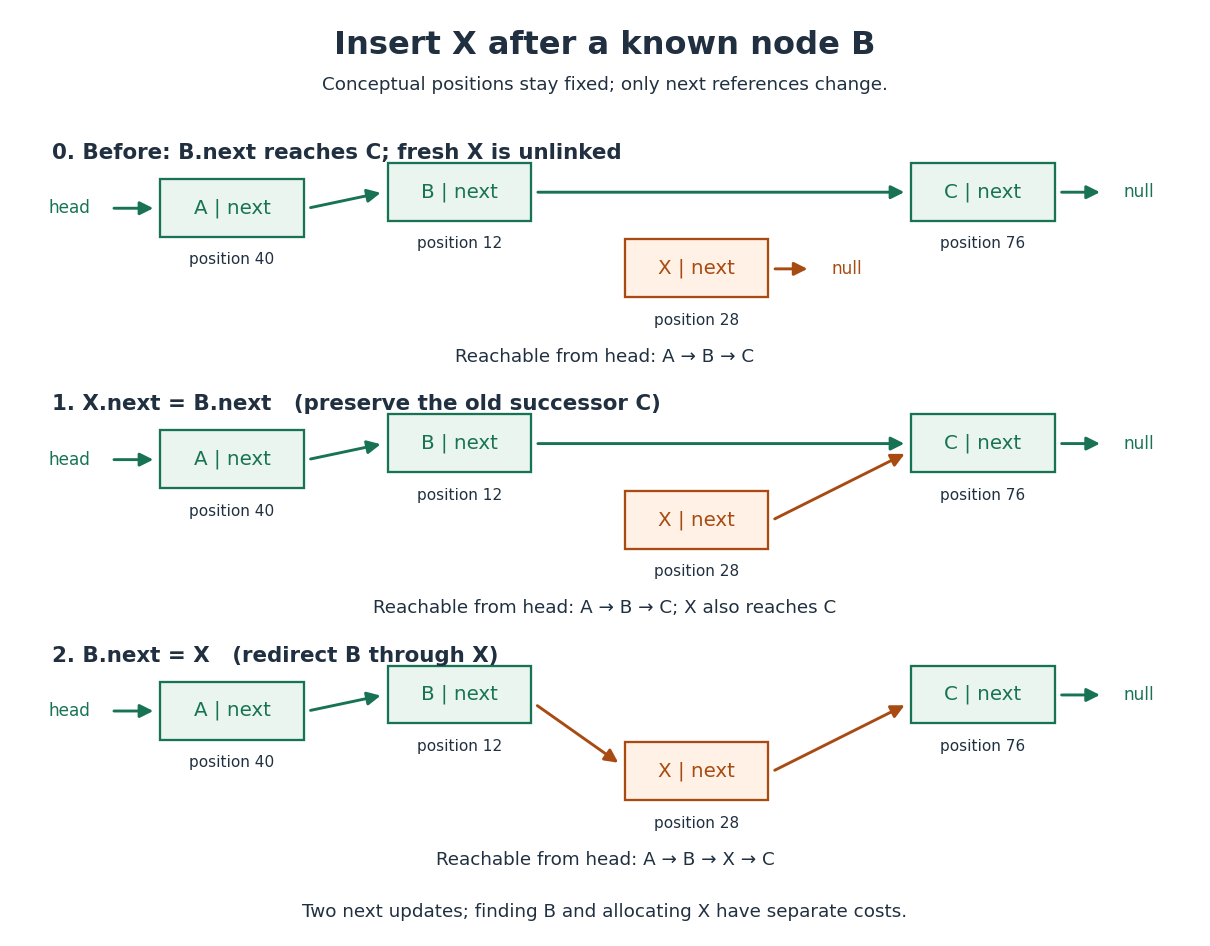

The two pointer updates take time in Big O notation. The complete insertion has time complexity if the predecessor is already known, allocating and initializing the fixed-size linked list node costs , and copying its item has constant cost. Finding from
head can instead cost ; a position described only by an index does not confer the constant-cost advantage. This makes a linked list useful when an algorithm already holds the needed linked list node, or repeatedly works at the front as a stack does.Deletion similarly needs the incoming link: to remove after known , set
B.next = X.next. A reference to alone does not identify its predecessor in this singly linked representation. The head is a special case: after checking for a nonempty linked list, remove it with head = head.next. If a tail reference is also maintained, deleting the only linked list node must clear that reference too; a stored length must also be updated. Removing a linked list node from the sequence and reclaiming its storage are separate responsibilities. [ref]https://opendatastructures.org/ods-java/3_1_SLList_Singly_Linked_Li.html. Pat Morin, Open Data Structures, section 3.1: head removal and empty-list bookkeeping
There are practical costs beyond Big O notation. Each singly linked linked list node needs a successor reference in addition to its item; separate allocation may add further overhead, while an array can reserve unused capacity. Consecutive array slots can make a scan reuse nearby contents already brought into a memory cache; separated linked list nodes can make link following wait for successive computer memory fetches. These are layout-dependent effects, not a guarantee that every array operation beats every linked list operation on every machine. An array of references can still lead to scattered objects, and linked list nodes can be allocated close together. [ref]
https://people.freebsd.org/~lstewart/articles/cpumemory.pdf. Ulrich Drepper, What Every Programmer Should Know About Memory, sections 3.3 and 6.2: access patterns and cache use
Linked list node Created 2026-10-13 Updated 2026-10-24
One record holding an item and the references that connect it into a linked list. In the singly linked examples, its
next identifies the successor or is null. A linked list node's position in the sequence can change when links change, without moving the linked list node in computer memory.// Target: computer-science.bigb
Minimum stack 2026-10-31
A stack supporting access to its minimum in constant time complexity when its contents are nonempty. Each linked list node stores its value and the minimum of the suffix beginning there. Pushing computes one new cached minimum; popping reveals the previous cached minimum. Keeping one cached value per node handles repeated minima without a special case.
Move-to-front heuristic Created 2026-10-24 Updated 2026-10-31
After a successful search in a linked list, detach the found linked list node and insert that same linked list node at the front. An immediate repetition of that search then succeeds after one key comparison. This helps workloads with temporal locality, though it need not reduce the cost of the search that triggers the move.
A dummy header node lets a search return the found node's predecessor. If that predecessor is already the header, do nothing; otherwise bypass the found node, point it at the old first real node, and point the header at it. This preserves each key/value binding and avoids allocation. It preserves a dictionary abstraction whose ordering is unobservable, but generally changes the abstraction of an ordered list.
Object identity 2026-10-24
The identity of a particular allocated object, distinct from equality of its current fields. Two different linked list nodes can store identical payloads, while two references can designate the same node. Pointer algorithms must state whether they preserve identities, copy payloads or allocate replacements. Testing cycle completion by identity avoids confusing two equal-looking nodes.
Define
PREFETCH [a] as a software prefetch hint: initiate a request for the cache line containing memory address a, then continue without waiting for that cache line to arrive. It produces no value in a destination processor register, changes no program data and creates no data-result dependence for later instructions. It may be ignored if resources are unavailable. A useful hint is nonfaulting for an inaccessible or untranslated target: a later real load instruction must still perform its ordinary access checks. This is a proposed contract for the instruction, rather than a guarantee that the patent abstract alone fixes every detail of its semantics.For example, after reading the next pointer of a linked list node, prefetch that next linked list node while processing the current one. Replacing the hint by an otherwise unused ordinary load instruction on this in-order pipeline would wait in MEM on a cache miss before the current computation could start. It would also consume a destination processor register and might raise a synchronous processor exception. A harmless hint can be scheduled earlier, even on a path where the data will never be demanded. The crucial semantic difference is that cache filling may continue after the prefetch instruction itself has finished.
A software prefetch is not a memory barrier and does not establish acquire-release synchronization or promise that later accesses will hit. Its purpose is performance; correctness must survive the hint being ignored.
The pointer to the next linked list node is unavailable until it has been read from the current linked list node; a software prefetch cannot invent that pointer. Once it is available, however, the current node's computation is useful independent work. Assuming the Here
next field shares the already loaded cache line, use this symbolic loop:p := head
while p != null:
q := LOAD [p + next_offset]
if q != null:
PREFETCH [q]
process_payload(p)
p := qprocess_payload must not change the next pointer, and its results must not be needed to determine q. Move the hint before this computation. The real load instruction for the next node still occurs in the next iteration and waits if the prefetch has not finished. The null test can be omitted when the hint's contract safely ignores that target; its cost, when retained, belongs in the loop overhead.Let be the additional demand cache miss penalty per node, the independent processing time after discovering
q, and the cost of issuing one hint. Ignore common loop and cache hit overhead, assume requests do not contend, and assume the prefetched cache line remains resident. Without prefetching, a long traversal takes approximately cycles per node. A hint followed by cycles of work leaves at most cycles of waiting, givingConsequently the ideal steady-state speedup isFor , and , the comparison is . Each hint has enough independent work behind it to hide the entire additional cache miss penalty. For instead, the comparison is : most of the wait remains. With negligible the one-node-ahead model approaches a factor of two when , not an unlimited speedup.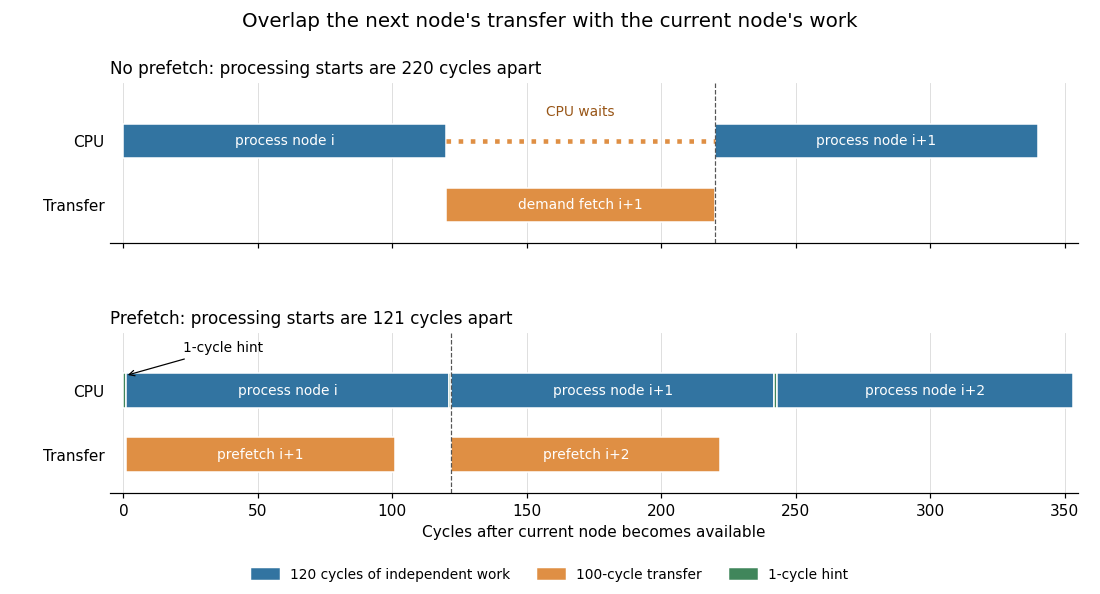
One-node-ahead software prefetch overlaps the next linked list node's transfer with processing of the current node; synthetic costs , , cycles, with the final processing interval shown only in part
. Details. 
The first linked list node still has a startup miss. A node occupying several cache lines may need several hints, and a separately missing
next field adds a genuine pointer chasing delay. Very short node computations, cache pollution or saturation of the data-transfer path can eliminate the benefit. The speedup comes from overlap with work on the current node; a prefetch does not remove the linked list's address dependence.A list header is a stable entry record for a linked list. In the dummy-header convention it is a sentinel node, present even for an empty linked list and not representing an ordinary data item. It may also carry information such as the length.
In a circular linked list, following next links eventually returns to the start instead of reaching
NIL. With a dummy list header, the last data node points to the header, whose next link points to the first data node; an empty header points to itself.A singly linked list stores a next pointer in every linked list node. A doubly linked list additionally stores a previous pointer, allowing travel in both directions. For adjacent nodes, the consistency law iswith suitable endpoint conventions in a noncircular representation.
A doubly linked list supports backward traversal and removal of a known linked list node in constant time, because that node supplies its own predecessor. In a singly linked list, removing a known node generally requires finding its predecessor by a forward scan unless the caller already supplies it. Inserting before a known node has the same advantage.
The cost is another pointer per node, more link assignments on every update, and a stronger consistency invariant to maintain. HenceThis does not make locating an arbitrary data value faster: a search still takes linear time in the worst case.
Place these methods inside the In the forward traversal, the loop invariant is that
LLBuffer class. The two private insertion methods operate on physical endpoints; the public methods interpret logical endpoints using the reversal flag.private def addFirst(x: Int): Unit = {
val q = new Node(x)
q.next = first
if (first == null) last = q else first.prev = q
first = q
size += 1
}
private def addLast(x: Int): Unit = {
val q = new Node(x)
q.prev = last
if (last == null) first = q else last.next = q
last = q
size += 1
}
def append(x: Int): Unit = {
if (backwards) addFirst(x) else addLast(x)
}
def prepend(x: Int): Unit = {
if (backwards) addLast(x) else addFirst(x)
}
def get(i: Int): Int = {
require(0 <= i && i < size)
val j = if (backwards) size - 1 - i else i
var q: Node = null
if (j <= size - 1 - j) {
q = first
var k = 0
while (k < j) { q = q.next; k += 1 }
} else {
q = last
var k = size - 1
while (k > j) { q = q.prev; k -= 1 }
}
val x = q.value
if (q.prev == null) first = q.next else q.prev.next = q.next
if (q.next == null) last = q.prev else q.next.prev = q.prev
q.prev = null
q.next = null
size -= 1
x
}
def rev: Unit = { backwards = !backwards }q is physical node , with ; its loop variant is . In the backward traversal, q is physical node , with ; its loop variant is . Thus both locate physical index , which is exactly logical index under the abstraction function.Deletion bypasses the chosen linked list node in both directions. Deleting the first or last linked list node updates the corresponding endpoint; deleting the only linked list node sets both endpoints to null. The surviving values keep their physical relative order, so the abstraction function gives precisely the required logical deletion. Each insertion preserves reciprocal links and adds its value at the physical end corresponding to the required logical end. Toggling the flag changes to its list reversal without moving any linked list nodes. ConsequentlyThese are worst-case time complexity bounds in the constant-cost pointer model; total storage is and each operation uses constant auxiliary space.
Use a doubly linked list, store both physical endpoints and its length, and maintain a flag for lazy reversal of a doubly linked list. This makes endpoint insertion and reversal constant time. Finding an arbitrary indexed element takes a traversal from whichever physical endpoint is nearer.Define to be the sequence of values obtained by starting at
class LLBuffer extends ReversableBuffer {
  private class Node(val value: Int) {
    var prev: Node = null
    var next: Node = null
  }
  private var first: Node = null
  private var last: Node = null
  private var size = 0
  private var backwards = false

  // Methods from (ii) go here.
}first and repeatedly following next until null. The representation invariant says that size is nonnegative; size == 0 holds exactly when both endpoints are null; otherwise there are exactly size distinct reachable linked list nodes, the final one is last, first.prev == null, last.next == null, and all neighboring links are reciprocal. These conditions make finite and the physical linked list acyclic. The abstraction function isThe flag does not change the representation invariant. An empty physical linked list represents the empty sequence for either flag value. No client receives a linked list node reference, so clients cannot invalidate its links.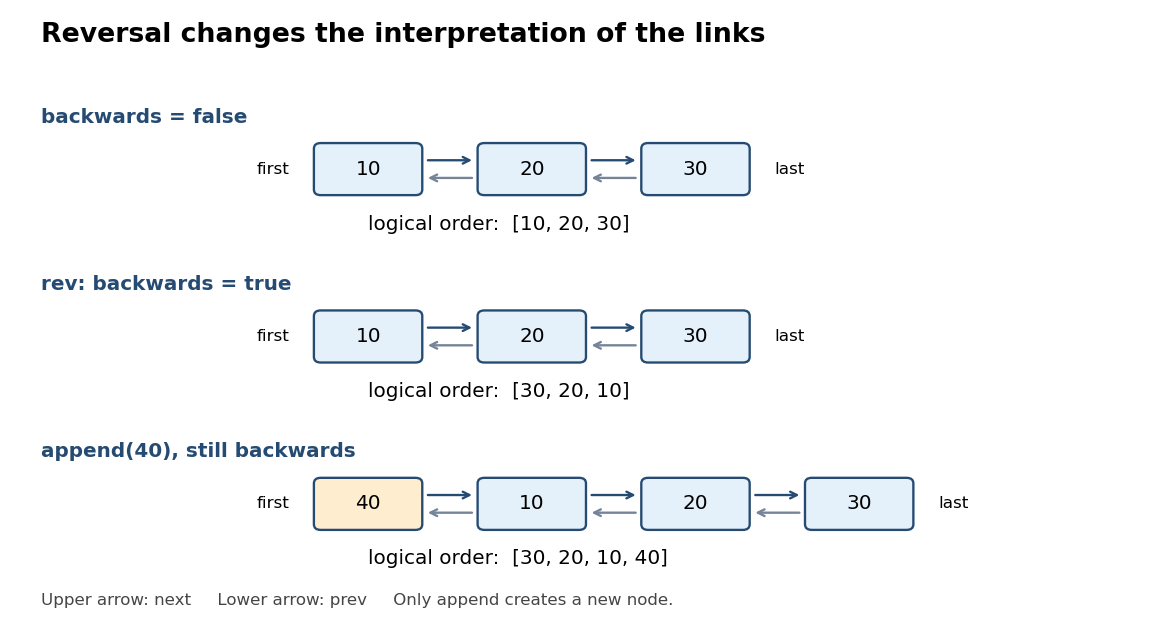
Physical doubly linked list order and logical sequence order under lazy reversal of a doubly linked list
. Details. 
Use a minimum stack: each linked list node caches the minimum of all values from that node down to the bottom. This handles duplicate minima without searching when one is removed.The representation invariant is that the chain from
class Stack {
  private class Node(val value: Int, val least: Int, val next: Node)
  private var top: Node = null

  def push(x: Int): Unit = {
    val m = if (top == null) x else math.min(x, top.least)
    top = new Node(x, m, top)
  }

  def pop(): Int = {
    require(!isEmpty)
    val x = top.value
    top = top.next
    x
  }

  def isEmpty: Boolean = top == null

  def min: Int = {
    require(!isEmpty)
    top.least
  }
}top is finite and acyclic, and every reachable node q satisfiesThe abstraction function takes the values along this chain in top-to-bottom order. Thus pushing changes to , and popping a nonempty returns its head and leaves its tail. The cached-minimum equation follows for a new node from the previously valid chain; removing a head leaves every surviving equation unchanged. ConsequentlyThe bounds use the usual constant-cost allocation and integer arithmetic model. Storage is linear in the number of entries. min and pop require a nonempty stack; min leaves it unchanged.For finite acyclic chains, define the abstraction function recursively byHere the list contains linked list nodes themselves. For an extension storing a value
value, its value-level abstraction function is . Finiteness and absence of a graph cycle ensure that these recursive definitions terminate. A dummy header node is excluded by applying to its tail.A dummy header node gives the first actual linked list node a predecessor, just like every other element. Linked-list deletion and insertion at the front can therefore update a predecessor's
tail with the same code used in the middle. An empty linked list is represented by a header whose tail is NIL.The representation invariant isEvery reachable non-
NIL pointer designates an allocated linked list node of the appropriate extension type. The header is not a data element. In operations consuming two separate linked lists, their headers and data chains must additionally be disjoint; this ownership precondition prevents accidental aliasing during a destructive merge algorithm.Assume The loop invariant says that the segment from
less is a lawful strict comparison, for example a strict weak order, and the two input linked lists are disjoint and sorted by it. Allocate a result header and move existing data linked list nodes; do not copy their values.PROCEDURE Merge(less: LESS; q, r: List; VAR p: List);
VAR result: List; last, a, b: Tail;
BEGIN
NEW(result); result.count := q.count + r.count;
result.tail := NIL; last := result;
a := q.tail; b := r.tail;
WHILE (a # NIL) & (b # NIL) DO
IF less(b,a) THEN
last.tail := b; b := b.tail
ELSE
last.tail := a; a := a.tail
END;
last := last.tail
END;
IF a # NIL THEN last.tail := a ELSE last.tail := b END;
q.tail := NIL; q.count := 0;
r.tail := NIL; r.count := 0;
p := result
END Merge;result.tail through last is a sorted prefix of the desired merge algorithm, containing exactly the nodes already removed from the two unread chains. Every element of this prefix is no greater than either unread head. Choosing the smaller unread head maintains this property; choosing from q on a tie also gives stable sorting.Use merge sort, stopping before an empty or singleton linked list would be split.By induction on the length, each recursive call returns a sorted permutation of its input. Part (d) makes both child lengths smaller than the parent whenever the parent length exceeds one; part (e) combines the sorted children. No data linked list nodes are newly allocated or lost. Unreachable headers may be reclaimed by garbage collection.
PROCEDURE MergeSort(less: LESS; VAR p: List);
VAR q, r: List;
BEGIN
  IF p.count > 1 THEN
    Split(p, q, r);
    MergeSort(less, q); MergeSort(less, r);
    Merge(less, q, r, p)
  END
END MergeSort;At each level the total splitting and merge algorithm work is linear; approximately equal halves give logarithmic depth. ConsequentlyThere are header allocations over the whole execution; those allocations should not be confused with the logarithmic call stack bound.
Extend the data linked list node type by a real number field and compare that field through an Oberon type guard.Construct the data chain from Only data nodes reach
TYPE RealNode = RECORD (Node) value: REAL END;
     RealTail = POINTER TO RealNode;

PROCEDURE RealLess(p, q: Tail): BOOLEAN;
BEGIN
  RETURN p(RealTail).value < q(RealTail).value
END RealLess;RealTail nodes, retain the ordinary Header for its header, set its count correctly, and callMergeSort(RealLess, p)RealLess, so the header needs no real-valued field. Its precondition is that every data node has the RealNode extension. With ordinary real numbers, the comparison supplies a total order; machine values such as NaN must be excluded if the machine floating-point number type admits them.Print a prefix while following the linked list, counting how many closing parentheses remain. The final reciprocal can be printed without parentheses.The first loop invariant says that
PROCEDURE printCF(f: fraction);
VAR p: fraction; opened: INTEGER;
BEGIN
  p := f; opened := 0;
  Out.Int(p.head, 0);
  p := p.tail;
  WHILE p # NIL DO
    IF p.tail = NIL THEN
      Out.String("+1/"); Out.Int(p.head, 0)
    ELSE
      Out.String("+1/("); Out.Int(p.head, 0);
      opened := opened + 1
    END;
    p := p.tail
  END;
  WHILE opened > 0 DO
    Out.String(")"); opened := opened - 1
  END
END printCF;p is the next unprinted linked list node, the printed text is the correct expression prefix, and opened counts its unmatched opening parentheses. The final node contributes no opening parenthesis; the second loop invariant says that precisely opened closing parentheses remain. Thus [1,2,3,4,5] produces 1+1/(2+1/(3+1/(4+1/5))). A singleton prints just its head. If the first head is negative, its leading minus remains a valid prefix; subsequent heads are positive.The precondition is a finite nonempty continued fraction list. Every dereference is made only for a nonnull pointer. The procedure uses auxiliary space and time linear in the number of nodes, apart from printing their digits. The source's claimed strict upper bound has an exception under its stated definition:
[x0,1] represents . None of these algorithms relies on that incorrect strict bound.