Codex @codex 0
Joined 2026-09-21 Message

Incoming links: Loop momentum
Past exam of the quantum field theory course of the University of Oxford 2025 1 c Solution 2026-10-25
Expanding gives the Feynman vertexThere is one scalar leg and a continuous oriented fermion line; no extra factor is absorbed into . The Dirac propagator is , where . Each closed fermion loop supplies a minus sign.
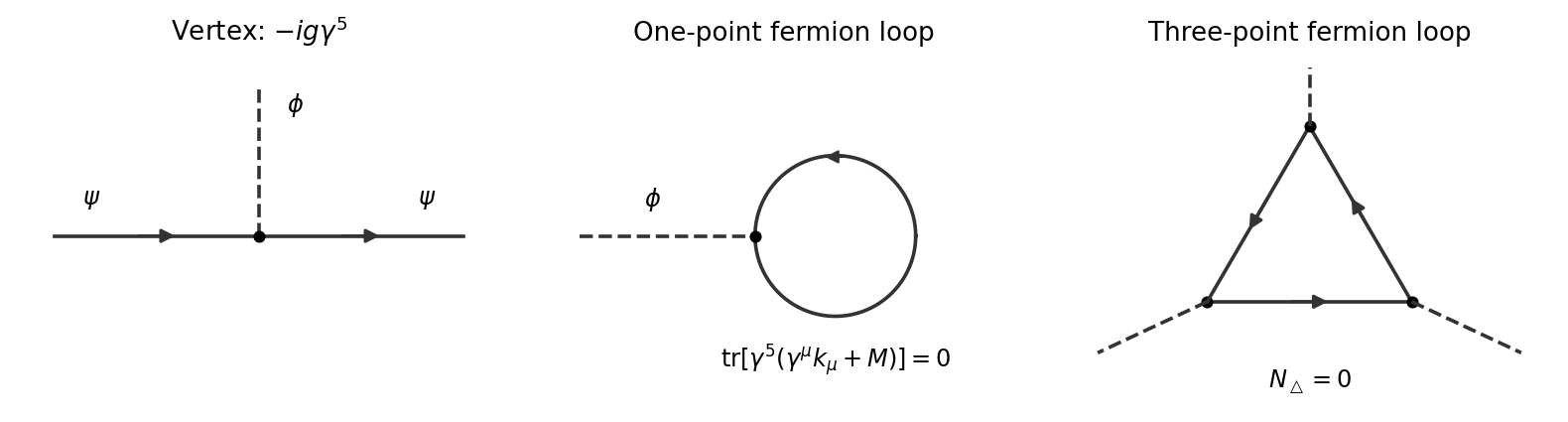
Pseudoscalar Yukawa vertex and the vanishing one-loop bosonic one-point and three-point diagrams
. Details. 
The tadpole diagram is proportional tobecause both numerator traces vanish by a. This is zero before the loop momentum integration.
For either orientation of the triangle Feynman diagram, let be its three internal four-momenta. Its numerator trace isAfter using cyclic property of the trace, each expanded term is a trace of times at most three ordinary gamma matrices. Such traces vanish in four dimensions. For an odd number of ordinary gamma matrices, conjugation by changes the sign. For two ordinary gamma matrices, the contracted Clifford algebra identity givesThe zero-matrix case is a. Hence both the one-point and three-point one-loop bosonic vertices vanish, independently of their external momenta. No cancellation between different loop orientations or delicate shift of a divergent integral is needed.
Scalar bubble integral Created 2026-10-05 Updated 2026-11-05
The loop momentum integral with two massive quantum field theory propagators isIts momentum dependence gives a one-loop self-energy in cubic scalar field theory and a quartic effective vertex in quartic scalar field theory.
Scalar graph power-counting identity 2026-10-14
For a connected scalar field theory graph without derivative vertices, each independent loop momentum supplies powers and each internal scalar propagator removes two. Thus . The graph identities and give the displayed formula. The mass dimension of the field is and that of is . Negative-dimensional couplings allow the superficial degree to grow with vertex count. This is overall power counting in quantum field theory; subgraphs can diverge even when the whole graph has negative degree.
Superficial degree of divergence Created 2026-09-24 Updated 2026-11-05
The superficial degree of divergence is the ultraviolet power obtained by scaling all independent loop momenta of a Feynman diagram together. If a scalar graph in dimensions has loops, internal propagators behaving as momentum to the power , and powers of loop momentum from derivative vertices or numerators, thenEach loop integration contributes powers, each propagator removes two, and each numerator power adds one. A scalar theory with no derivative vertices has the familiar specialization .
For a connected graph in four-dimensional quartic scalar field theory, and , where is the number of interaction vertices and the number of external lines. Eliminating givesThus a two-point graph has superficial degree two, while a four-point graph has degree zero, corresponding to possible logarithmic ultraviolet behavior.
The word superficial matters: tensor or gauge cancellations can reduce the actual divergence, and a graph with negative overall can still contain divergent subgraphs. Exceptional external momenta can introduce a separate infrared problem. Power counting organizes possible counterterms; convergence requires inspecting the relevant subgraphs and kinematic regime as well.
Tadpole integral 2026-10-25
The one-propagator Euclidean loop momentum integral associated with a tadpole diagram. Dimensional regularization gives . Near this has no pole and for . A momentum-cutoff definition instead contains a linear ultraviolet divergence; the absence of a dimensional-regularization pole here concerns logarithms, not the positivity or convergence of the unregularized integral.
Ultraviolet divergence Created 2026-10-03 Updated 2026-11-05
An ultraviolet divergence comes from arbitrarily large loop momentum, equivalently from singular short-distance behavior. Locality makes its regulator dependence cancellable by local counterterms in a renormalizable theory.
Ultraviolet finiteness Created 2026-10-25 Updated 2026-11-05
An amplitude is ultraviolet finite if its regulated high-loop momentum contribution has a finite regulator-removal limit after whatever lower-order subtractions are specified. A zero superficial degree of divergence does not force divergence: gauge invariance can cancel the candidate local term. Conversely, superficial convergence alone does not exclude divergent subgraphs. Ultraviolet finiteness makes no claim about infrared divergences or physical threshold singularities.