
Anthony W. Parker 2026-11-05
Anthony W. Parker, professionally known as Tony Parker, works on time-resolved spectroscopy of chemical and biological systems at the Central Laser Facility. His institutional profile describes Raman spectroscopy, infrared spectroscopy, two-dimensional infrared spectroscopy and development of spatially offset Raman spectroscopy.[ref]
One aim of time-resolved spectroscopy is to identify short-lived reaction intermediates rather than observe only the final products. A structural assignment comes from the spectrum; its changing amplitude can then constrain a kinetic model. Those two kinds of information support each other but are not interchangeable.
For an original idealized example, suppose an intermediate disappears in a first-order reaction and its baseline-corrected band amplitude is proportional to its concentration. ThenAt delay , the amplitude is , about36.8% of its starting value. A series of delayed measurements can estimate , whereas a single steady-state spectrum cannot determine that decay time. The model assumes a fixed band strength and a sufficiently fast measurement response.
Parker also coauthored the2022 study of RNA hairpin melting and refolding using a temperature jump and time-resolved infrared observation.[ref]
Measuring RNA UNCG Tetraloop Refolding Dynamics Using Temperature-Jump/Drop Infrared Spectroscopy by C. P. Howe and others. Byline and Abstract
This illustrates how a spectroscopic technique developed for transient chemistry can be applied to structural dynamics of nucleic acids. Barbara Procacci 2026-11-05
Barbara Procacci is a chemist whose work includes time-resolved nuclear magnetic resonance and infrared spectroscopy of photochemical reactions. Her University of York profile identifies mechanistic studies of light-induced transformations in metal complexes and development of NMR methods for following fast reactions.[ref]
The experimental strategy couples an initiating event to a later structural probe. A light pulse can perturb a molecular system; a measurement at a controlled delay then asks which products or intermediates are present. Repeating the measurement over delays connects spectral assignments with a reaction time course. A single final spectrum would lose that ordering information.
Procacci coauthored the2022 RNA hairpin refolding paper, which combines an infrared temperature jump with delayed spectroscopic observations during melting and cooling.[ref]
Measuring RNA UNCG Tetraloop Refolding Dynamics Using Temperature-Jump/Drop Infrared Spectroscopy by C. P. Howe and others. Title-page byline; Abstract; experimental method
Her contribution thus sits at the interface between a physical perturbation and a chemical interpretation of the response. An observed transient band must be related to a molecular change and to the measurement's timing; its occurrence after a pulse alone does not identify a unique reaction mechanism.
Clement Howe 2026-11-05
Clement Howe studied the melting and refolding dynamics of RNA hairpins and related DNA structures using infrared spectroscopy. His2023 University of York thesis identifies N. T. Hunt as supervisor and examines the influence of sequence and structure on these dynamics.[ref]
Howe was the first author of the2022 study combining a rapid temperature jump with a thin sample's rapid cooling to observe both melting and refolding of a UNCG tetraloop RNA hairpin and its DNA analogue.[ref]
A numerical comparison from that study separates forward and recovery dynamics. At70degrees Celsius, the reported melting times were microseconds for the RNA hairpin and microseconds for the DNA analogue, a ratio of about7.5. Their refolding occurred on similar timescales of roughly200microseconds. Similar recovery times therefore did not require similar melting times.[ref]
Gregory M. Greetham 2026-11-05
Gregory M. Greetham, known professionally as Greg Greetham, develops ultrafast spectroscopic instrumentation at the Central Laser Facility. His institutional profile describes work on the Ultra laser laboratories and their control systems, including two-dimensional infrared spectroscopy and femtosecond stimulated Raman spectroscopy.[ref]
Greg Greetham profile at the Central Laser Facility. Professional background and Ultra development
This instrumentation makes controlled pump-probe spectroscopy possible: one pulse initiates a change, and another probes the sample after a chosen delay. Pulse generation, timing, sample handling and acquisition all affect which molecular dynamics can be resolved. A faster probe alone cannot compensate for an initiating perturbation whose timing is poorly defined.
Greetham coauthored the2022 RNA hairpin refolding study, in which thin sample geometry enabled fast cooling as well as an initial temperature jump.[ref]
Measuring RNA UNCG Tetraloop Refolding Dynamics Using Temperature-Jump/Drop Infrared Spectroscopy by C. P. Howe and others. Byline; experimental description of sample geometry and cooling
The study illustrates the scientific role of instrument design. Following recovery toward the starting structure requires the thermal perturbation to relax on a useful timescale; a setup that only heats quickly can obscure the later folding dynamics.

Greg Greetham
. Externally hosted profile photograph linked from the Central Laser Facility's named staff page. Neil T. Hunt 2026-11-05
Neil T. Hunt is a physical chemist who uses ultrafast infrared spectroscopy to study molecular structure and dynamics. His York profile describes applications of two-dimensional infrared spectroscopy to proteins, DNA and their interactions, together with instrument development at the Central Laser Facility.[ref]
In two-dimensional infrared spectroscopy, a sequence of pulses distributes the response over two frequency axes. Diagonal and off-diagonal features reveal different information; correlations between vibrational modes can help distinguish structures whose ordinary absorption bands overlap. Hunt's account discusses this approach for proteins in water, where solvent absorption complicates observation of the protein bands.[ref]
Hunt also coauthored the2022 RNA hairpin study using a rapid temperature jump followed by sufficiently fast cooling to observe refolding directly.[ref]
The distinction is experimentally useful: an equilibrium spectrum records the population-weighted response after relaxation, while a time-resolved measurement follows how that response changes after a perturbation. Measuring the dynamics requires a known time reference and a sufficiently fast instrumental response, not merely a spectrum with narrow frequency bins.
RNA melting relaxation time 2026-11-05
An RNA melting relaxation time characterizes how quickly a perturbed RNA population approaches its new equilibrium. It belongs to a specified kinetic model, temperature, solution and measured signal. It is not an RNA melting temperature or, in general, the mean waiting time for an individual unfolding event.
For a reversible two-state RNA melting model, let be the first-order unfolding rate constant and the refolding rate constant. The unfolded fraction obeysAt fixed temperature,Both directions contribute to the return to equilibrium. For original stipulated values and , and . The mean lifetime of an isolated folded state in this model is , which differs from the observed population exponential decay time.
A temperature jump shifts populations rapidly enough to reveal the subsequent motion. A primary study used 4-ns heating pulses, a 12-μm sample path and time-resolved infrared spectroscopy to follow melting and refolding of a UACG-containing RNA hairpin. Thin-cell cooling enabled direct observation of the return process. Its loop is UACG, not a UUCG tetraloop.[ref]
Measuring RNA UNCG Tetraloop Refolding Dynamics Using Temperature-Jump/Drop Infrared Spectroscopy by C. P. Howe and others. Printed pp.9171–9172, sequence and pump/probe apparatus; Abstract, melting and refolding dynamics.
An RNA relaxation instrument-response correction may be needed if heating, detector response or cooling occur on comparable timescales. A changing sample temperature changes the equilibrium target during the measurement, invalidating a constant-temperature fit across the whole trace. Multiple kinetic states can also produce several decay components. One fitted exponential should therefore be identified as a model-dependent observed relaxation, rather than automatically assigned to a unique molecular step.
An RNA relaxation instrument-response correction accounts for the way an experiment's heating, detection and recording alter an underlying molecular transient. A measured RNA melting relaxation time can otherwise combine molecular kinetics with instrumental behavior. The response must be characterized for the actual apparatus and measurement conditions.
For an illustrative linear, time-invariant detector, let the normalized instrument response function be for . Suppose the ideal molecular signal is after excitation, and both vanish before it. Their convolution gives, for ,The recorded trace rises before decaying even though the assumed molecular transient begins at its maximum. Fitting the entire trace as one unblurred exponential would misdescribe the model.
An original example sets and . The measured signal peaks at with height . Its normalized temporal centroid is , rather than 10. These different time summaries cannot be substituted for one another.
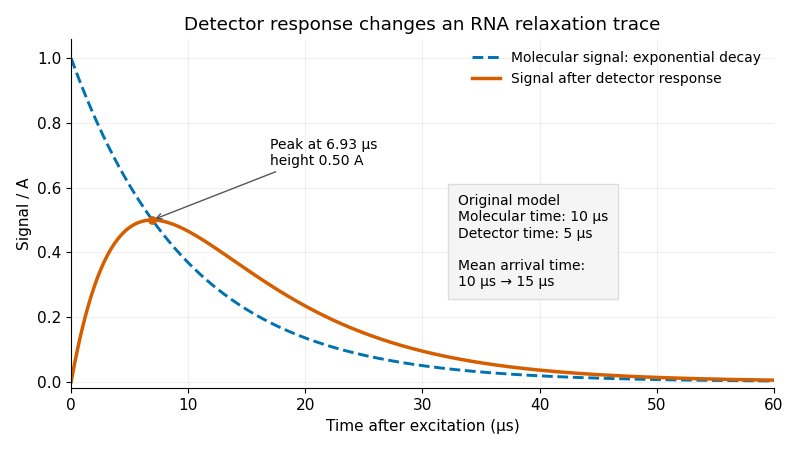
Original exponential RNA transient and its convolution with a finite instrument response function; stipulated molecular time10μs and detector time5μs
. Details. 
One useful approach predicts a molecular transient, convolves it with the characterized instrument response function, and fits that forward prediction to the data. Directly undoing a smoothing response can amplify measurement noise. Parameters that produce nearly indistinguishable recorded curves may remain difficult to determine separately.
Sample cooling is an additional physical process. A primary temperature jump study used a thin sample cell to accelerate cooling enough to observe RNA refolding, with separate infrared probe pulses following the transient.[ref]
Measuring RNA UNCG Tetraloop Refolding Dynamics Using Temperature-Jump/Drop Infrared Spectroscopy by C. P. Howe and others. Printed pp.9171–9172, thin-cell cooling and pump/probe measurement.
If temperature changes during a trace, the molecular equilibrium and rate constants may change too; detector convolution alone does not account for that changing input. The two-exponential example is a stipulated teaching model, not a fit to that paper.