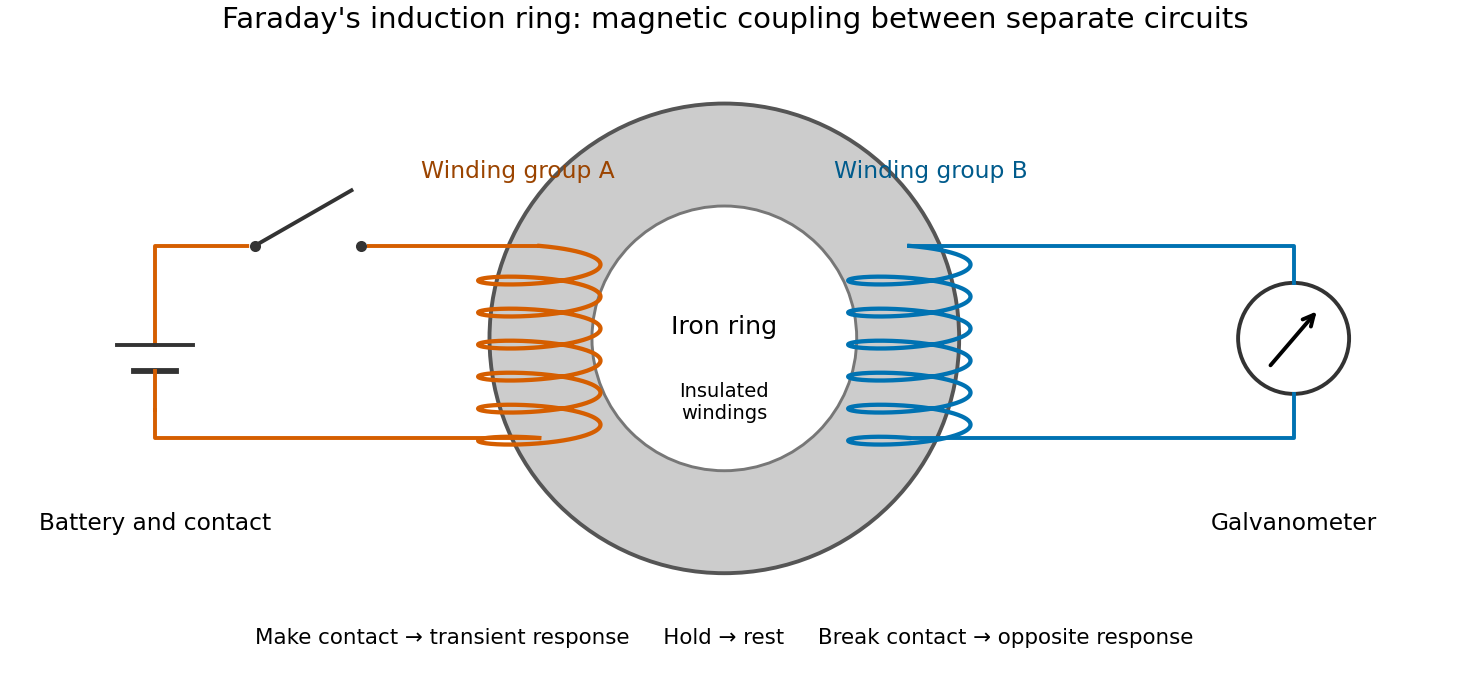
Michael Faraday's induction ring separates two questions: can one electrical circuit affect another without an electrical connection, and does that effect continue under steady conditions? The surviving apparatus uses insulated copper windings around an iron ring; the Royal Institution dates the successful experiment to 29 August 1831.[ref]
Faraday connected one winding group to a battery, the other to a galvanometer. Making battery contact deflected the needle; maintaining contact let it return to rest; breaking contact reversed the response. Reversing the battery reversed the deflections. His separate cylinder comparison enhanced induction with iron, whereas replacing it with copper gave no enhancement over the windings alone.[ref]
Figure 1.
Separate electrical circuits in Faraday's induction-ring experiment
. Original functional diagram. Each drawn winding represents a winding group; the illustration gives no historical turn count, dimensions or scale. The needle is the readout, rather than a plotted electric-current measurement. Source. Details.
The contrast between a switching response and a quiet steady state makes mutual induction tangible. A steady primary electric current can maintain magnetic flux without sustaining a secondary electromotive force. Changes in magnetic flux linkage matter, as expressed by Faraday's law of induction. This is why a driven electrical transformer uses repeated changes in magnetic flux to supply secondary power.
The galvanometer readout of an induction pulse also separates the measured motion from the inferred electric current. Its moment of inertia and damping mean that a deflection is not an instantaneous trace of electric current. The following coupled RL induction model calculates currents in a stipulated circuit, rather than fitting Faraday's needle motion or reconstructing his switching times.
Michael Faraday established new electrical phenomena through carefully varied experiments and made the field a central explanatory concept. His achievements were not confined to a single apparatus or to applications later expressed in equations by other researchers.
In 1821 he demonstrated continuous electromagnetic rotation: a current-carrying conductor could move around a magnet, or a magnet around a conductor, with the current maintained through an appropriate contact. The circular motion was difficult to reduce to an ordinary static attraction along a line and provided an experimental route toward electric-motor action.
In 1831 his induction experiments linked changing magnetic conditions to an induced electrical response. In the ring-coil arrangement, switching current in one winding produced a transient deflection in the other winding rather than a persistent response to a steady current. Moving a magnet relative to a coil produced a related effect. Comparing these arrangements helped identify change of magnetic linkage, rather than mere proximity to a magnet, as the essential feature. His rotating-disc generator showed a further way to obtain electrical output from mechanical motion.[ref]
His electrolysis studies established quantitative relationships between charge transferred and material deposited or liberated. These supported a connection between chemical change and definite electrical quantities, even though they did not yet amount to a modern atomic theory of charge. His work on dielectrics and electrostatic shielding examined how materials and conducting boundaries influence electrical effects.
In 1845 he observed magnetic rotation of the plane of polarization in a material and investigated diamagnetism. The magneto-optical effect gave experimental evidence for a connection between light and magnetism, while diamagnetism showed a response opposite to ordinary magnetic attraction. Those findings broadened electromagnetism beyond currents and permanent magnets.[ref]
Faraday's lines of force emphasized processes in the intervening region rather than only direct action at a distance. James Clerk Maxwell subsequently converted crucial parts of that field conception into a mathematical electromagnetic theory. Calling Faraday merely an unmathematical precursor would miss the explanatory and experimental content of his field ideas; crediting him with Maxwell's completed equations would be equally inaccurate. His legacy combines new effects, reproducible experimental techniques, quantitative electrochemistry and a fertile physical picture of fields.