Two routes to electric polarization are displacement and reorientation. An electric field can shift the centres of positive and negative electric charge in a neutral chemical atom or molecule, inducing an electric dipole moment. A polar molecule already has an electric dipole moment; a field biases its orientation. At finite temperature, random molecular motion opposes complete alignment, so a nonzero average need not mean that every electric dipole points the same way.[ref]
8.5 Molecular Model of a Dielectric. §8.5, Figures 8.19–8.20 and the thermal-fluctuation qualification following Figure 8.20
For a single species with number per unit volume , the electric polarization isThe brackets denote the local average electric dipole moment, rather than its magnitude. Opposite orientations can cancel while individual electric dipole moments remain nonzero.[ref] This averaging explains how an initially unpolarized material can respond strongly without acquiring net electric charge.
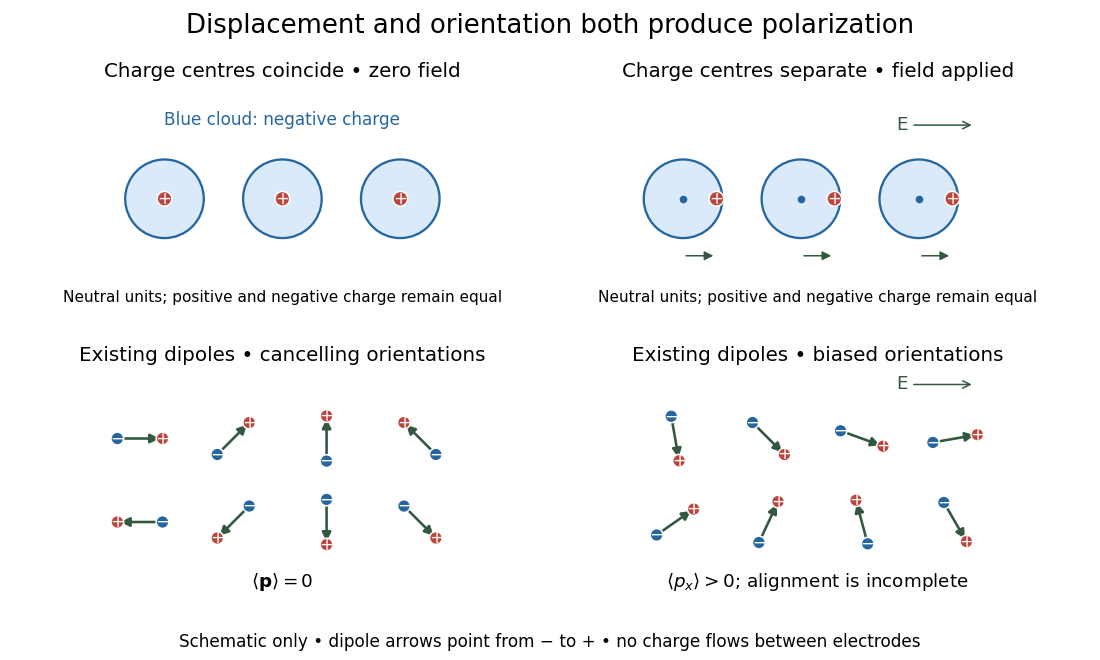
Two microscopic routes to electric polarization
. Original schematic: upper panels show coincident charge centres becoming separated; lower panels show existing electric dipoles changing from cancelling orientations to a biased distribution with incomplete alignment. Arrows run from negative to positive electric charge. Positions, displacements and orientations are illustrative, not measurements or a simulation of a particular substance. Details.
Articles by others on the same topic
There are currently no matching articles.