Evidence transfers at a stated level. Sequence alignment can suggest a candidate relationship between genes; functional complementation tests whether a candidate can supply a particular function in a chosen recipient. Neither alone establishes identical native gene expression, identical signal transduction, or identical consequences in every species. The yeast cross-species complementation experiment is especially useful because it tests a conserved function by intervention rather than assuming it from resemblance. [ref]
Pathways over Time: Functional Genomics Research in an Introductory Laboratory Course by Todd D. Reeves and others. Reeves et al. (2018), project design, pp. 3–4, and Course Activities, pp. 5–6
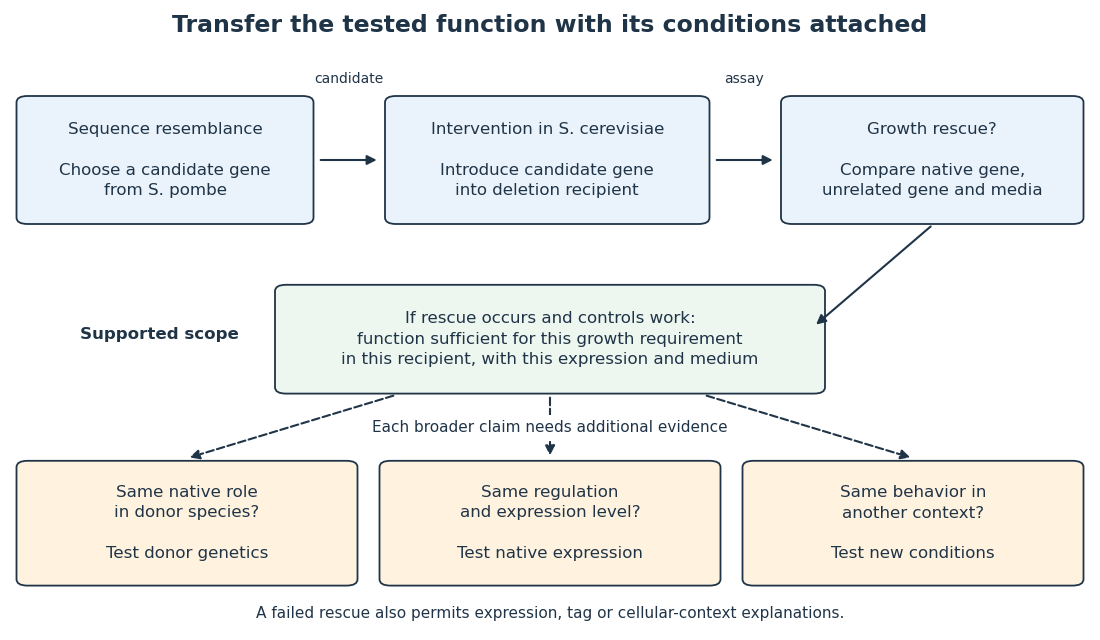

Even successful functional complementation occurs within a specific genetic background, nutrient supply and imposed gene expression. The enzyme may work with the recipient’s available substrates and partner proteins at an experimentally imposed abundance. Establishing the same role in the donor species calls for experiments there; establishing behavior under another condition calls for experiments under that condition. A conserved component can therefore coexist with context-dependent behavior of an entire pathway. This separation makes model organisms powerful: an accessible experiment supplies a precise mechanistic foothold and a better question for the next system.
Articles by others on the same topic
There are currently no matching articles.