Signal transduction converts a detected signal into a change inside a biological cell. For chemical signals, distinguish reception by a receptor, intracellular signal transduction, and the response: altered gene expression, enzyme activity or ion channel opening, for example. A cell-surface receptor can relay a ligand's presence across a cell membrane without the ligand entering the cytoplasm. Thus a hydrophilic signal need not cross the membrane to influence the interior. See Clark, Douglas and Choi, Biology 2e, 9.2: intracellular signal propagation.
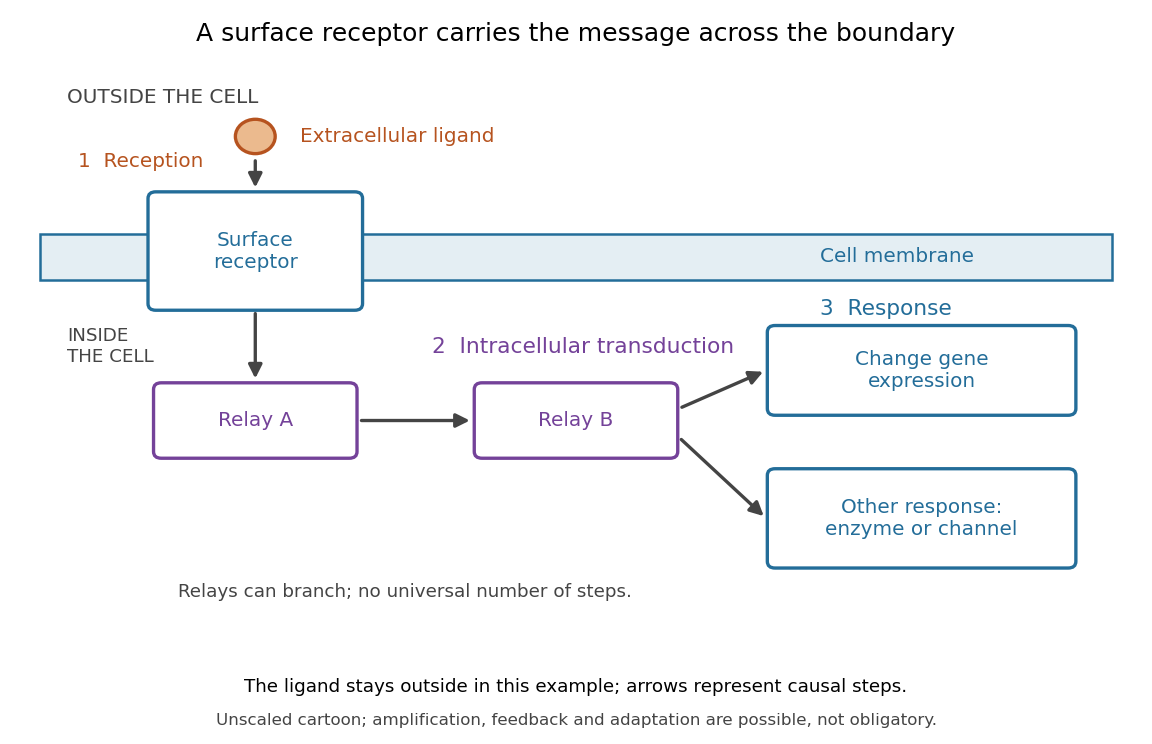
Reception, intracellular signal transduction and a cellular response
. Original cartoon of a ligand outside a biological cell, a cell-surface receptor spanning its cell membrane, and intracellular relays branching toward gene expression or another response. Arrows denote causal steps, not transport of the ligand through the membrane. Shapes, distances and relay counts are illustrative. Details.
For a computed example of possible signal amplification, suppose one activated receptor activates five relay proteins, and each relay activates twenty target proteins during a chosen interval. If the targets are distinct and available, targets are activated. Those assumed counts illustrate multiplication, not a measured pathway or a universal gain. Actual signal transduction can branch, saturate or inhibit activity. Changes in gene expression and changes in existing enzyme activity are different responses. See Clark, Douglas and Choi, Biology 2e, 9.3: cellular responses.
Signal amplification, signaling feedback and signaling adaptation are possible properties of signal transduction, rather than requirements of every cascade. Intracellular relays can use proteins or second messengers; different biological cells can interpret the same ligand differently because they contain different receptors and relay machinery. The useful and striking idea is that recognition and response are separable: an extracellular chemical message can control many internal tasks without itself performing those tasks. See General Principles of Cell Communication.
An original experimental route to this separation appears in T. W. Rall and Earl W. Sutherland's 1958 work on cAMP. They described a heat-stable factor formed from ATP in separated biological cell preparations; it affected enzyme activity in other preparations where the initiating chemical signals had no direct effect. This helped distinguish an initial signal from a molecule carrying its effect to another target. [ref]
https://doi.org/10.1016/S0021-9258(19)77422-5. Rall and Sutherland, Formation of a cyclic adenine ribonucleotide by tissue particles, Journal of Biological Chemistry 232 (1958), pp. 1065–1076, introduction
Articles by others on the same topic
There are currently no matching articles.