Choose a hypothetical fluid with molar constants and , using . These stipulated constants are not a fit to carbon dioxide. The molar critical formulas giveAt and , first convert to . The repulsive-volume term and attractive correction areso . The ideal gas law would instead give . The excluded volume raises pressure relative to that ideal value, but attraction more than offsets the increase here. Neither correction alone describes this example.
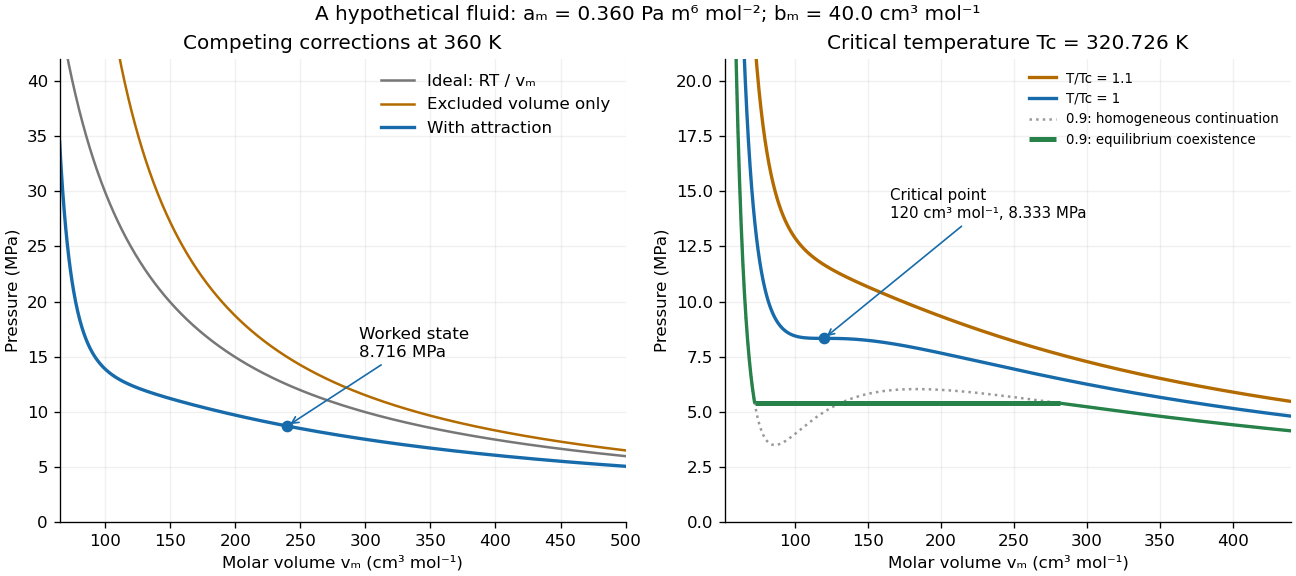

For , the same state occupies . The total-volume formula gives and the same . Halving the sample has halved both its physical volume and its excluded volume, while retaining its pressure. Conversely, if the two critical measurements are used to determine model constants, inversion givesAn independent critical molar volume then tests the prediction ; agreement with two fitted numbers does not ensure agreement with the third.
At , the Van der Waals liquid-gas coexistence example below becomes , , and . For a mean molar volume of , the lever rule gives gas mole fraction . Its volume fraction is instead : less than one quarter of the molecules occupy more than half the volume. The flat equilibrium pressure corresponds to changing these proportions. It does not describe a homogeneous sample sliding along the unstable loop.
Articles by others on the same topic
There are currently no matching articles.