Four water molecules contain eight hydrogen and four oxygen chemical atoms, twelve constituent chemical atoms altogether. Counting the constituents does not mean they have been separated by breaking chemical bonds. The same sample has different counts because the specified entities differ.
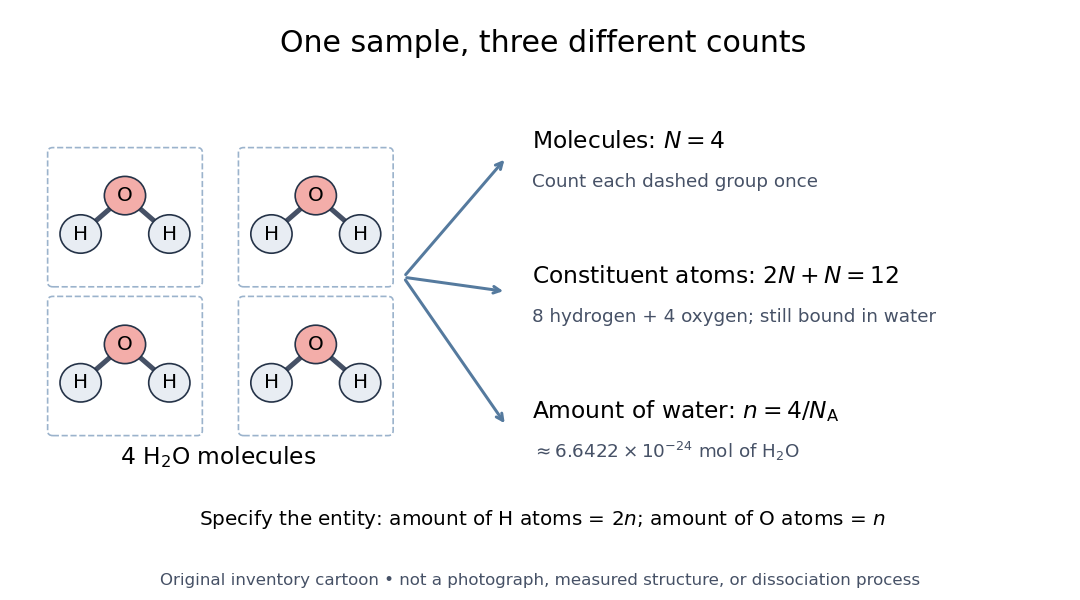

For water molecules, their amount of substance is , while the constituent hydrogen and oxygen inventories correspond to and respectively. The exact Avogadro constant is . The mole applies to specified entities, including chemical atoms, molecules, and ions.[ref]
SI base unit: mole by Bureau International des Poids et Mesures. SI base unit: mole, definition and the requirement to specify the elementary entity
Thus four water molecules correspond to approximately of water, but twice that amount of substance of constituent hydrogen chemical atoms. A macroscopic conversion through measured mass additionally needs the relevant molar mass, as in water mass to molecular count. Articles by others on the same topic
There are currently no matching articles.