Percolation theory asks how many local connections must be available before a large connected structure appears. Start with a graph, randomly retain some edges or vertices, and study the resulting percolation clusters. In independent bond percolation, every edge is open with probability , independently of the others. In independent site percolation, the random decisions concern vertices instead. A percolation cluster is a connected component of a graph formed by the available connections; an open path joins two vertices exactly when they belong to the same percolation cluster.
The attraction is that a local rule can produce a global change. One open edge says little about travel across a large graph. Many alternative graph paths can nevertheless make distant connections likely. The model separates the geometry of possible connections from the probability distribution of which connections are usable. This was the central perspective of Broadbent and Hammersley's 1957 paper, which discussed porous solids and disease transmission as interpretations of the same mathematical structure: [ref]
https://courses.physics.ucsd.edu/2019/Spring/physics235/Broadbent_Hammersley.pdf. Percolation processes I: Crystals and mazes, introduction
. Independent bond percolation supplies a simplified model of those systems; the physical interpretation still requires justification of its independence assumptions.For a completely calculable example, consider the four edges around a square and ask whether opposite corners and are connected. There are two graph paths, each using two edges. Each open path has probability . Their events are independent events because the paths share no edges, even though they share endpoints. The inclusion-exclusion principle therefore givesAt , the connection probability is , larger than the for either chosen graph path. Counting all sixteen equally likely edge configurations gives the same answer: two configurations with exactly two open edges, four with three, and one with four connect to . Connectivity benefits from alternative routes; adding their probabilities without subtracting their overlap would count the all-open configuration twice.
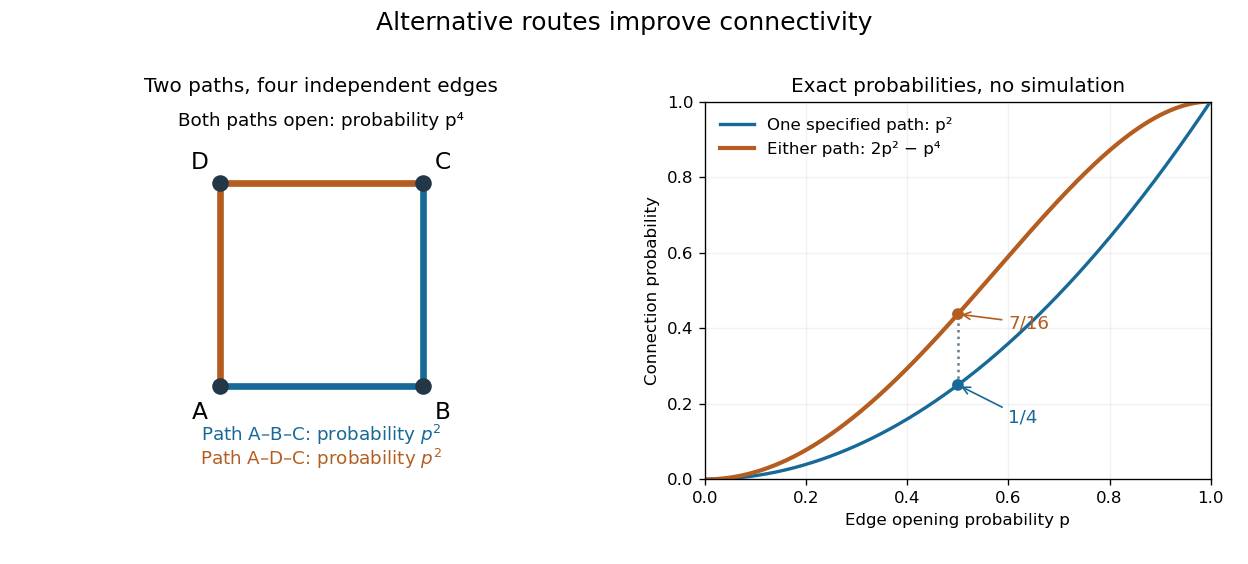
Two alternative paths increase the probability of connecting opposite corners
. Details. This finite calculation is already useful for studying redundant connections. The deeper question is what happens as the graph becomes arbitrarily large: does connectivity remain confined to finite percolation clusters, or can an infinite percolation cluster appear? The percolation probability and percolation critical probability make that question precise. A finite picture can illustrate the geometry, but cannot establish the existence of an infinite percolation cluster.
In bond percolation on a directed graph, independently open each directed edge with probability . The out-cluster of consists of vertices reachable by open directed paths. In site percolation, independently open vertices and require every vertex of the directed path, including , to be open. The same definitions allow a multigraph. The orientation matters: an infinite underlying connected graph need not contain an infinite out-cluster from a specified root.
Independently open vertices of a directed graph with common probability , and require every vertex of an infinite directed path to be open, including its root. Conditioning the root to be open changes the survival probability by a factor and does not change the critical probability. This model gives an independent comparison process in the independent oriented-percolation comparison for the contact process.
Independently open the bonds of a directed graph with a common probability , and ask whether an infinite open directed path starts at a specified root. On the oriented square lattice, edges run from to with even. The critical probability is the infimum of parameters with positive survival probability. The incoming-edge coupling of site and bond percolation compares this threshold with that of oriented site percolation.
Take a directed graph with vertices and parallel bonds from to . This is a locally finite graph, although the incoming degrees are unbounded. For bond percolation, whenever : the failure probabilities are summable, so the infinite product is positive. For site percolation, survival requires every vertex of the ray to be open, which has probability zero for . Thus the survival and susceptibility thresholds for directed percolation satisfy and .
Suppose every vertex of a directed graph has at most incoming bonds. In bond percolation with parameter , open a site whenever at least one incoming bond is open. Incoming bond sets have different heads and hence are disjoint, so these site indicators are independent random variables. Supplement their probabilities to . Every vertex reached by a nontrivial open directed path is now open. Conditioning the root to be open gives , since a simple directed path from the root never uses a bond entering the root. Thus .
For the out-cluster in directed percolation, define and , with value when the relevant set is empty below . The first is a survival threshold; the second is a percolation susceptibility threshold. Both depend on the root in a general directed graph. Exploring a site percolation cluster and using each fresh vertex coin for its first tested incoming bond gives a coupling of probability distributions with bond percolation such that and . Consequently and .
For critical site percolation on the triangular lattice, scaling-limit crossing probabilities transform naturally under conformal maps between planar domains. This rigorously established property supports descriptions of interfaces by SLE and calculations of planar percolation critical exponents. Transferring it to a different lattice or to bond percolation requires a separate universality argument.
An iterative expansion of long-range connectivity functions that separates an approximately random-walk contribution from corrections caused by loops and intersections. In suitable high-dimensional percolation models it controls these corrections and proves mean-field percolation exponents. It also applies to other models, including self-avoiding walks; its use always requires model-specific estimates.
In independent bond percolation with parameter , every edge of a graph is open with probability and closed with probability . The choices are independent random variables with a Bernoulli distribution. All vertices remain present; only the usable connections change. The percolation clusters are the connected components of a graph formed by the open edges, including isolated vertices.
A specified simple graph path with edges is an open path with probability , by independence. Connecting its endpoints is a different event: other graph paths may also connect them. The four-edge example in percolation theory makes that distinction explicit. Interpreting open edges as usable channels makes the model useful for connectivity questions; it does not by itself assign a travel time, flow rate, or capacity to a channel.
For the induced square lattice subgraph in , is the probability of an open graph path from its left boundary to its right boundary under independent bond percolation of density . Width and height count lattice spacings. Dual bond percolation exchanges failure with a top-to-bottom dual crossing of dimensions , with the usual exterior boundary vertices.
Take the increasing event that a finite square torus graph contains some long horizontal or vertical rectangle crossing. Translations and a quarter turn make this a transitive increasing event on its bonds. A positive critical crossing bound and the Friedgut-Kalai sharp threshold theorem make its supercritical probability tend to one. A bounded family of shorter, thicker rectangles intercepts every possible long crossing. The square-root trick for positively associated events transfers the high probability to each fixed intercepting rectangle. Using every possible translate would lose the useful bounded exponent.
A path in the underlying graph all of whose edges are open. Connectivity of open paths determines the percolation clusters. A ray in a graph with all edges open is an infinite ray in a graph.
If independent edges of a locally finite graph receive fair orientations, exploring outward from a root tests each fresh reached-to-unreached boundary edge with success probability . Deferred decisions give exactly the exploration law of the root cluster in bond percolation of density . Thus the two reachable graph vertex sets have the same distribution. An infinite out-cluster contains an infinite simple directed ray by the König infinity lemma. Geometrically biased orientations do not generally give the same uniform edge-success law.
Here is critical two-point connectivity. The condition controls the intersection effects that spoil a branching approximation. It is a sufficient criterion for important mean-field percolation exponents, including the order-parameter, percolation susceptibility and cluster-tail exponents. Establishing detailed spatial asymptotics is a further task, commonly addressed by lace expansion.
The two-point percolation two-point connection probability is the probability that two fixed graph vertices belong to the same percolation cluster. On a translation-invariant lattice it depends on their displacement. Restricting the permitted connecting graph paths to a subgraph gives the corresponding confined percolation two-point connection probability. The Harris-FKG inequality implies .
For bond percolation on the square lattice, write and . A maximal-probability boundary graph vertex can be placed at by symmetry. Reflection about identifies its connection probability from with that from . The Harris-FKG inequality yields for .
For nearest-neighbour bond percolation with on the strip , put . The Harris-FKG inequality and translation invariance imply . Thus is a subadditive sequence, and the Fekete lemma givesThe direct horizontal graph path gives . Enlarging the strip increases every percolation two-point connection probability, so is nonincreasing in and has a nonnegative limit of a sequence.
Let be the unrestricted planar two-point percolation two-point connection probability. Every finite connecting graph path is contained in some strip, so for each fixed . ThereforeThe equality uses commuting infima and monotonicity, not an unjustified interchange of two general limits. The right-hand side is the whole-plane connection decay rate by the Fekete lemma.
A vertical cut between consecutive columns of contains edges. All are closed with probability . Cuts in different columns use disjoint edges, so their closed-cut events are independent. A connection from column zero to column must cross each of the intervening cuts. ConsequentlyThis finite-width obstruction persists even when the unrestricted planar percolation is supercritical.
The independent edge law of bond percolation on is ergodic under lattice translations: every translation-invariant event has probability zero or one.
In bond percolation, a percolation cluster is a connected component of a graph formed by the open edges, with every graph vertex retained. In site percolation, it is a connected component of a graph of the subgraph induced by the open graph vertices. Write for the cluster containing ; for site percolation set when is closed.
Suppose the one-arm probability on the cubic lattice satisfies with . Define as the largest maximum-norm radius of any cluster rooted in . Then convergence in probability. An upper bound is a union bound over roots. For a lower bound, pack disjoint radius- boxes and use the independent first-hit connection events inside them. Clusters are finite almost surely under the positive-rate hypothesis.
An infinite percolation cluster is an open connected component of a graph with infinitely many graph vertices. On a countable translation-invariant lattice, a zero root percolation probability implies that no infinite percolation cluster exists almost surely, by the countable union over all graph vertices. A positive root probability implies almost-sure existence by translation ergodicity of Bernoulli percolation; uniqueness is an additional theorem.
For independent site percolation or bond percolation on the cubic lattice , there is almost surely at most one infinite percolation cluster at every fixed parameter. Above the percolation critical probability, there is exactly one almost surely. This theorem is called the Burton-Keane theorem. Existence uses translation ergodicity together with positive percolation probability; uniqueness is a separate conclusion. At uniqueness is deterministic.
For a connected infinite locally finite graph that is also an amenable graph and a quasi-transitive graph, an invariant independent site percolation law with every orbit parameter strictly between and has either no infinite percolation cluster or exactly one, almost surely. Invariance and independence give a zero–one law. The finite-energy property of Bernoulli percolation excludes a fixed finite number greater than one by opening a finite joining region. Infinitely many clusters would create an encounter box in percolation with positive probability; translated disjoint boxes then have positive density, contradicting the boundary count in a Følner sequence. The finite-energy hypothesis matters if some orbit parameters are or .
Independent bond percolation on has at most one infinite percolation cluster at every parameter, including a possible critical parameter. The number of infinite percolation clusters is constant almost surely by translation ergodicity of Bernoulli percolation. A finite constant larger than one is impossible: a box meeting two clusters can be made entirely open, joining them and decreasing that number with positive probability by finite modification of Bernoulli percolation.
If infinitely many clusters existed, a box would meet three with positive probability. Preserve one infinite exterior arm from each and replace the finitely many interior and boundary edges by a three-armed tree joining them, closing the remaining edges. Its branch graph vertex becomes a trifurcation vertex in percolation. Translation invariance therefore gives a positive density . But the trifurcation boundary-counting lemma gives for every large box, contradicting vanishing boundary-to-volume ratio. This proves uniqueness without assuming absence of an infinite percolation cluster at criticality.
An encounter box is a finite connected set of open vertices whose removal from its infinite percolation cluster leaves at least three infinite connected components. Unlike a trifurcation vertex in percolation, it allows branching to occur across several vertices, which is useful for site percolation on graphs with local cycles. Contract disjoint encounter boxes to junctions. In a finite region, each junction must connect at least three different exits. Pruning to a forest gives at most as many junctions as boundary exits, by the identity for a finite tree. Positive density of encounter boxes is therefore incompatible with an amenable graph.
A trifurcation graph vertex is a graph vertex of an infinite percolation cluster whose deletion separates that cluster into at least three infinite connected components of a graph. In a finite modification argument one may make it have exactly three open incident edges leading to three different infinite components. On a translation-invariant lattice, a positive probability of trifurcation at one graph vertex gives a positive expected density of trifurcations.
For a finite graph vertex set in a locally finite graph, let be its exterior graph neighbours. The number of trifurcation vertices in percolation lying in is at most .
For each cluster meeting , contract its connected components of a graph outside to terminal graph vertices, keeping only those adjacent to . The resulting incidence graph is finite and connected. Each trifurcation graph vertex in separates at least three groups of terminals, because every infinite branch must leave the finite set . Take a minimal subtree connecting all terminals. Each such trifurcation is unavoidable in that subtree and has degree of a vertex at least three. All leaves are terminals. The tree identity bounds the number of these branching graph vertices by the number of leaves minus two, hence by the number of terminals. Different terminals, even across different clusters, can be assigned different exterior graph neighbours. Summing proves the bound. For square boxes in , the boundary has order and the volume has order .
Delete a finite set of degree-three trifurcation vertices in percolation in each infinite percolation cluster and contract the remaining components to nodes. The incidence graph is a tree: a cycle would bypass an original trifurcation vertex in percolation. All leaf components are infinite, otherwise a graph vertex would have a finite branch after deletion. The tree degree identity gives at least two more infinite leaves than degree-three graph vertices. Distinct infinite components escape a containing box through distinct outer boundary graph vertices. Hence the number of counted trifurcations is at most the outer boundary size.
The percolation susceptibility is the expected size of the open cluster containing a specified root:
For translation-invariant independent bond percolation with finite percolation susceptibility , the BK inequality gives for , with . Prune a connecting open tree for the labelled vertices, suppress unmarked degree-two vertices, and split higher branching into binary branching with zero-length connections. There are binary tree topologies and connections. The connections have disjoint bond witnesses, so the BK inequality bounds their joint probability by a product of two-point connection probabilities. Summing successive leaves contributes for each connection. Since , this proves for . Finite percolation susceptibility therefore gives an exponential cluster-volume tail.
The percolation susceptibility is . Finiteness gives a boundary sum . The weighted BK boundary-splitting estimate then gives . The strict bound absorbs the finitely many smaller radii into a positive exponential rate with unit prefactor. At , all positive-radius connection probabilities are zero.
At critical planar percolation, the probability of an open crossing of a rectangle of any fixed aspect ratio stays bounded away from zero and one uniformly over its scale.
For independent bond percolation on the square lattice, a positive uniform lower bound for square crossings implies a positive uniform lower bound for rectangle crossings of every fixed aspect ratio . The RSW reflection extension lemma first extends a square to aspect ratio . Overlapping rectangles and transverse overlap-square crossings then glue using the Harris-FKG inequality. The required constant depends on and , not on scale. At a self-dual parameter, dual crossings also give a uniform upper bound below one.
For independent bond percolation on the square lattice at , square crossing probabilities bounded below by self-duality extend to a uniform positive bound for rectangles of aspect ratio . Expose an extremal vertical square crossing, reflect its geometry, and attach it to an exterior side through an unexposed independent region. Reflection symmetry bounds the attachment probability below. Two attachments and a horizontal square crossing join by the Harris-FKG inequality. Overlapping rectangles and transverse overlap-square crossings then give all fixed aspect ratios. Reflecting a geometrical graph path does not require its reflected edges to be open.
In a rectangle , , let require an open vertical crossing of the corner square attached to the rectangle's right side. Explore the leftmost vertical crossing of the square without inspecting edges to its right. Reflect its geometry in the line , obtaining a deterministic separator. Every horizontal rectangle crossing reaches this separator from the right; reflection divides these possible attachments into two equally probable choices, so the lower-half attachment has probability at least half the horizontal crossing probability. The required edges remain unexposed and independent of the explored crossing. Averaging proves the estimate. Reflected geometry need not be open.
For independent bond percolation on the cubic lattice, define and , with . Split an open self-avoiding walk at its first radius- boundary vertex . The remaining segment reaches distance at least from , using disjoint edges. The BK inequality, translation invariance and the union bound yield the displayed estimate. Keeping the individual connection weights can be stronger than replacing their sum by .
At for independent bond percolation on the square lattice, there exist and with . The Russo-Seymour-Welsh theorem and the Harris-FKG inequality give a uniform positive probability of a closed dual graph cycle around each geometrically spaced square ring. The independent annular barriers for percolation give the polynomial bound and imply zero critical percolation probability. This does not determine the exact critical exponent.
Closed dual graph cycles in disjoint square rings depend on disjoint primal edge sets. In independent bond percolation their barrier events are independent. If each event has probability at least , an open graph path from the origin across rings has probability at most . A geometric sequence of radii turns this estimate into the polynomial critical one-arm upper bound.
For bond percolation on the square lattice, put . Splitting an open self-avoiding walk at its first visit to the radius- boundary gives disjoint certificates for reaching a boundary graph vertex and then reaching radius about that graph vertex. The Van den Berg-Kesten inequality and the union bound give for positive . With and , the boundary-cardinality form holds for zero indices as well.
For bond percolation on the square lattice, the one-arm probability has a root limit of a sequence . The BK boundary-splitting estimate implies that is submultiplicative for positive integers. Applying the Fekete lemma to its logarithm proves existence when ; at the rate is zero. The same rate is the root limit of the percolation two-point connection probability along a coordinate axis, by the reflection lower bound for two-point percolation.
For independent bond percolation of density on the cubic lattice in dimension , let be the one-arm probability for reaching maximum-norm distance . The weighted BK boundary-splitting estimate gives . Since the logarithm of this boundary size is , the asymmetrically almost-subadditive sequence argument applies to . The rate exists and lies in ; positive rate gives exponential decay.
The Russo-Seymour-Welsh theorem and the Harris-FKG inequality imply for a scale-independent constant .
RSW rectangle crossings and positive association join two separated one-arm events with probability bounded below uniformly over scale.
For increasing events under a finite Bernoulli distribution product measure, first assume all parameters are at most . Write and for last-coordinate sections. The zero-section of their disjoint occurrence of increasing events is ; its one-section is . The intersection in this union contains . If , and the last parameter is , mathematical induction bounds disjoint occurrence by . The product of the two marginal probabilities exceeds this bound by . For a larger parameter , replace that coordinate by the logical disjunction of independent bits with parameter . Disjoint original witnesses lift to disjoint bit witnesses. Apply the small-parameter inequality and then pass to degenerate parameters by continuity.
At density , planar duality gives crossing probability for the -by- lattice rectangle. A self-avoiding left-right crossing passes through one of its middle-column vertices. At that vertex its two halves are disjoint edge witnesses for two copies of the radius- connection event. The BK inequality and the union bound give , proving the estimate.
A finite open coordinate set witnesses an increasing event when prescribing those coordinates open forces the event, regardless of the remaining configuration. The disjoint occurrence of increasing events means that and have disjoint finite witnesses. For finite-coordinate events this is the usual disjoint-occurrence definition. The Van den Berg-Kesten inequality bounds its probability by under an independent Bernoulli distribution product measure.
For independent bond percolation on an infinite graph with a specified root , let be its percolation cluster. The percolation probability isIt concerns the root, rather than the existence of an infinite percolation cluster somewhere else. Even above the percolation critical probability of the square lattice, an isolated root has probability , because its four incident edges can all be closed. Thus when . Positive percolation probability does not mean every vertex is connected to infinity.
On the square lattice, the events that is joined by an open path to the boundary of decrease as increases. Their probabilities converge to by continuity from above of a measure. This relates an infinite question to finite observations, without equating any one finite boundary connection with survival forever. The monotone coupling of Bernoulli percolation shows that is a monotone function of .
If an infinite percolation cluster exists almost surely, the probability that a large square box intersects one tends to one. The four rotationally symmetric exterior-side arm events are increasing. By the Harris-FKG inequality, their common probability is at least , where is their union. Thus a pair of specified opposite sides both has an infinite exterior arm with probability at least , tending to one. The rays start at a boundary graph vertex and immediately leave the graph vertex box.
Suppose a planar bond percolation model has critical one-arm probability at most with , and a finite-radius connection event depends on edges. The finite-box comparison for percolation parameters gives . Balancing at gives . For the square lattice use and the polynomial critical one-arm upper bound.
For independent site percolation or bond percolation on a rooted locally finite graph, is right continuous on . Finite-radius connection events have polynomial probabilities in and decrease to infinite connection. Thus is their infimum by continuity from above of a measure. This infimum of continuous functions is upper semicontinuous; parameter monotonicity from the monotone coupling of Bernoulli percolation then gives right continuity.
Independent site percolation and bond percolation on the cubic lattice have continuous percolation probability on . Fix and an intermediate . By uniqueness of the infinite percolation cluster, every origin in the infinite -cluster has a finite -open graph path to the infinite -cluster. In the uniform-label monotone coupling of Bernoulli percolation, the finitely many labels on this graph path are strictly below fixed almost surely, so it persists at some parameter below . The coupled onset parameter for origin percolation has no attained atom there, giving left continuity, including at . Combine this with right continuity of percolation probability.
For the rooted infinite model defining percolation probability, the percolation critical probability isBelow , the root has probability zero of belonging to an infinite percolation cluster. Above , that probability is positive, by the definition and the monotone coupling of Bernoulli percolation. The definition alone does not determine behavior at , or the numerical value of : these require results specific to the graph and the model.
A finite graph with edges has open/closed configurations. The probability of any connectivity event is a finite sum of terms , hence a polynomial in . The square's is an example. These finite probabilities vary smoothly, although an infinite-system limit can distinguish a whole interval with from one with . A steep finite connection curve and a mathematically proved percolation critical probability are different kinds of information.
Independent bond percolation on the cubic lattice has exponential connection decay at every and positive percolation probability at every . The finite-set criterion for percolation sharpness gives decay below its auxiliary threshold. The Margulis–Russo formula and exploration from a finite box boundary give , with the infimum over interior finite sets. Above the auxiliary threshold the infimum is at least one; integrating gives positive percolation probability and identifies the two thresholds. This theorem does not identify the value of for a particular lattice.
For independent bond percolation on a transitive locally finite lattice, let count rooted self-avoiding walks and let be the connective constant. An infinite open percolation cluster supplies an open walk of every length. The union bound gives , which tends to zero when . Thus .
The percolation critical probability of independent bond percolation on the infinite square lattice is exactlyIn this model, for and for . The particular graph, independent edge decisions, and distinction between bond percolation and site percolation matter: this value is not a universal threshold for arbitrary random networks. The equality of open and closed edge probabilities at suggests a relation to dual bond percolation, but that symmetry alone is not a proof of long-distance connectivity.
Harris established the lower bound, including absence of an infinite percolation cluster at , in 1960. Kesten completed the equality in 1980. His original paper states the threshold result as Theorem 1 and the positive/zero percolation probability alternatives as Theorem 2: [ref]
https://math.bme.hu/~balint/oktatas/perkolacio/percolation_papers/kesten_1.pdf. Harry Kesten, The critical probability of bond percolation on the square lattice equals 1/2
. These are claims about the infinite square lattice, rather than deductions from a simulated finite sample.Uniform fixed-aspect rectangle crossing in bond percolation bounds at the self-dual parameter yield a positive lower bound for closed dual circuits in geometrically spaced disjoint annuli. The independent annular barriers for percolation imply that an origin-to-infinity open graph path has probability zero. Parameter monotonicity gives zero percolation probability for every .
At parameter , primal and dual bond percolation on the square lattice have the same probability distribution. Suppose an infinite percolation cluster exists. Large boxes meet it with probability tending to one. The square-root trick for positively associated events and quarter-turn symmetry imply that each side has an infinite exterior open arm with probability tending to one. The same holds for dual arms. A union bound then gives positive probability of primal top and bottom arms together with dual left and right arms.
Use a primal box and a dual box with sides at . Open only primal edges whose endpoints both lie in the primal box, preserving all outward and exterior arm edges. The two primal arms are joined inside. Planarity prevents the two alternating dual arms from joining: a proposed dual connection together with the inner boundary arc separates one primal infinite arm from infinity. Thus the modified configuration has two infinite dual clusters. Its positive probability by finite modification of Bernoulli percolation contradicts uniqueness of the infinite percolation cluster. Consequently the percolation probability at is zero. This is often called Zhang's argument.
For independent bond percolation on a periodic plane lattice with three-fold rotation symmetry, the primal model at and the dual bond percolation model at cannot both percolate. To adapt Zhang's argument, divide a large boundary circle into six arcs, repeating the division in each -degree sector. Vary the division point until the failure probabilities of the two alternating primal arc types are comparable within a factor . Moving past a single crossing edge changes a failure probability by at most a factor , by the FKG inequality. If the probability of no primal exterior arm is at most , then and both failures are at most . For the dual model, at least one arc type has failure at most ; its three rotations have the same bound. Four alternating primal/dual arms now occur with positive probability, contradicting the alternating exterior-arm separation lemma and uniqueness after a finite modification. This extends the four-fold argument to the martini lattice.
Four infinite exterior arms entering a square in alternating primal-open and dual-open order force the two primal arms to be disjoint outside the square. If they met, their finite connecting crosscut together with a boundary arc would enclose one dual arm, preventing its escape to infinity. Connecting the two primal arms through the square creates a proper doubly infinite open path, separating the two remaining dual infinite tails. finite-energy property of Bernoulli percolation can then turn this configuration into two infinite dual clusters, contradicting uniqueness. Care is needed to preserve the exterior dual tails even if the finite modification destroys their original boundary attachments.
Assign each edge an independent uniform distribution label on . At parameter , declare open exactly when . Each open/closed decision then has the required Bernoulli distribution, and different edge decisions are independent. The same construction applies to site percolation with labels on vertices.
Keep those labels fixed when increasing . For , every -open edge is also -open, so every -open graph path survives and each percolation cluster can only gain vertices. This coupling of probability distributions compares complete configurations on one probability space, rather than comparing two unrelated pictures. Any increasing event, such as an open path between specified vertices, consequently has a nondecreasing probability.
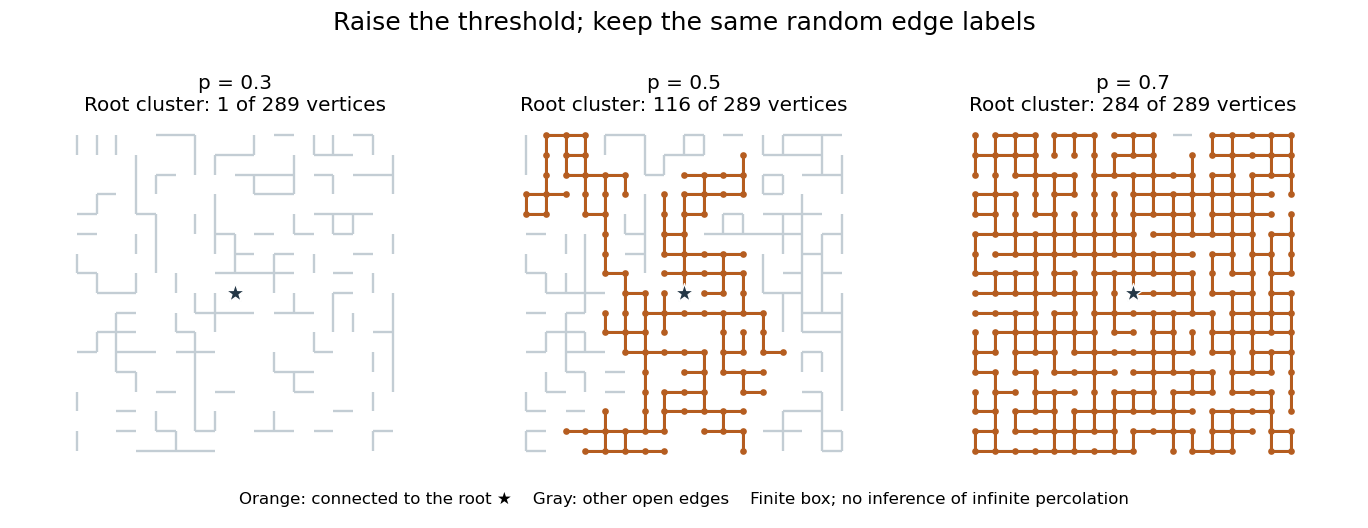
The three panels use one seeded collection of labels on a finite square lattice box. Colored edges and dots show the central root's percolation cluster; gray edges are open but disconnected from it. A percolation cluster can grow by many vertices when one newly opened edge joins it to another large percolation cluster. The panels illustrate a nested construction, not an estimate of or a proof of the Harris-Kesten theorem.
If an increasing event depends on sites or edges, the uniform-label monotone coupling of Bernoulli percolation and the union bound give for . A change of the event requires a coordinate with label in . For bond percolation from the origin to the boundary of , first-hit graph paths use the internal edges, so the same count bounds the parameter sensitivity.
In the uniform-label monotone coupling of Bernoulli percolation, let mean that the origin belongs to an infinite percolation cluster, and let . The occurrence parameters form an upper interval. Therefore and . Since , the jump is . Occurrence at the infimum is not presumed.
For , first sample Bernoulli percolation at parameter , then independently open each remaining closed coordinate with probability . Every coordinate is then open with probability , so the union has the parameter- law. This coupling separates existing -clusters from the additional sprinkled connections between them.
In independent site percolation with parameter , each vertex of a graph is open with probability , independently of the others. Retain those vertices and every original edge whose two endpoints are retained. This gives an induced subgraph, whose connected components of a graph are the percolation clusters. A closed vertex is absent from the usable network, whereas bond percolation keeps all vertices and instead removes individual edges.
A specified simple graph path of edges has distinct vertices. Its probability of being entirely open is therefore , including the starting vertex. Conditional on that vertex being open, it is by independence. For a two-edge graph path at , the unconditional probability is , compared with in bond percolation. This comparison concerns a fixed route; percolation critical probabilities require analysis of all possible routes on the specified infinite graph.
For independent site percolation on the triangular lattice, the critical probability is . Self-duality, crossing estimates, and exclusion of an infinite critical cluster identify the threshold.
Conditioned on the sites revealed by an exploration interface, every unrevealed site retains its independent Bernoulli law. The explored boundary supplies boundary conditions for subsequent crossing events.
Dependent percolation allows the open states of different vertices or edges to be statistically dependent.
A bond percolation law is one-independent if the bond states in any two sets with disjoint endpoint sets are independent as collections. In particular, states of bonds in a matching in a graph are mutually independent. The law need not be invariant under translations or positively associated.
Place side- square lattice boxes around the points , . The width- rectangle joining adjacent boxes has length . Declare a coarse bond open when its long rectangle is crossed and each endpoint box is crossed in the transverse direction. Nonincident coarse bonds use disjoint fine-bond sets, while incident good bonds give connected open paths inside their common endpoint box. When fixed-aspect crossing probabilities tend to one, these coarse bond probabilities tend to one. The Peierls circuit bound for one-independent percolation then yields an infinite fine-lattice open cluster.
If each bond has closed probability at most in one-independent bond percolation on the square lattice, a set of bonds contains a matching in a graph of size at least : divide horizontal bonds by the parity of their left endpoint and vertical bonds by the parity of their lower endpoint. Each of the four classes is a matching. Mutual independence in the largest class proves the circuit bound. There are at most dual circuits of length surrounding the origin. For sufficiently small , the sum of these circuit probabilities is less than one, so the origin has a positive chance of belonging to an infinite percolation cluster.
Color the vertices of a periodic graph independently red or blue with equal probabilities, and declare a vertex of its line graph open exactly when the corresponding edge has equal-colored endpoints. The resulting site percolation has marginal and is a finite-range dependent random field: sets at line-graph distance greater than one use disjoint color inputs. Red and blue open clusters cannot join. If the original graph has an infinite red component and an infinite blue component, its line graph consequently has at least two infinite percolation clusters. One explicit amenable graph with that property is obtained by replacing each square-lattice vertex by a complete graph on ten vertices, joining neighboring blocks completely. Blocks containing both colors have independent probability ; a Peierls argument proves that they percolate, and their infinite cluster carries both a red and a blue component. Thus finite-range dependence, even with all site marginals nondegenerate, does not substitute for finite energy in percolation uniqueness.
On a finite graph, the random-cluster model assigns an edge configuration probability proportional towhere count open edges, closed edges, and open connected components.
For , the random-cluster measure lies between the two Bernoulli product measures displayed above. The upper Holley condition ratio is . The lower ratio is , because adding an edge reduces the component count by at most one. The comparisons persist under wired limits and give .
The multiplicative factor assigned to each connected component of a graph in a finite random-cluster measure. At fixed edge probability, the weight of a configuration with components includes . For this reduces to independent bond percolation; increasing at fixed , for , suppresses increasing events by random-cluster weight monotonicity.
The threshold for the origin to have an infinite percolation cluster under a consistently chosen infinite-volume random-cluster measure, conventionally the wired measure: . The definition alone makes no assertion about percolation exactly at the threshold.
The finite-volume random-cluster weight monotonicity passes to consistently wired or free infinite-volume measures for finite increasing connection events. Decreasing these events to origin-to-infinity connectivity yields for . The corresponding supercritical parameter sets are nested, and hence .
For fixed and , the random-cluster measure at stochastically dominates that at . In Holley's condition, Bernoulli factors cancel. Put and ; supermodularity of graph component count gives , and the weight ratio is . The comparison also holds with the same boundary wiring in both measures.
Planar random-cluster duality relates edge odds by . The fixed point has odds , giving the displayed parameter. A self-dual parameter does not by itself establish a critical threshold on an arbitrary planar graph. At this parameter the symmetric cluster weight at the self-dual parameter makes the primal-dual cluster counts explicit.
The planar cluster-count identity rewrites as . At the self-dual parameter of the random-cluster model, , so its weight is up to a configuration-independent factor. Absorbing into normalization proves the symmetric weight, with the unbounded dual face counted.
For an edge with endpoints already connected without that edge, including any boundary wiring, the conditional open probability is . Otherwise opening the edge merges two components, so the conditional probability is . For , this conditional probability increases when more other edges are open or more boundary vertices are identified. This is the local mechanism of boundary monotonicity of the random-cluster measure.
A boundary condition for a finite-box random-cluster measure is a partition of the boundary vertices. All vertices in one block are identified before counting open components; the identifications carry no Bernoulli edge factors. The weight is . A coarser partition makes more identifications. General partitions need not have a planar realization.
Here means each block of lies in a block of , and the measure order is stochastic domination of probability measures. The random-cluster single-edge conditional probability is increasing in both exterior open edges and wiring for . Couple two heat-bath Markov chains by identical update edges and uniform random variables, starting from ordered states. Order persists, and convergence of the finite chains to their stationary laws proves the displayed inequality. At , the law does not depend on the boundary partition.
All boundary vertices are identified into one vertex for component counting. This is the most wired random-cluster boundary condition on a fixed boundary, and maximizes increasing-event probabilities when by boundary monotonicity of the random-cluster measure.
For , finite random-cluster measures with all boundary graph vertices identified have a weak infinite-volume limit of a sequence. On a regular lattice it is invariant under translations and lattice reflections and has positive association of the random-cluster model. Its conditional single-edge open probability lies between and . Connection events can be approximated by increasing finite-volume path events, so their positive-association inequalities pass to the limit of a sequence.
Positive association of random variables and translation invariance give for axis connection probabilities. The Fekete lemma applied to proves the displayed limit of a sequence and the bound . The lower single-edge conditional bound gives , so the decay rate is finite and nonnegative. It may be zero.
Choose a graph vertex on the boundary of a lattice box. Translation and reflection invariance identify the probabilities of and . Their intersection implies , so positive association of random variables gives . A union bound and lattice symmetries choose such an with probability at least the box-boundary connection probability divided by the number of boundary graph vertices. This polynomial factor disappears in the exponential rate, identifying boundary and axial inverse correlation lengths.
The boundary partition has singleton blocks, so no different boundary vertices are identified. Open component counting is the ordinary counting in the finite graph, including isolated vertices. This is the least wired random-cluster boundary condition.
For and , the FKG inequality implies that increasing functions of a random-cluster configuration have nonnegative covariance. The conclusion can fail for .
On a finite connected graph, fixing and sending makes the random-cluster model converge to the uniform law on connected spanning subgraphs: the factor selects the minimum possible component count , while all surviving configurations have equal remaining weight.
If with , the random-cluster model on a finite connected graph converges to the uniform spanning tree. Relative to a tree, an acyclic configuration with components pays a factor , while every additional cycle pays a factor asymptotic to .
The Edwards-Sokal coupling assigns one common random spin to every random-cluster component. For it couples the random-cluster model to the Ising model.
Given a random-cluster configuration, its components receive independent uniform colors under the Edwards-Sokal coupling. Two vertices have equal Potts spins with probability if connected and otherwise. Averaging proves the identity. With a wired component fixed to color , the same argument gives normalized spontaneous magnetization in infinite volume. Thus its onset is the wired random-cluster critical probability, transformed to in this convention.
A heat-bath Markov chain repeatedly chooses one coordinate and redraws it from its conditional distribution given all other coordinates. The target distribution is reversible and stationary for these updates.
The critical threshold is the boundary between levels at which an unbounded superlevel component can occur and levels at which every superlevel component is almost surely finite.
Articles were limited to the first 100 out of 111 total.
Articles by others on the same topic

This field is likely both ugly and useless.
OK, in 2D they've achieved some cute rational number results. But still.



Percolation theory is a mathematical concept originally developed in the context of physics and materials science to study the behavior of connected clusters in a random medium. It explores how the properties of such clusters change as the density of the medium is varied. The theory has applications in various fields, including physics, chemistry, computer science, biology, and even social sciences.