Two random variables have negative covariance when , assuming finite second moments. Opposite deviations from their respective expected values then outweigh matching deviations on average. For example, if for a constant , the bilinear identities of covariance give , which is strictly negative when has positive variance.[ref]
Covariance and Correlation by Jeremy Orloff and Jonathan Bloom. §2.1, scaling and covariance with oneself
Sampling without replacement gives a useful example in which the negative sign comes from a shared finite resource. Choose a simple random sample of exactly distinct members from a statistical population of size , with . For each member define the inclusion indicator . Its inclusion probability is . For different members , the joint inclusion probability isSubtracting the product of the expected values givesThe Pearson correlation coefficient follows because each inclusion indicator has variance . Once member is included, only places remain for the other members, reducing member 's conditional probability of inclusion below .
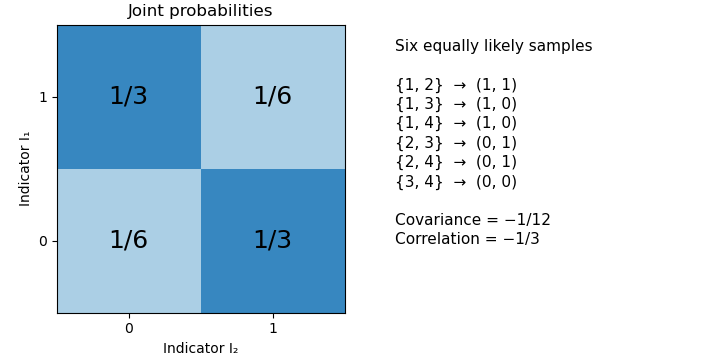
For an original exact example, draw two members from four. The six unordered sample pairs are equiprobable. For , the outcomes and each have probability , while and each have probability . Hence , and their Pearson correlation coefficient is . Matching outcomes remain possible despite the negative covariance.

A fixed total alone does not force every pair among three or more random variables to have negative covariance. If , thenThis constrains the sum of the off-diagonal entries in a row of the covariance matrix. It does not fix each entry's sign. For a counterexample, let be equally likely to be zero or one, and set , , . Their total is always two, yet .
In the simple random sample, exchangeability makes the off-diagonal covariances equal, so the fixed-total identity does determine each of them: . The same distinction between a linear constraint and individual pair signs matters for the joint dependence of leave-one-out consensus residuals.
Articles by others on the same topic
There are currently no matching articles.