Transverse nuclear magnetic resonance measures absorption from a radio-frequency magnetic field perpendicular to the static field. In the A phase, the resonance moved above the Larmor frequency; in the B phase it returned to that frequency despite the changed state. Anthony James Leggett connected the shift to collective spin-orbit structure. A predicted longitudinal resonance, driven parallel to the static field, supplied a further B-phase test.[ref]
Nobel Lecture: Superfluid 3He: the early days as seen by a theorist by Anthony James Leggett. pp.1002–1003 and1009, transverse geometry and longitudinal test
The helium-3 superfluid discovery experiment establishes why a new phase was inferred; comparing response channels then tests its internal structure. An unchanged peak in one geometry cannot, by itself, establish that nothing ordered.
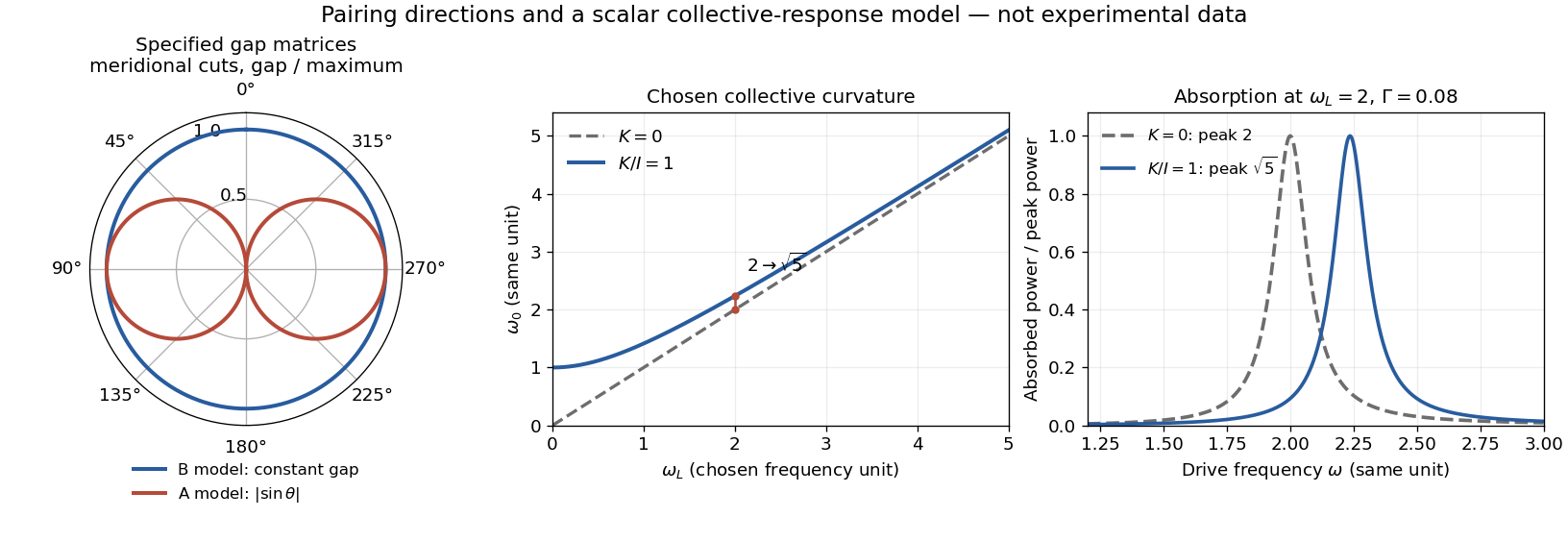
Consider an original scalar response model for a small collective angle . Stipulate effective inertia , restoring curvature , damping rate , and a drive torque :The undamped resonance scale is , where . This illustrates the role of an additional collective restoring energy. It is not the full coupled spin dynamics of either helium phase, and its parameters are not fitted to historical observations.
The steady response and mean absorbed power follow directly:With constant damping, differentiating this last expression places its positive-frequency maximum exactly at . Setting chosen and moves the peak from to , about . At the same curvature moves it only to , about . At large , the shift is to leading order. A smaller shift at larger field therefore need not mean that the restoring curvature vanished.

Articles by others on the same topic
There are currently no matching articles.