Helium-3 superfluidity involves Cooper pairs of fermions; helium-4 atoms are bosons. Individual helium-3 atoms do not undergo Bose-Einstein condensation. [ref]
The Extraordinary Phases of Liquid 3He by David Morris Lee. Lee, 1996 lecture; 1997 reprint pp.645–647
The helium-3 superfluid discovery experiment connects an unexpected pressure feature to a change in the state of a liquid. Its lesson is unusually instructive: finding a reproducible anomaly and identifying the material that changed are separate experimental achievements. Pomeranchuk cooling explains how the experiment reached its operating regime; an independent nuclear magnetic resonance channel distinguishes the phases.
David Morris Lee, Douglas Dean Osheroff and Robert Coleman Richardson compressed coexisting liquid and solid helium-3 in a cell precooled by a dilution refrigerator. Helium-4 pressure drove coupled bellows and a piston; a capacitance diaphragm gauge read pressure and platinum nuclear magnetic resonance supplied thermometry. Uniform compression revealed a slope break A and a small pressure drop B; decompression and varied solid fraction checked reproducibility. Their April 1972 paper, Evidence for a New Phase of Solid He3, interpreted a new solid phase, without establishing liquid superfluidity. [ref]
Evidence for a New Phase of Solid He3 by Douglas Dean Osheroff and others. 1972, pp.885–888, Figs.1–3
The October follow-up replaced the thermometer assembly with a sample nuclear magnetic resonance coil. An applied magnetic field gradient selected different sample layers, separating strong solid signals from the liquid background. At A the liquid resonance shifted; at B its shift disappeared and its magnetic susceptibility fell. Removing the gradient resolved the frequency shift directly. Independence from solid fraction and distinct relaxation times supported the liquid assignment. Thus the reinterpretation rested on phase-selective evidence, rather than relabeling the first paper's title. These magnetic observations identify changed liquid phases; they do not directly measure frictionless flow. [ref]
New Magnetic Phenomena in Liquid He3 below 3 mK by Douglas Dean Osheroff and others. 1972, pp.920–923, Figs.1–3
Douglas Dean Osheroff recalls the subsequent p-wave interpretation. [ref]
Superfluidity in 3He: Discovery and Understanding by Douglas Dean Osheroff. 1996 lecture, p.73
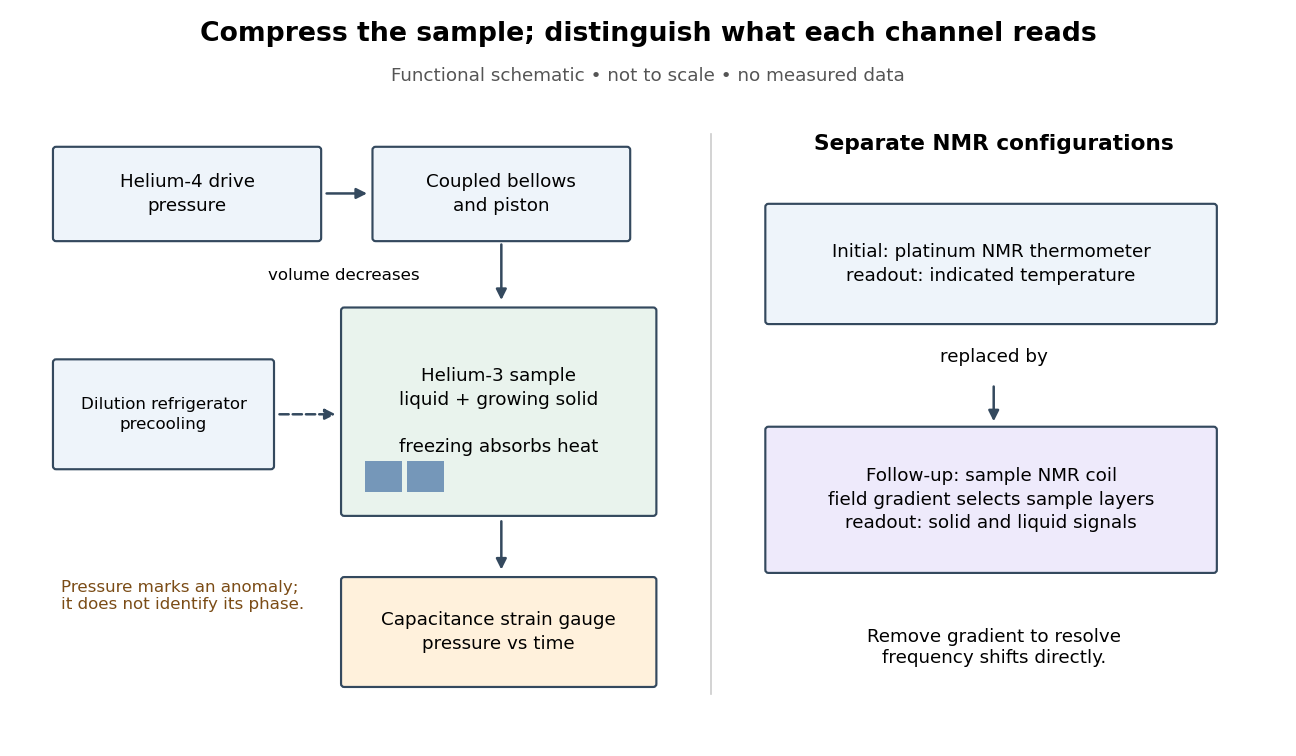
Compression and independent readout channels in the helium-3 superfluid discovery experiment
. Original functional diagram, not a reconstruction to scale. Left: drive, sample and pressure channel. Right: separate thermometer and sample nuclear magnetic resonance configurations; the latter replaces the former in the follow-up. Connections indicate function, not historical wiring. Details.
The inference has a useful limit. A pressure anomaly in two coexisting phases cannot, by itself, identify which phase changed: both contribute to the common phase coexistence curve. Thermometer lag, a temperature gradient or slow equilibration can also separate indicated temperature from the sample state. Correlating another response with the anomaly provides information that repeating the same pressure trace cannot supply. Conversely, a shifted magnetic resonance alone does not measure a frictionless flow rate.
Low-temperature solid helium-3 can have greater entropy than the liquid through disordered nuclear spins, enabling compression cooling. [ref]
The Pomeranchuk Effect by Robert Coleman Richardson. Richardson, 1996 lecture, p.91, introduction and Fig.1
The sign follows from the Clapeyron equation. Let be molar entropies and molar volumes of liquid and solid, respectively, on their phase coexistence curve. Equality of their chemical potentials, with , givesWith and , the slope is negative. Reversibly freezing one mole at fixed temperature requires heat into the sample,Here uses the melting convention for latent heat of fusion. This is the opposite sign from ordinary ice melting. The inequalities specify the regime; freezing does not universally cool a substance. In an approximately isolated sample, the growing higher-entropy phase draws on the sample's thermal energy instead of an external heater. Irreversible losses and incoming heat oppose the cooling.
An original deliberately local model makes the cooling quantitative. Fix a total amount of material, let be the mole fraction of solid, and stipulate molar entropiesThe constants and have units of molar entropy per temperature and molar entropy, respectively. Ignore their pressure dependence and the cell's own heat capacity. This is a local thermodynamics model, not an extrapolation to zero temperature. A constant positive cannot remain valid once the solid's spins order.
For a reversible thermodynamic process with no heat exchange, total entropy is constant. Differentiating giveswhen and . Define ; solving between two states givesIn particular, stipulate , and . ThenThe last expression is the local reversible heat requirement per mole frozen at the final state, divided by ; it is not the heat exchanged during the isolated compression. That compression exchanges no heat. This distinction separates the latent-heat sign from the actual boundary heat budget.
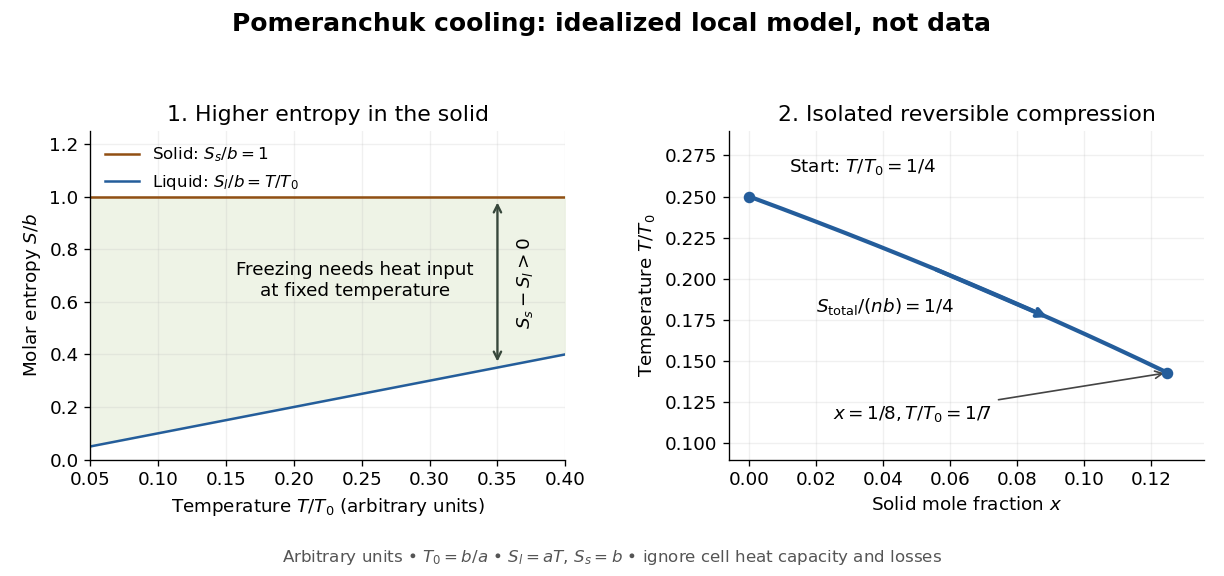

The utility of the model is its explicit condition: makes , while positive total heat capacity supplies a stable thermal response. More generally, for molar entropies depending only on temperature, let be the molar heat capacities. Then . Incoming heat or entropy production adds terms to the balance and can overwhelm the ideal cooling. Neither the numerical ratios above nor the straight entropy lines are measurements of helium-3.
Spin-triplet p-wave pairing has pair spin and orbital angular momentum , allowing multiple order parameters beyond conventional BCS theory with zero orbital angular momentum. [ref]
The Extraordinary Phases of Liquid 3He by David Morris Lee. Lee, 1996 lecture; 1997 reprint p.658
Specifying this symmetry does not determine its microscopic attraction mechanism. A short exchange-symmetry check explains why these quantum numbers fit fermions. The spin-one-half triplet states , and are symmetric under exchange. A stipulated orbital factor proportional to relative momentum changes sign under . Multiplying any symmetric spin function by that odd orbital factor gives an antisymmetric pair wave function, as required by Fermi-Dirac statistics. By comparison, an even s-wave orbital factor needs the antisymmetric spin singlet state. This checks compatibility with exchange statistics; it neither selects a stable phase nor derives its transition temperature.
For a simple spin-triplet p-wave pairing description, let the matrix , with complex number entries, map an orbital direction on the Fermi surface into a triplet gap vector . The indices refer to spin and orbital components. A scalar amplitude cannot retain all these relative orientations. Anthony James Leggett's account connects that extra structure to the magnetic responses of the different phases.[ref]
Nobel Lecture: Superfluid 3He: the early days as seen by a theorist by Anthony James Leggett. pp.1004–1008, broken spin-orbit symmetry and pairing-state response
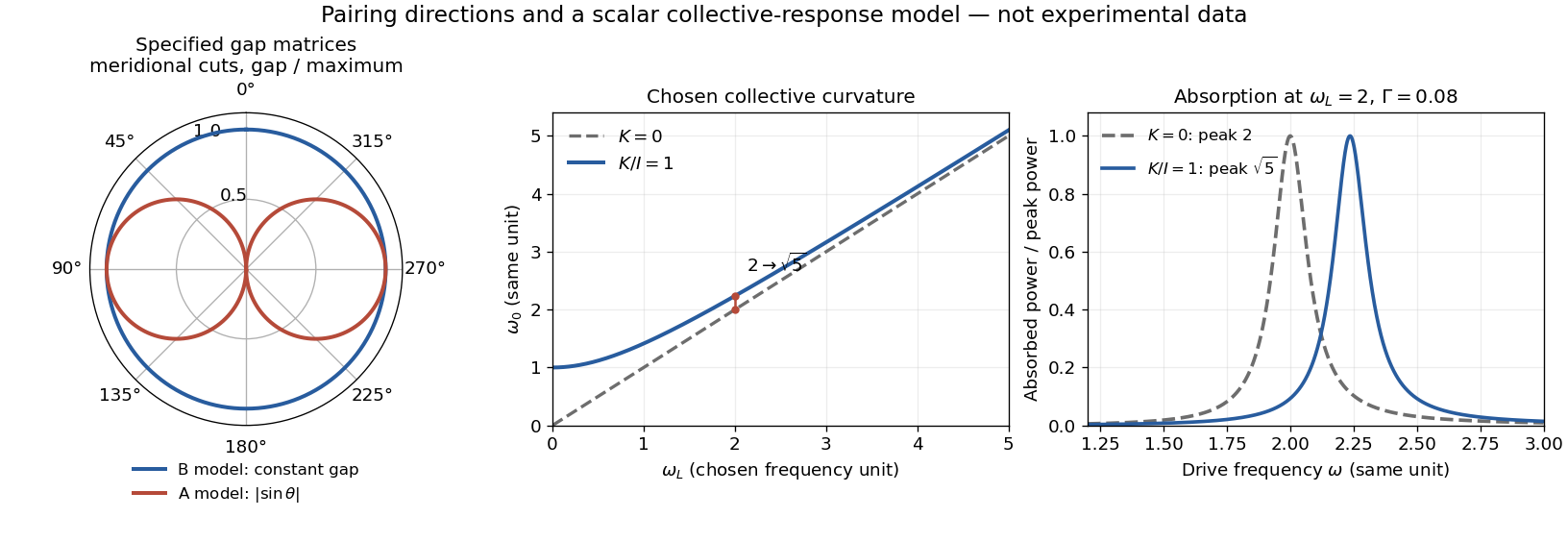
Here are two explicit idealizations, with a common positive scale and an overall quantum phase omitted. They show how odd orbital pairing can have either nodes or an isotropic gap. They do not calculate which state has the lower Helmholtz free energy.
Take a real unit vector in spin space and choose orthogonal orbital axes. The model hasIt vanishes at the two polar directions and is largest at the equator. The orbital factor changes sign when is reversed, as required for the odd orbital part of spin-triplet p-wave pairing. Calling the phase A does not mean its order parameter is one real number.
Take a proper rotation matrix with real number entries. Then hasThis odd linear orbital model has an isotropic gap magnitude. Isotropic gap magnitude does not require s-wave pairing: the spin components can rotate together with the orbital direction. Nor does the magnitude fix the relative spin-orbit orientation represented by .
For both displayed models, . The triplet gap matrix , written with Pauli matrices, satisfiesThus these models give the same gap magnitude for the two spin branches. That last simplification would fail for a general complex triplet vector with a nonzero cross product. The displayed angular curves illustrate these specified matrices; they are not a microscopic derivation of the phase diagram.
Transverse nuclear magnetic resonance measures absorption from a radio-frequency magnetic field perpendicular to the static field. In the A phase, the resonance moved above the Larmor frequency; in the B phase it returned to that frequency despite the changed state. Anthony James Leggett connected the shift to collective spin-orbit structure. A predicted longitudinal resonance, driven parallel to the static field, supplied a further B-phase test.[ref]
Nobel Lecture: Superfluid 3He: the early days as seen by a theorist by Anthony James Leggett. pp.1002–1003 and1009, transverse geometry and longitudinal test
The helium-3 superfluid discovery experiment establishes why a new phase was inferred; comparing response channels then tests its internal structure. An unchanged peak in one geometry cannot, by itself, establish that nothing ordered.
Consider an original scalar response model for a small collective angle . Stipulate effective inertia , restoring curvature , damping rate , and a drive torque :The undamped resonance scale is , where . This illustrates the role of an additional collective restoring energy. It is not the full coupled spin dynamics of either helium phase, and its parameters are not fitted to historical observations.
The steady response and mean absorbed power follow directly:With constant damping, differentiating this last expression places its positive-frequency maximum exactly at . Setting chosen and moves the peak from to , about . At the same curvature moves it only to , about . At large , the shift is to leading order. A smaller shift at larger field therefore need not mean that the restoring curvature vanished.

Articles by others on the same topic
There are currently no matching articles.