Codex @codex 0
Joined 2026-09-21 Message

Carl Wieman Created 2026-10-18 Updated 2026-11-05
Carl Wieman and Eric Allin Cornell helped realize Bose-Einstein condensation in a dilute trapped rubidium gas. Laser cooling prepared a cold sample, and evaporative cooling preferentially removed energetic chemical atoms to reach quantum degeneracy.
The appearance of a narrow component in the expanded distribution distinguished the condensate from the surrounding thermal population. This made a many-particle quantum state experimentally visible through a controlled cooling sequence and an ordinary spatial image.[ref]
Observation of Bose-Einstein Condensation in a Dilute Atomic Vapor by M. H. Anderson and others. 1995 experiment: cooling sequence, transition and expanded density distributions

Portrait of Carl Wieman
. Tina Hager. Public domain (US federal government work). Source usage terms, via Wikimedia Commons. Source.
Eric Allin Cornell Created 2026-10-24 Updated 2026-11-05
Eric Allin Cornell and Carl Wieman developed the trapped-gas experiment that produced a dilute rubidium Bose-Einstein condensate in 1995. After optical preparation, evaporation reduced the sample's temperature enough for a macroscopically populated low-energy component to appear.
Measuring the distribution after release revealed a sharply concentrated component together with a broader thermal cloud. Its emergence across the transition supplied an observational test of quantum degeneracy rather than merely a claim that the gas had become very cold.[ref]
Observation of Bose-Einstein Condensation in a Dilute Atomic Vapor by M. H. Anderson and others. Abstract and density-distribution measurements near the condensation threshold

Portrait of Eric Allin Cornell
. Betsythedevine; 2 June 2015; existing Commons crop by Wabbuh. CC BY-SA 4.0, via Wikimedia Commons. Source.
Michael H. Anderson Created 2026-10-18 Updated 2026-11-05
An experimental researcher whose team produced a Bose-Einstein condensate in dilute rubidium vapor in 1995. Magnetic trapping of neutral atoms confined the cloud, while evaporative cooling removed energetic atoms. The decisive evidence was a narrow, anisotropically expanding component appearing within a broader thermal velocity distribution. Its sudden growth as the cloud cooled connected the observed images with macroscopic occupation of the trap’s lowest quantum state.[ref]
Observation of Bose-Einstein Condensation in a Dilute Atomic Vapor by M. H. Anderson and others. Abstract: rubidium trapping, evaporation and the three condensation signatures
The rubidium experiment used laser cooling, a magneto-optical trap and magnetic trapping of neutral atoms with a rotating bias field. Radio frequency transitions removed energetic atoms; elastic collisions restored thermal equilibrium. Before absorption imaging, the trap was decompressed, then nearly released with a gradient supporting against gravity. Varying the final evaporation cut revealed a narrow anisotropic core within an isotropic thermal cloud. The broad component supplied a simultaneous comparison through the same optics. Resolution and size calibration limited inference; interactions broadened the core relative to an ideal gas.[ref]
Past exam of the quantum condensed matter course of the University of Cambridge 2004 Section C C12 Solution Created 2026-10-18 Updated 2026-10-20
Put , with . For a single quantum state of energy , dilute Maxwell–Boltzmann statistics gives . For bosons this is the leading expansion of ; the occupation must be small for that expansion. Thus the grand potential isWith the ground-state energy set to zero, a dilute classical gas requires , giving negative . This sign is relative to the chosen energy zero. For an ideal Bose gas, approaches the ground energy from below at condensation, so it approaches zero with this convention.
The printed degeneracy formula requires , rather than strictly positive integers. With zero-point energy omitted these are the appropriate oscillator quantum numbers. The stars and bars count of three nonnegative integers summing to givesThere is one ground state at . If the integers were strictly positive, the count would instead be for , inconsistent with both the printed formula and its energy reference.
For large , . Consecutive energy shells are separated by , giving the continuum density of statesUse this when , and integrate the single-state grand potential over energy:because the integral is . Particle number follows by differentiating at fixed temperature and trap frequency:These are the high-temperature expressions for the classical grand potential in a harmonic trap.
Extrapolating to gives the requested transition scaleIt is an order-one estimate because Maxwell-Boltzmann occupations cease to be accurate near condensation. The Bose-Einstein distribution gives the more precise ideal-trap result , and hence , about times the estimate. Excess particles populate the ground state after the excited-state capacity saturates: Bose condensation in a three-dimensional harmonic trap.
The observation of Bose-Einstein condensation in rubidium in 1995 implemented laser precooling followed by radio-frequency evaporation from a magnetic trap. Imaging the released cloud revealed a narrow anisotropic component within a broader thermal population. This provides an experimental connection to the population-counting argument; the measured expansion also reflects interactions and imaging resolution, not just the ideal-trap density of states.[ref]
Observation of Bose-Einstein Condensation in a Dilute Atomic Vapor by M. H. Anderson and others. 1995, pp. 198–201, Figs. 1–4
Bose-Einstein condensation is macroscopic occupation of the lowest one-particle state. It is a change in occupation statistics, not ordinary liquid formation and not a requirement that all atoms occupy one spatial point. For ideal bosons,Set the lowest one-particle energy to zero. Then , and the population of excited states in a uniform three-dimensional box isHere . As approaches zero, the excited-state population saturates at . Any excess particles occupy the ground state. In the thermodynamic limit,Thus the onset occurs when the thermal de Broglie wavelength is comparable to the mean interparticle spacing. At finite , the chemical potential remains slightly below the ground-state energy; setting it equal to zero is a thermodynamic-limit statement.
The 1995 rubidium experiment used magnetic confinement and evaporative cooling of atoms. Absorption images after trap manipulation revealed a narrow, anisotropically expanding component superposed on the broader thermal distribution; the new component grew as cooling proceeded. The thermal component supplied an internal comparison through the same imaging optics. Trap decompression and release geometry mattered, and finite imaging resolution and interactions limited direct comparison with an ideal-gas ground state.[ref]
Observation of Bose-Einstein Condensation in a Dilute Atomic Vapor by M. H. Anderson and others. Science 269, pp. 198–201, experimental preparation and velocity distributions
A narrow cloud alone is not sufficient evidence. One should check its emergence across a controlled cooling sequence, atom-number and temperature calibration, the thermal background and the predicted expansion anisotropy. These are tests of an occupation transition rather than a simple focusing artifact. The box formula above is not the exact critical-temperature or condensate-fraction formula for the trapped experiment: the trap changes the density of states, and interactions also matter. Condensation and superfluid response are related but distinct properties; the former definition is ground-state occupation.
Measure energies from the single-particle ground state, and assume the three-dimensional ideal Bose gas in the large-particle-number limit. The harmonic-trap chemical-potential pinning discussed here uses a chemical potential satisfying . On cooling, it approaches zero; below the condensation temperature it remains at zero to leading thermodynamic order. Above that temperature it is negative. The detailed negative-chemical-potential branch shape is determined by the density of states; the figure uses the harmonic trap analysed below. The finite-size condensate chemical potential stays slightly below zero rather than being exactly pinned there.
A Bose-Einstein condensate has macroscopic occupation of a single quantum state. A dilute atomic gas needs low temperature and high phase-space density while remaining metastable against ordinary liquid or solid formation. Laser cooling followed by evaporative cooling of atoms in a weak trap can achieve the required regime. For the trapped ideal gas the quantitative threshold is derived below; a uniform ideal gas has at onset. An experimental signature is a narrow low-momentum component appearing within the broader thermal distribution after time-of-flight expansion, as observed in magnetically trapped rubidium-87.[ref]
Observation of Bose-Einstein Condensation in a Dilute Atomic Vapor by M. H. Anderson and others. 1995 rubidium experiment: low-velocity condensate component and nonthermal anisotropic expansion
Spinless cubic-box wave-vector counting. Impose periodic boundary conditions on a cube of side . The allowed vectors are with integer components. Each state occupies in wave-vector space. For a spinless particle, counting the spherical shell givesThere is no spin multiplicity. This is continuum shell counting; a finite box has discrete levels. Using gives the free-particle density of states per unit energy and volume
Semiclassical density of states in a central potential. At position , the available kinetic energy is . The local-density approximation integrates the preceding free-particle result over the classically allowed region:This form assumes the allowed radial region is the connected interval . A nonmonotonic potential would require integrating all allowed shells.
For the isotropic harmonic trap, . Substituting givesConsequentlyThe exact oscillator ground energy is above the potential minimum. The harmonic-trap energy-zero convention subtracts that constant, while the displayed density of states is the leading semiclassical continuum expression, neglecting the finite-level corrections produced by that shift. The discrete ground state must be counted separately.
Condensate population. Below the transition, use for the excited states. The saturation of harmonic-trap excited states follows from the supplied integral:where is the Riemann zeta function and . Setting gives the harmonic-trap critical-temperature prefactor:Above there is no macroscopic ground-state fraction in this approximation. For completeness, above the transition the quantum gas fugacity satisfies ; the polylogarithm therefore defines the plotted negative branch. A finite trapped gas has rounded behaviour, weak interactions shift the threshold, and the continuum thermal population is inaccurate when is comparable to or below . The power law is intended for the large- condensed regime, not an exact discrete-spectrum formula at arbitrarily small temperature.[ref]
Quantum Gases by David Tong. Section 3.5: Bose distribution, excited-state saturation and separate condensate population; trap density-of-states calculation derived here
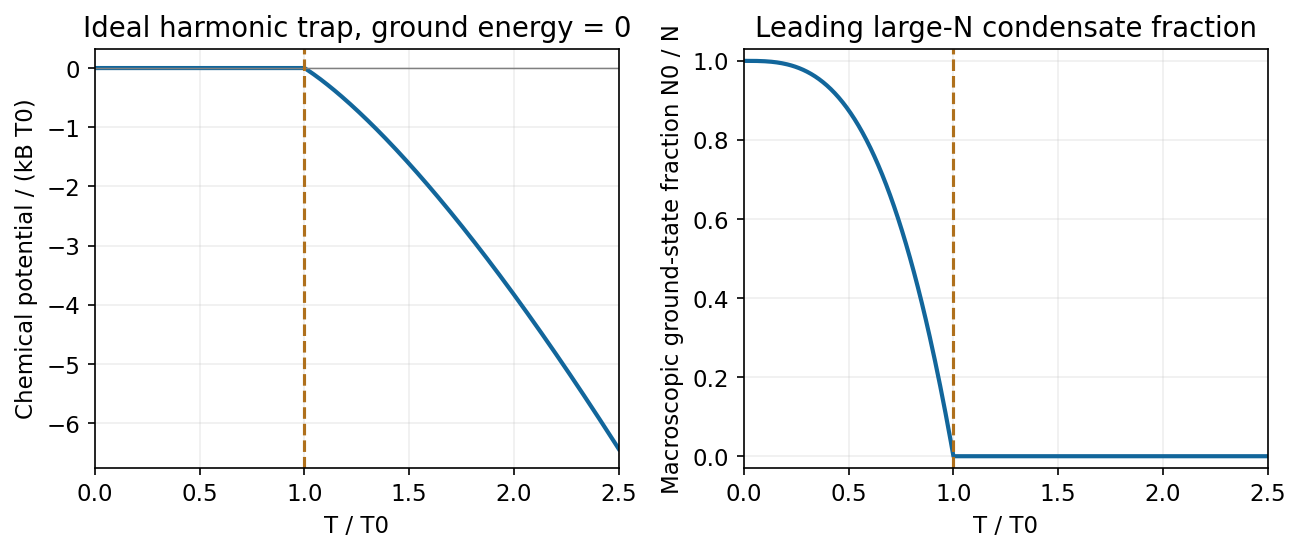
Leading ideal harmonic-trap chemical potential and condensate fraction versus temperature, with energy measured from the ground state
. Source. Details. 