Observation-time dependence of apparent compliance is the change in an inferred volume-per-pressure response when the measurement is made at different stages of filling or relaxation. For an original single passive compartment exposed to a pressure step,The equilibrium compliance is , but a finite-time observation is smaller whenever and are positive and finite. A short observation can therefore confound stiffness with slow filling.
Two observation times identify the parameters only within the assumed model. Taking measurements at and and defining givesFor stipulated and , this model gives and s. The parameter values follow from the model as well as the data.
A second original example exposes finite-time ambiguity between stiffness and slow filling. Suppose the real response is the sum of two compartments, each with compliance 0.10, but time constants 0.2 and 2 s. Then and . Fitting the single-compartment formulas to just those two values gives s and equilibrium compliance about 0.146, although the actual equilibrium sum is 0.20. Two exact measurements can fit the wrong model exactly.
Even one perfect finite-time value supplies no finite upper bound on equilibrium compliance without further restrictions. For an observed at time , every choice can reproduce it withIncreasing compliance while increasing the filling time can preserve the measured response. Additional times, an independently bounded time scale or a validated compartment model add information.
The primary pilot study's discussion of non-uniexponential deflation and multiple time constants illustrates the experimental importance of this distinction.[ref]
Static and Dynamic Measurements of Compliance and Driving Pressure: A Pilot Study by Pierre Tawfik and others. Study Procedures and Discussion of method D
The constructed calculations here are pressure-step examples, not patient measurements or a replacement for the study's actual compliance definitions.Finite-time ambiguity between stiffness and slow filling means that a small volume response at one time can come from a stiff compartment or from a more compliant compartment that has not finished filling. In a passive single-compartment pressure-step model,One observation supplies one equation for equilibrium lung compliance and time constant . It does not generally identify both.
An original family makes the ambiguity exact. For an observed , choose any and setEvery choice reproduces the observation. At s and stipulated , equilibrium compliances 0.12, 0.20 and 1.00 correspond to time constants about 0.558, 1.443 and 9.491 s. Their agreement at one time does not imply agreement about equilibrium volume response.
Later measurements distinguish these particular models. At , the predicted response isThe three examples predict approximately 0.1167, 0.1500 and 0.1900 in compliance units. Those differences motivate observing more than one stage of the transient. They do not prove that a one-compartment model is adequate for an actual lung.
Early-time resistance dominance of a filling response explains the limiting behavior. Expanding the exponential for givesThe leading response depends on resistance rather than equilibrium compliance. As grows in the indistinguishable family, and tends to . Much larger equilibrium compliance can therefore be hidden behind similar early filling.
The primary respiratory pilot study discusses estimates based on expiratory time constants and why deflation need not be uniexponential.[ref]
Static and Dynamic Measurements of Compliance and Driving Pressure: A Pilot Study by Pierre Tawfik and others. Introduction, Method D; Study Procedures; Discussion of multiple time constants
An experiment should constrain its pressure step, observation duration and model class. A fitted finite-time response is not automatically an identified equilibrium material property.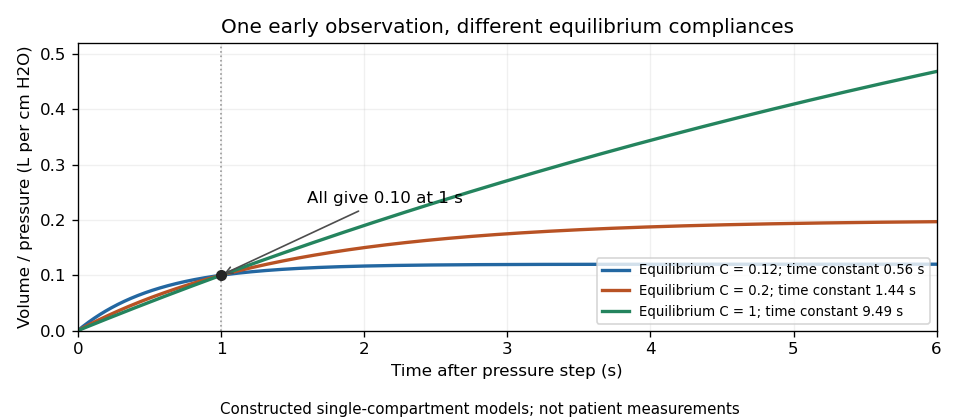
Original passive models sharing one early response while predicting different equilibrium lung compliances and time constants
. Details. 
Early-time resistance dominance of a filling response means that the initial volume admitted by a pressure step is governed mainly by airway resistance, even when the eventual volume depends strongly on lung compliance. For a passive compartment with constant airway resistance , lung compliance , imposed pressure increment and initial added volume zero,Initially the elastic recoil increment is zero, so the initial volumetric flow rate is . The initial slope identifies within this model, not .
A Taylor series makes the separation explicit:Information about lung compliance first enters the curvature. Recovering that curvature from noisy early measurements can be much harder than measuring the initial slope. The dimensionless ratio controls the approximation: the exact response divided by the resistance-only prediction is .
For an original calculation, take , and compare with . Both predict initial volumetric flow rate 1 L/s. At 0.05 s their admitted volumes are approximately 0.04877 and 0.04975 L, although their equilibrium added volumes are 1 and 5 L. An apparently precise short filling trace can therefore provide little discrimination between very different equilibrium lung compliances.
This is an ideal pressure-step calculation. A finite instrument response, an unknown driving pressure, nonlinear airway resistance or multiple compartments changes what can be inferred. A primary ventilation study explicitly measured multiple expiratory time constants because deflation need not follow one exponential.[ref]
Static and Dynamic Measurements of Compliance and Driving Pressure: A Pilot Study by Pierre Tawfik and others. Materials and Methods, Study Procedures: two expiratory time constants rather than an assumption of uniexponential deflation
An early filling slope and an equilibrium lung compliance answer different experimental questions. Articles by others on the same topic
There are currently no matching articles.