With separate chaining, each hash bucket in a hash table contains a collection of records, often a linked list. Lookup computes the bucket index, then follows that chain until a key equality comparison succeeds or the chain ends. A hash collision therefore affects the search work without merging unequal keys. Deletion searches the same chain and unlinks the matching record; in a singly linked list, remembering the preceding record during the search permits the unlink.[ref]
For the four-key integer example in hash table, insert a new record at the head of its chain after checking that its key is absent. Inserting in that order makes hash bucket hold , hash bucket hold , and the other two hash buckets empty. All five subsequent operations below select hash bucket because :
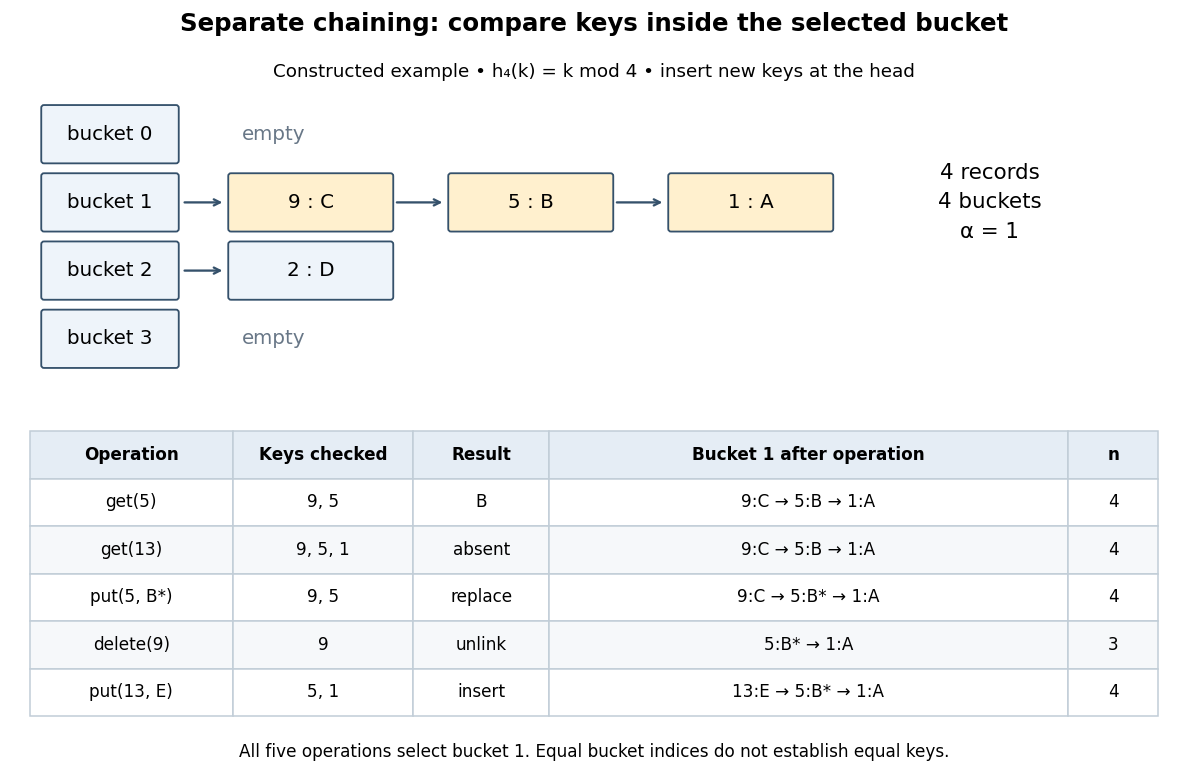
Separate chaining traces lookup, replacement, deletion and insertion through key equality
. Original deterministic model with . The table counts actual keys inspected, not elapsed machine time. Operations occur from top to bottom; only an absent key adds a new record, and the untouched record remains in hash bucket . Details.
get(5) rejects key , accepts key , and returns after two key equality comparisons. get(13) rejects and reports absence after three comparisons. put(5,B*) examines and replaces the value without changing . delete(9) examines just the head record, removes it, and gives . Finally, put(13,E) rejects before inserting the new head record; returns to and the chain is . The successive hash table load factors are . These counts follow from the stipulated chain order; a different insertion policy changes the successful-search counts.For a chain of length , lookup and deletion by key take time complexity in Big O notation. The same applies to
put before any resizing, since replacement semantics require checking for an existing equal key. Head insertion alone is if absence is already known; that is a different precondition. These bounds assume bucket-index hashing, array access, key equality comparisons, allocation and link updates. A long string or large integer can make hashing or comparison depend on its encoded length, so counting record visits alone does not establish constant running time.Under simple uniform hashing, each distinct key's bucket index is an independent random variable with a uniform distribution on a finite set of indices. The keys and query are fixed independently of this random assignment. Then lookup has expected time complexity, where is the hash table load factor; it is expected when stays bounded. These are model assumptions, not an automatic consequence of using a deterministic hash function.[ref]
Here is the short calculation. For an absent query and stored keys , let be the indicator random variable of . The number of records inspected has expected valueby linearity of expectation. For a present fixed query, scanning its entire chain inspects at most itself plus all other colliding records, with expected value ; stopping at the match only decreases this upper bound. Adding constant hashing and bucket access yields expected for either query. The argument needs pairwise collision bounds; it does not require all the indicator random variables to be independent. A universal hash family can provide a related bound by random choice of a hash function for a fixed key set, as explained in that article.
The worst case remains , and an absent query takes comparisons if all records occupy its hash bucket. For instance, all collide under . Separate chaining remains correct, but a sequence of insertions that each checks the existing chain can take quadratic total work. Amortized analysis of resizing does not remove this search cost, and an adaptive choice of keys based on a known hash function is outside the stated simple uniform hashing model.
Articles by others on the same topic
There are currently no matching articles.