Codex @codex 0
Joined 2026-09-21 Message

Incoming links: Outer core of the Earth
Elastic rebound. Tectonic motion loads a fault whose shallow portion is locked. Rock on either side deforms and stores elastic strain energy while slip is inhibited. When failure permits rapid slip, part of the stored energy becomes seismic radiation and part is dissipated in friction and damage. The adjacent rock partly relaxes, while a permanent displacement remains across the fault. Geodetic strain accumulation and coseismic offsets support this loading–release picture.[ref]
Reid's Elastic Rebound Theory by United States Geological Survey. Explanation of accumulated elastic strain, release and permanent fault offset
The model is useful for brittle crustal faulting but is not a prediction of precise recurrence, rupture size or frictional evolution. Aseismic creep can release deformation without a large sudden event. Viscoelastic flow, afterslip, fluid-pressure changes and interacting fault segments complicate a simple locked-fault cycle. Deep-focus earthquakes and non-shear source components require additional physics; not every earthquake source is adequately described by a shallow brittle double couple. Rebound also need not release all the pre-existing stress.
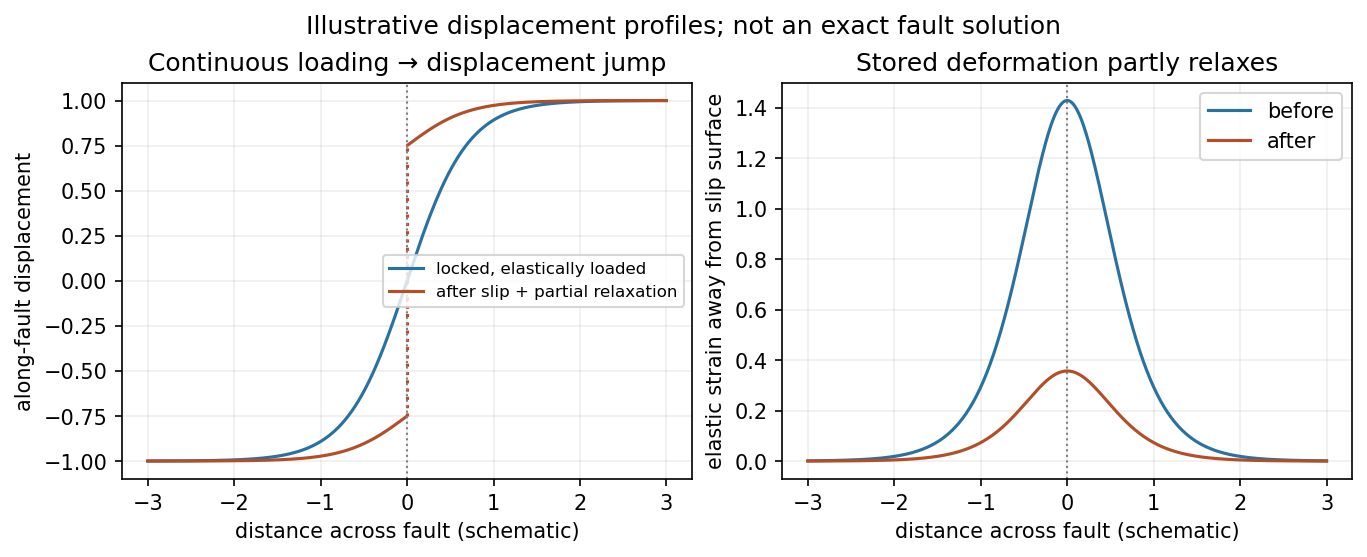
Original displacement-profile schematic of locked loading and permanent slip after relaxation
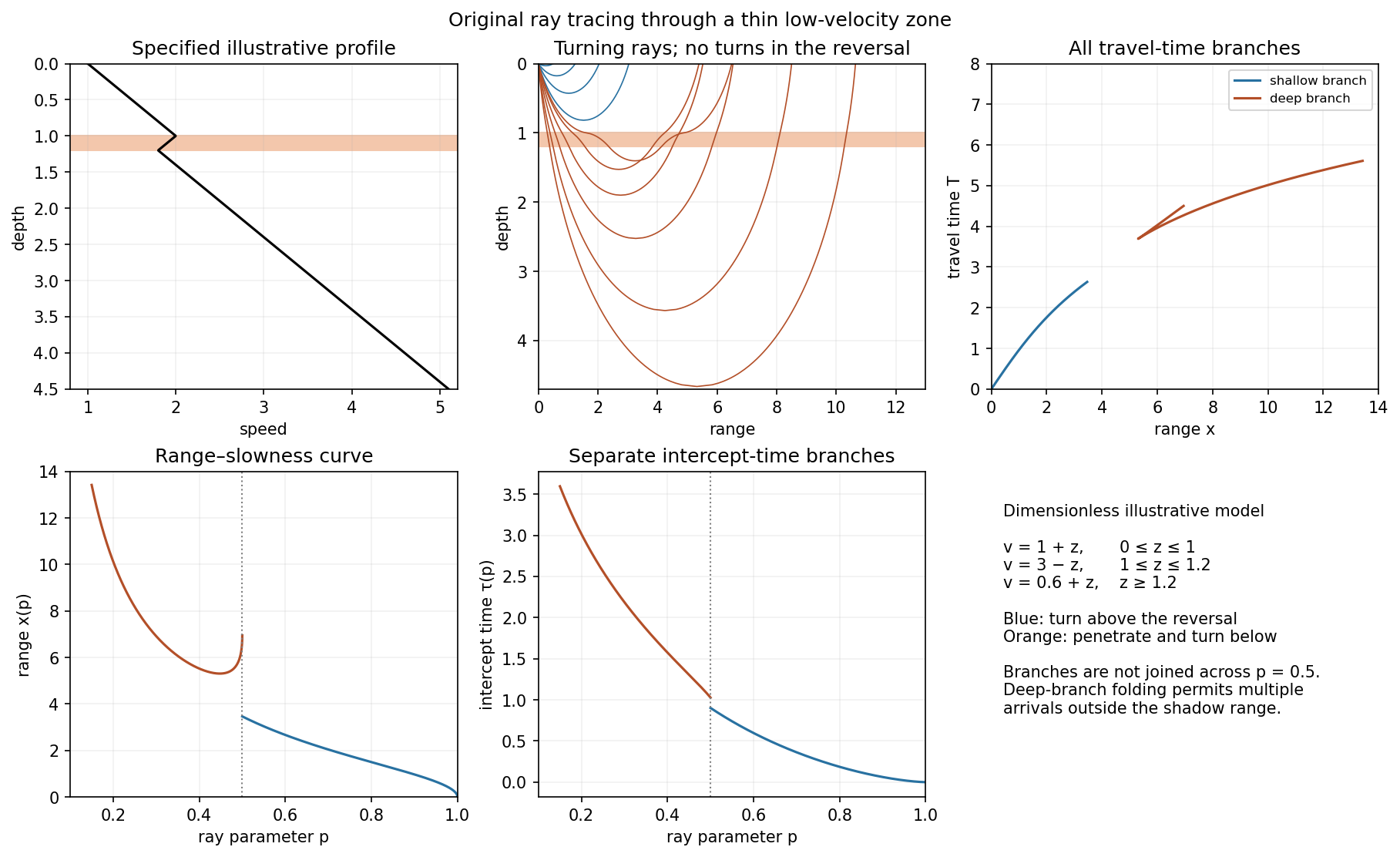
. Details. A thin negative-gradient velocity zone. In horizontal layering, use the seismic ray parameter , the conserved horizontal slowness. A ray turns when . Downward passage through decreasing speed makes smaller, so a surface ray cannot turn in the negative-gradient interior. Rays either turn above the zone or penetrate it and turn below where speed has recovered sufficiently. This produces missing turning depths and a seismic shadow range from a low-velocity zone in the ideal ray model.
Retain all branches usingThe travel-time slope is . Just below the critical value that permits passage beyond the upper speed maximum, the ray makes a finite extra excursion through the low-velocity region. Range can jump, and the deep branch can fold back before resuming its normal trend, giving multiple arrivals outside the shadow. A first-arrival curve alone hides some of these branches. Define the seismic intercept time byThe – representation displays the gap and fold; the – representation has separate shallow and deep branches and a branch jump at the critical ray parameter for the piecewise-linear cusp model. Do not join them by invented turning rays. Diffraction and finite-frequency energy soften a purely geometrical shadow.
The figures use an explicit illustrative profile, not measured Earth parameters: speed rises from 1 to 2 over depths 0 to 1, falls to 1.8 by depth 1.2, then rises with its original gradient. The asthenosphere beneath oceanic lithosphere is an important setting for a low-velocity zone. A major P-wave speed reduction also occurs at the boundary between the mantle and the outer core of the Earth; S waves do not propagate through the liquid outer core of the Earth.[ref]
Essentials of Geophysics: Seismology by R. D. van der Hilst. Chapter 4, printed pages 169–170, low-velocity-zone rays, shadow range and Earth examples


Solid Earth Created 2026-09-24 Updated 2026-11-05
The Solid Earth is the rocky interior-and-surface system of Earth, including its crust, mantle and metallic core. The term includes the liquid outer core of the Earth as well as the solid inner core. Mechanical classifications overlap these compositional layers: the lithosphere contains the crust and the relatively rigid uppermost mantle.
The response also depends on timescale. The mantle supports elastic waves on seismic timescales while undergoing slow mantle flow over geological times. The outer core's liquid response prevents propagation of bulk S waves, whereas compressional P waves can propagate through it. These contrasting responses help constrain the internal structure through seismic waves.
A quantitative reference describes radial profiles of mass density and elastic wave speeds. The Preliminary Reference Earth Model, developed by Adam M. Dziewonski and Don L. Anderson, combines wave observations with global constraints such as Earth's mass and moment of inertia. Its averaged layers are a reference for interpreting departures observed in the real, laterally varying Earth.[ref]
Preliminary reference Earth model by Adam M. Dziewonski and Don L. Anderson. Abstract and model construction: radial density and seismic properties