Suppose three measurements constrain two unknowns:The linear system asks for , , and , which are incompatible. A least-squares solution makes a balanced compromise. The matrix has full column rank, soThe fitted output and residual areThus the two direct measurements are each overshot by one, and the measured sum is undershot by one. The residual has Euclidean norm and is orthogonal to the column space, the plane in output coordinates .
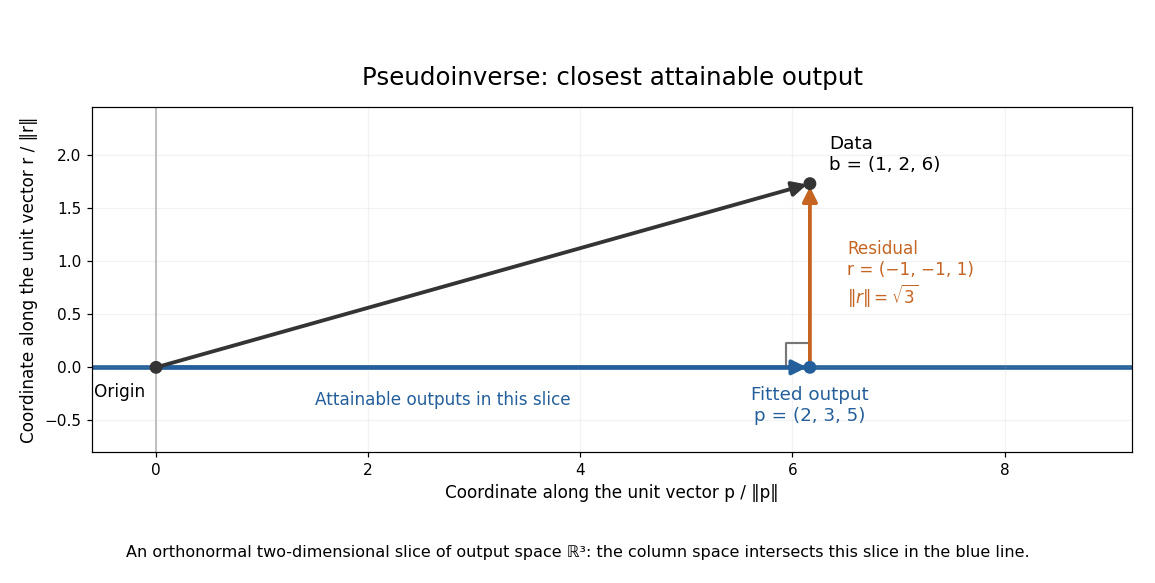

For any perturbation , the orthogonality of to givesSince the kernel of is trivial, every nonzero increases the residual. The least-squares solution is unique in this example. The formula using is convenient for these small exact calculations; an actual numerical computation can use a QR decomposition or singular value decomposition to avoid the extra conditioning cost of the least-squares normal equations. For full column rank, the squared singular values of are the eigenvalues of , so its condition number in the Euclidean norm is . [ref]
https://ocw.mit.edu/courses/18-065-matrix-methods-in-data-analysis-signal-processing-and-machine-learning-spring-2018/resources/lecture-9-four-ways-to-solve-least-squares-problems/. Strang, MIT 18.065 Lecture 9: four ways to solve least-squares problems
Articles by others on the same topic
There are currently no matching articles.