Use the original scanned boundary condition. The scan fixes the normal-field amplitude at the corner . The supplied TeX drops the condition and would instead prescribe a constant normal field on the entire bottom. Those are different boundary-value problems; the solution below uses the legible original scan.
Choose a positive integer , put , and seek a separated decaying mode. A suitable flux function isThis is a decaying linear force-free magnetic arcade. The first and third curl components then satisfy the force-free equation automatically; its second component requires . ThusDirect differentiation gives and . Both horizontal components vanish at , and . The magnetic field on the bottom is , not a uniform .
A strictly decaying real normal mode requires , soFor the fundamental, single-arcade choice , this becomes . Equality gives no vertical exponential decay, while a larger magnitude gives an oscillatory rather than decaying vertical dependence for that mode. The data do not explicitly fix the horizontal mode number. If arbitrarily fine higher-mode arcades are permitted, every finite real admits some integer with . The fundamental restriction must therefore not be advertised as a necessary bound for every possible field satisfying only the stated pointwise and wall data.
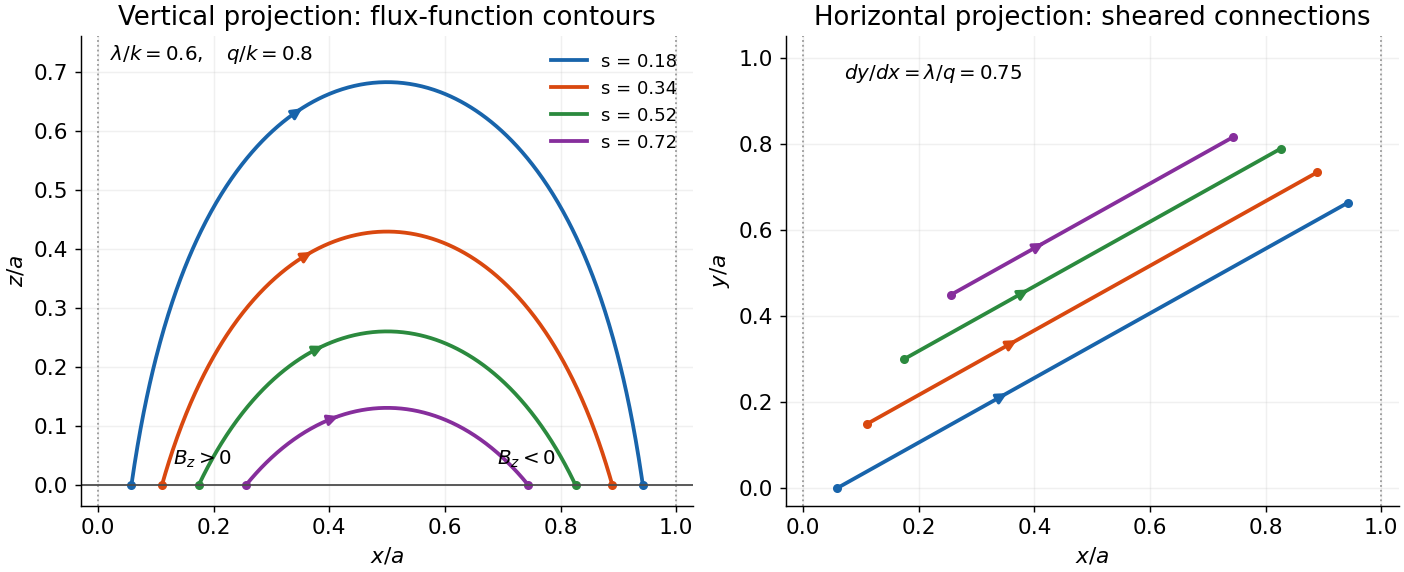
For a fundamental field line, is constant along its projection in the plane. If denotes its normalized flux-function value, its arch isThe maximum height is at . In the horizontal projection,Thus the vertical projections are arches and the horizontal projections are straight sheared segments joining their paired footpoints. Positive gives positive horizontal slope, negative reverses the shear, and gives an unsheared potential arcade. Higher repeats such cells across the width.

The transcription's alternative uniform-bottom condition would be inconsistent with exponential decay and zero side flux for : solenoidality gives , whereas a uniform nonzero bottom would give a conserved flux that cannot decay to zero. This integral check is an independent reason not to silently solve that mistranscribed problem.
Articles by others on the same topic
There are currently no matching articles.