Choose two independent labels for the magnetic field lines, constant along each line. These are Euler potentials: . Where the two gradients are independent, the vector perpendicular to both is , so initially writeThe solenoidal condition gives . Thus is constant along a field line and is locally a function of its labels. Redefining one label, for example , absorbs this factor. Dropping the tilde givesThis representation automatically has zero divergence, since it is also .
For an magnetic arcade, assign the labels on one polarity of the footpoint surface and transport them along each line to its other footpoint. They specify both line identity and magnetic flux: on a transverse surface, flux coordinates can be chosen so that the directed flux element is . In particular,The boundary labels at paired footpoints must agree, so prescribed boundary functions encode a compatible footpoint mapping, not independently arbitrary values at the two ends.
The construction assumes a smooth family of nonintersecting lines that can be labelled from a transverse boundary patch, with suitable patches at nulls or coordinate singularities. A local Euler-potential representation does not establish the existence of two globally single-valued regular labels for every possible solenoidal field; closed, recurrent or more complicated field topology can obstruct such a global choice. The line-tied magnetic arcade geometry supplies the relevant simplifying assumption here.
Use the magnetic energy . Vary the Euler potentials while keeping their boundary values fixed. The field variation isLet . Integration by parts givesbecause on the boundary. ThereforeThe two interior variations are independent. At a smooth minimum their coefficients must vanish, so the curl is perpendicular to both potential gradients and hence parallel to wherever :This is a force-free magnetic field: the Lorentz force density vanishes. Taking the divergence also gives , so the proportionality factor is constant along a field line but need not be the same on different lines.
The fixed-label variation preserves the encoded field-line connection rather than allowing arbitrary reconnection during minimization. The argument proves a necessary condition for a smooth minimum, not that every force-free stationary field is a stable energy minimum. It also does not include gas pressure or gravity in the minimized functional.
A linear force-free magnetic field has a spatially constant proportionality factor, . Taking its curl and using givesHenceThe constant has dimensions of inverse length in this convention. If it varied in space, the extra term would remain, so the same Helmholtz equation would not follow merely from a nonlinear force-free condition.
Use the original scanned boundary condition. The scan fixes the normal-field amplitude at the corner . The supplied TeX drops the condition and would instead prescribe a constant normal field on the entire bottom. Those are different boundary-value problems; the solution below uses the legible original scan.
Choose a positive integer , put , and seek a separated decaying mode. A suitable flux function isThis is a decaying linear force-free magnetic arcade. The first and third curl components then satisfy the force-free equation automatically; its second component requires . ThusDirect differentiation gives and . Both horizontal components vanish at , and . The magnetic field on the bottom is , not a uniform .
A strictly decaying real normal mode requires , soFor the fundamental, single-arcade choice , this becomes . Equality gives no vertical exponential decay, while a larger magnitude gives an oscillatory rather than decaying vertical dependence for that mode. The data do not explicitly fix the horizontal mode number. If arbitrarily fine higher-mode arcades are permitted, every finite real admits some integer with . The fundamental restriction must therefore not be advertised as a necessary bound for every possible field satisfying only the stated pointwise and wall data.
For a fundamental field line, is constant along its projection in the plane. If denotes its normalized flux-function value, its arch isThe maximum height is at . In the horizontal projection,Thus the vertical projections are arches and the horizontal projections are straight sheared segments joining their paired footpoints. Positive gives positive horizontal slope, negative reverses the shear, and gives an unsheared potential arcade. Higher repeats such cells across the width.
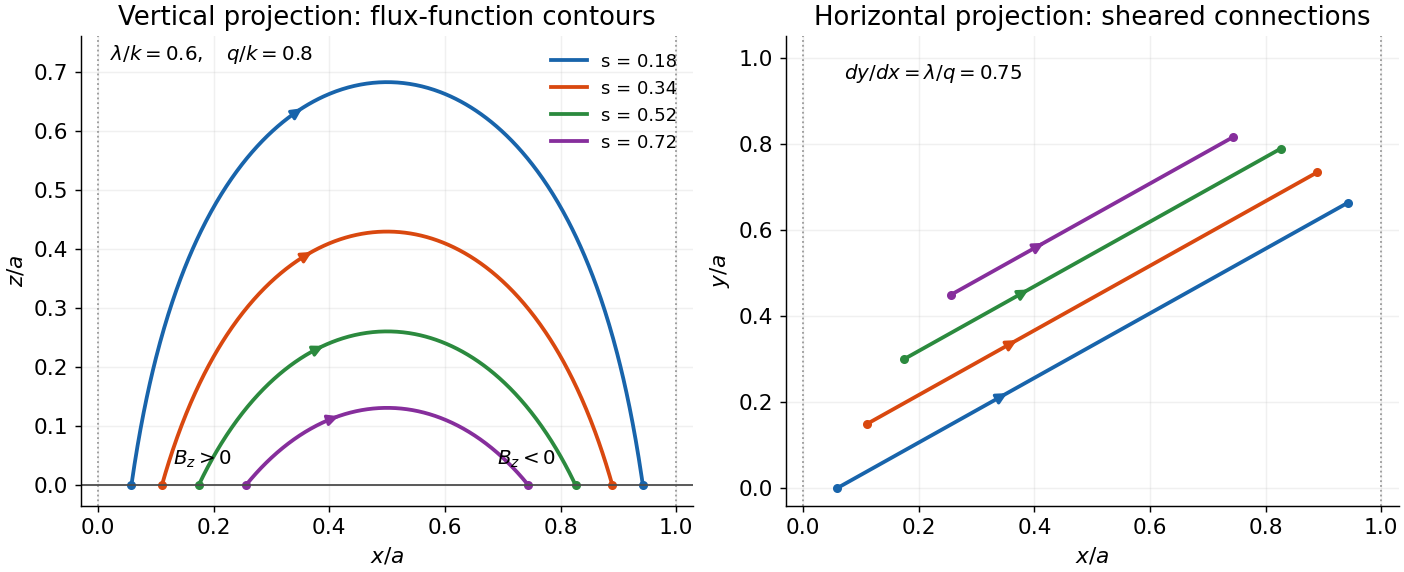

The transcription's alternative uniform-bottom condition would be inconsistent with exponential decay and zero side flux for : solenoidality gives , whereas a uniform nonzero bottom would give a conserved flux that cannot decay to zero. This integral check is an independent reason not to silently solve that mistranscribed problem.
Articles by others on the same topic
There are currently no matching articles.